Key Takeaways
The end of a major global event is where the real opportunity begins. Brands will have accumulated a wealth of high-intent data: who engaged, what they cared about, how they interacted.
After a major sporting event, brands should follow up with fans, using the insights to continue the relationship.
Strategies to follow up with fans include delivering experiences tailored to fan preferences, expanding engagement into new channels and touchpoints, and using AI to refine and personalize future interactions.
Scale alone doesn’t guarantee impact: Organizations must rely on unified data and AI-driven engagement to enable them to engage in real time.
In 2026, global sporting events are making history.
From major games in Italy this winter to the summer of football hosted across North America, millions of fans show up to enjoy the thrill of sports in person, and billions more engage online. For brands, cultural events like these represent some of the most concentrated moments of global attention in the next decade.
But the real opportunity isn’t simply engaging with fans. It’s in what happens after the final whistle. How do you turn a surge of attention into lasting impact? How do you convert first-time visitors into lifelong fans?
The effect of the collective fan experience: scale, speed, and expectation
Events on the global stage present a unique engagement dynamic. Engagement isn’t gradual—it’s explosive. Fans flood websites, apps, and digital experiences in real time, often interacting across multiple touchpoints in the same session.
At the same time, expectations are higher than ever. Fans want:
- Instant, time-sensitive, and relevant updates
- Personalized content and offers
- Seamless experiences across channels and devices
For many organizations, especially in industries like Sports & Entertainment, Retail, and Consumer Products, this creates a familiar challenge: systems built for steady-state engagement suddenly need to perform at massive scale during high peak seasons.
Without the right foundation, brands risk missing the moment, or worse, losing the audience as quickly as they gained it. And in today’s world, every marketing dollar matters.
Why most event engagement falls short
Too often, engagement strategies around major events focus on the moment itself.
You’ve spent months ensuring your campaigns are timed to perfection, promotional pushes are created with precision, and every content and channel has been tested to its limits to prepare for the influx of customer engagement.
While these efforts can drive impressive results, they rarely translate into long-term value. The result is a pattern seen across industries: the dreaded unsubscribe.
The problem isn’t effort. It’s infrastructure.
To truly capitalize on a global sporting moment, brands need to think beyond campaigns and build a continuous engagement engine backed by data connected across your entire business.
Building a connected customer data foundation
At the center of that engine is unified customer data. Every fan interaction during a major sporting event—streaming a match, browsing merchandise, opening an email, downloading an app—creates valuable insight. But when those interactions live in disconnected systems, they miss the opportunity to maximize their impact.
Connecting your customer data in real time changes that by bringing together signals from across your business into a single unified profile.
This allows organizations to:
- Recognize each fan across devices and touchpoints
- Build a continuous understanding of preferences and behavior
- Act on that insight instantly
During highly dynamic events, this real-time visibility becomes a competitive advantage.
Evolving from campaigns to real-time conversations
With unified data in place, engagement can evolve from static campaigns to dynamic, AI-driven conversations. Instead of sending the same message to everyone, brands can segment audiences based on live event behavior and trigger personalized communications in the moment.
This is especially powerful during live matches and tournament progression, when fan interest shifts rapidly based on outcomes, teams, and storylines.
AI enables brands to keep pace with the speed of fan expectations, optimizing engagement continuously, with less manual effort. Win or lose, this leaves every fan with a newfound sentiment towards your organization and a huge opportunity for marketers to compound this moment to grow their fan base.
Gamifying a sporting event
Major tournaments ignite passion and bring people together across cultures and backgrounds. Fans don’t just watch; they live every moment, from dramatic build-ups to unforgettable finishes.
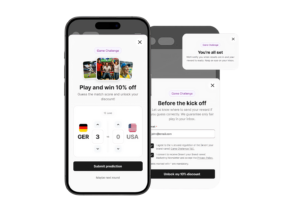
Gamification lets brands tap into that energy and turn passive viewers into active participants. By adding interactive experiences, you can reward curiosity, fuel competition, and deepen emotional connection with your audience.
How it works:
- An excited fan sees a prompt on your website or app inviting them to predict the match result.
- They submit their prediction—along with their email if you don’t already have it.
- If their guess is correct (or close), they earn a reward.
Simple, engaging, and highly effective.
The result:
More interaction, richer customer data, and stronger brand loyalty—delivered in a way that feels natural and fun.
SAP makes this easy with plug-and-play gamification tools and flexible, customizable solutions tailored to your needs.
Fan Engagement Widget
Build lasting relationships with your fans

Teeing up scale: how the Ryder Cup is transforming fan engagement
At SAP, we partner with some of the world’s most beloved sports teams, like FC Bayern and the San Jose Sharks, as well as prestigious sporting events.
Global sporting events are more than just moments; they are ecosystems of continuous engagement. With SAP Engagement Cloud, organizations like the Ryder Cup are delivering meaningful fan experiences by connecting with millions of people across digital touchpoints, languages, and moments in time.
The challenge
The Ryder Cup is jointly organized by two distinct entities, Ryder Cup Europe and the PGA of America, each of which leads the event when it’s held on its respective continent. While golf fans can engage with the sport throughout year-round tournament schedules, the Ryder Cup is a global event held every two years. This combination creates intense peaks in engagement but fewer opportunities to build relationships between events. Bridging those two models requires a unified, intelligent approach to fan engagement.
Within that landscape, the numbers tell a powerful story. During event week alone, the Ryder Cup sees engagement soar to 7 million unique web users across its digital ecosystem. Its database includes more than 2 million fan records, and the mobile app sees hundreds of thousands of active users each month.
Despite this scale, the issue was clear. Legacy tools and disconnected systems made it impossible to fully understand and engage fans.
Before its transformation, the organization relied on separate tools for email and mobile engagement, with no unified customer data approach. This meant fan interactions lived in silos, making it difficult to deliver coordinated, personalized experiences.
The solution
The brand’s transformation began with a strategic decision: to unify data, engagement, and intelligence on a single platform.
By adopting SAP Engagement Cloud and SAP Customer Data Platform, the Ryder Cup created a foundation built on three principles:
- Unified fan data: A single, real-time customer profile across both the DP World Tour and Ryder Cup Europe
- Connected engagement: Integrated email, mobile, and digital channels
- Scalable intelligence: Built-in AI capabilities powered by SAP Business AI
This unified approach allows every fan interaction—whether browsing a ticketing site, using the mobile app, or engaging with email—to contribute to a single, actionable profile.
The impact
Transformation is only meaningful when it delivers real outcomes.
Within just a few months of going live, the Ryder Cup European team began to see tangible results:
- A large-scale Ryder Cup 2027 ticketing campaign reaching 500,000 ticket prospects—executed as a unified, cross-channel initiative
- AI-powered subject line optimization to improve email performance
- Automated push notifications triggered by new content in their CMS
- Web and mobile tracking implemented for the first time, enriching fan profiles for the DP World Tour with behavioral data
These capabilities represent a significant shift from static campaigns to dynamic, data-driven engagement. Perhaps most importantly, these improvements were delivered without disrupting ongoing operations, even during active tournament seasons and while preparing for future Ryder Cup events.
While the foundation is in place, the Ryder Cup is beginning to explore the potential of AI. Early use cases include:
- Subject line optimization: Increasing engagement through AI-driven recommendations
- AI-powered analytics: Faster insights through automated reporting
- Content translation: Enabling communication with a truly global approach
Looking ahead, the opportunity is even greater. With unified data and integrated AI, the organization can:
- Create highly personalized fan segments
- Deliver real-time, context-aware messaging
- Expand engagement into new channels and markets
The Ryder Cup represents one of the most-watched and emotionally charged events in golf. It is also a proving ground for what modern fan engagement can look like.
Closing thoughts: Cultural moments can fuel marketing momentum
By building its foundation now, the Ryder Cup is preparing not just for the next bi-annual event, but for the future of fan engagement.
Because the foundation is already in place, the transition from event engagement to lifelong fan loyalty is seamless. What was once a one-time interaction becomes the start of a long-term relationship.
No matter how grand or global or exciting a sporting event may be, scale alone doesn’t guarantee impact. The organizations that succeed will be those that prepare before the moment, engage in real time, and continue the relationship long after it ends.
With unified data, AI-driven engagement, and the right foundation, brands can transform a surge of global attention into lasting customer loyalty.
And that’s how you win—long after the final whistle, put, or buzzer.

About the author
Megan Hostetler is Global Head of Content Marketing at SAP Engagement Cloud and has spent 10+ years in the SaaS industry across the martech and sales enablement tech landscape. With a product marketing background, she understands features and functionality inside and out to help customers realize the full value of their purchase and translate those learnings to content that resonates. Formerly, she hosted The Marketing Cloudcast podcast, where she interviewed hundreds of experts to discuss trends, innovative tactics, and relevant insights in today’s marketing landscape.