
The polarizing effects of AI are everywhere you look in marketing (and the wider world).
The enthusiasts are easy to spot. They’re all over LinkedIn, posting about how AI is ushering in an age of abundance for businesses, sharing how they use it for everything from automating campaigns to ordering their groceries.
The concerns are just as visible – factual inaccuracy, hallucinations, opaque data use, and real questions about what happens to human judgment and creativity when you hand more decisions to a machine.
These aren’t fringe worries. Some of the recent headlines around AI errors and misuse of personal data have been genuinely alarming, and any marketer paying attention has good reason to be cautious.
Most of us sit somewhere between those positions. We see the value AI can bring to our day-to-day, but are aware of the inherent risks it brings too.
Regardless of which end of the AI spectrum you find yourself on, the bigger question on all our minds is ‘What do our customers actually want?’
If we start introducing AI into our workflows, will that negatively affect brand perception or, at worst, alienate customers and drive churn?
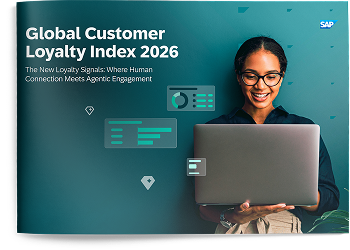
SAP’s Global Customer Loyalty Index (CLI) (now in its 6th edition) has revealed some fascinating insights about the effects of AI on customer loyalty, one of them being that AI is both making customers more loyal and, at the same time, making it easier than ever for them to jump ship.
The index shows that 31% of consumers say interactions with AI assistants make them feel more loyal towards a brand. Almost the same proportion (30%) have already switched away from a brand because of its use of AI, rising to 45% among Gen Z.
What this shows us is that it’s more complex than consumers simply asking brands for “more AI” or “less AI”. They’re asking for something more specific: they’re saying, “help me, remember me, and act for me when it makes my life easier – but don’t move the steering wheel somewhere I can’t reach it.”
For marketers deciding how far to push automation, the opportunity isn’t full autonomy, but rather earned autonomy: giving AI more responsibility as customer confidence grows.
Customer loyalty is shifting – but don't wave goodbye to the loyalty card just yet
Before we get to AI, it’s worth unpacking one of the CLI’s key findings.
Incentivized Loyalty – built through discounts, points, and rewards – has fallen from 48% in 2025 to 38% in 2026, the first time it has dropped below 40% in the six-year history of the research. Meanwhile, true Loyalty, SAP’s term for deeper brand love, has rebounded from 29% to 32%.
That does not mean discounts have stopped working, loyalty programs are dead, or somebody should ceremonially throw the coupon codes into a fire.
It means incentives alone are becoming a shakier foundation for the relationship. A discount can give someone a reason to buy this time. That’s different from giving them a reason to prefer you next time.
The rest of the report makes that distinction clearer. When consumers are asked what builds loyalty, all the usual suspects show up:
- 62% point to quality products
- 42% cite trusted brand reputation
- 31% value connected online and offline experiences
- 29% point to frictionless shopping
- 23% choose memorable, personalized experiences
The irony here is that while marketing teams are busy discussing agents, orchestration, and predictive personalization, customers overwhelmingly just care about whether the product is any good.
Declining product quality is also the biggest loyalty breaker at 45%, followed by rising prices at 40% and poor customer service at 36%.
The foundations that make any of this work are fundamentally unchanged: is the product good, is the price defensible, and can someone actually get help when things go wrong? AI cannot compensate for failing those tests. At best, it will help customers discover the disappointment more efficiently.
Where should marketers actually use AI? Start where choice gets overwhelming
One of the most useful findings in the report is that consumers turn to AI most often when the decision itself is starting to take up too much of their time and energy:
- 23% use it when they are unsure what to buy.
- 22% use it when there are too many options.
- 20% use it when they are short on time.
- 17% use it when buying gifts.
- 16% use it when they are new to the brand or platform.
The benefits they value are equally practical: fast advice, help finding the right products, efficient problem-solving, and a smoother shopping experience. There’s a great rule of thumb we can draw from these insights, which is simply that AI thrives where choice becomes overwhelming.
That means the better question is not “what can we automate?” but “where are we making the customer do unnecessary work?”
A catalog containing 400 near-identical products is an obvious candidate. So is choosing a gift, comparing complex plans, finding a compatible product, or navigating an unfamiliar category.
Those are moments where AI can remove friction rather than add an AI-shaped layer to an experience that was working perfectly well without one. If the customer thinks, “that saved me some effort”, you’re onto something.
Why AI autonomy has to be earned
SAP frames the relationship between AI and loyalty as an equation: Earned Trust + Human Control + Autonomous Action = Loyalty. I’d read that less as a mathematical formula and more as a permission model, because the research shows consumers want two things at once:
- 33% trust AI to complete purchases on their behalf.
- 31% regularly rely on AI to help choose what to buy.
- 56% still want the ability to reverse AI decisions when necessary.
That last figure is the answer to why autonomy has to be earned. Customers are not saying “don’t act for me”; they are saying “act for me, but if this goes sideways, I want to retain the ability to course correct or speak to a human.” The willingness to delegate is there, but it remains conditional on confidence and control.
For marketers, this means that the aim is not simply to make AI capable of doing more. It is to lower the perceived risk of letting it do more by proving accuracy over time, keeping consequential actions reversible, explaining decisions when it matters and ensuring a human can step in.
Think about any genuinely useful assistant. You don’t want to approve every tiny decision they make, because that defeats the point of having an assistant. But you do want them to recognize when a decision is consequential and let you intervene before a small mistake becomes an expensive one.
That is what makes autonomy feel earned rather than imposed. Trust gives the brand permission to personalize; control makes delegation feel safe; consistently useful outcomes can then make customers more comfortable handing over the next task.
The study does not prove that sequence causally, but it is a practical way to design around what consumers say they need. Autonomy is not the goal in itself; less effort for more reward without a corresponding loss of confidence is.
Gen Z is a stress test, not a crystal ball
Gen Z makes this tension especially visible. 45% have already switched brands because of better AI practices, while 44% say they would trust an AI assistant to purchase an item for them.
They appear unusually willing to embrace AI and unusually prepared to punish brands when the experience falls short.
That makes Gen Z useful, but not prophetic. There is no basis for assuming every older consumer will behave like today’s Gen Z in five years’ time.
A better use of the data is to treat younger consumers as a stress test: can the experience be useful enough that somebody is happy to delegate, while remaining transparent enough that the same person does not feel tricked, trapped or surveilled? If both answers are yes, you’re probably designing around the right tension.
What marketers should do now
- Find the moments of cognitive friction. Look for choice overload, uncertainty, repetitive decisions, and places where customers are wasting effort.
- Build useful memory before dazzling personalization. Remember orders, preferences, service history, and context that customers have already given you. “You don’t have to tell us again” is an underrated customer experience.
- Design the escape hatch with the automation. Overrides, reversibility, explanations, and access to a human are part of what makes people comfortable delegating.
- Use autonomy selectively. The more consequential the decision, the more visible the controls should be.
- Keep the boring stuff sacred. Product quality, price, service, and reputation still do more of the heavy lifting on loyalty than most technology-occupying marketing conference agendas.
The best AI experiences won't feel like AI experiences
The most interesting thing about SAP’s Global Customer Loyalty Index 2026 isn’t that consumers are ready for AI. Some are, some aren’t, and most sit somewhere in between. What’s more useful is that consumers are becoming comfortable granting technology more authority without giving it unconditional authority.
They’ll let AI narrow the options, remember useful context, and, increasingly, even buy. But they still want visibility, an override, and a human when things go sideways. The goal, then, is not to maximize how much AI can do. It’s to maximize how much useful work customers are comfortable letting it do.
That is a higher bar, but it is also a better customer experience. It makes the principle behind SAP’s Autonomous Marketing and Engagement proposition (ie. people set the direction, AI executes) more interesting, because the important word isn’t “executes”. It’s “direction”.
Earn that permission, and autonomy starts to feel less like losing control and more like receiving good service.
About the author
Sara has more than 15 years of experience in senior global marketing roles at high-growth martech organizations including Clicktale, IBM Tealeaf, Acquia, & Unica. Her passion is for building marketing teams that act as a trusted partner to the sales organization. Sara excels in strategy and communications which deliver measurable pipeline and revenue. Sara holds a BA from the University of California in Los Angeles.