
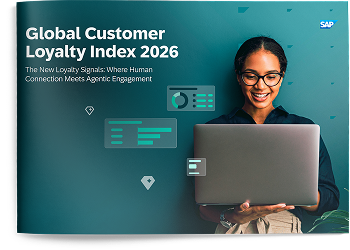
Hey everyone, pleasure to be here. I get the chance to talk to you about the future of customer engagement for the next roughly 20 minutes and more precisely on really how to scale personalization, automation, loyalty, and of course, all with the support of AI, because I think you're not allowed in 2026 to have a presentation that not contains AI. And by the end of it, I hope you are gonna be as delighted as this person on my beautiful slide. Before I go into recapping how we got to this point where we are today, to then also better understand why we are thinking about the future, the way we're thinking about this, I thought, you know, with all the marketers, expert leaders here in the room, when we talk about engagements, we are all consumers. So I would actually love to hear from you. I think you can use the slider for that, please. We're gonna create a wonderful kind of word cloud with it. If you think back to the last time, you on a personal level engaged with a brand. What was the channel you used? Because we always talk about all these different channels within marketing. I'd be just curious to see where we are really at today. Using traditional email newsletter, if you like me, you spend probably way too much time on Instagram, so you might have come across an ad that helped you to explore a new brand. And I can already see that the word cloud on the screen, I'm gonna move forward, but maybe we can come back to this one later on as well. Resonates quite well with what we've actually seen throughout the last couple of years. Can we move to the next slide? We love a good animation and PowerPoint presentations, right? If they work. Okay, so let's start with a recap. As a technology vendor, what we've done more than 25 years ago, obviously back then, we started with the most prominent, probably most effective digital channel by then, which was email. But over the time, now it kind of works. Okay, but over time we had to add more channel connectivity, we had to add, more data connectivity, and we also had to add more ecosystem connectivity. Why? Because of the consumer demand. So as soon as social media platforms got out there, consumers attention went to social media, platforms of course we as marketers had to go where the consumers are. And so we've added things like social media retargeting, We've then saw a huge amount of money, of budget investments from marketing, IT departments to go into mobile native applications because that was another trend. And so we added mobile capabilities like push, in-app, inbox. And nowadays you have more than 15 different channels you can use as a brand using SAP's technology to actually engage with your consumers. The data connectivity I think we heard also quite a lot about today was also important because if you reference, for example, a retail fashion customer. We understood, there are more touch points, perhaps, than just the e-commerce landscape. So for retail, it was quite important to then also combine e-commerce data with their physical retail store information, because those are all relevant touch points. For B2B companies, this perhaps meant that we actually needed to combine and help our sales teams closer collaborate with our marketing teams in order to really make it more personal for the accounts, for the individuals that we're marketing to from a B2B side of things, and so then the ecosystem connectivity. If we are talking about all these different marketing stacks, we heard about it today, you have various different third party systems that are relevant for your marketing activities. External voucher, incentive engines, your content management systems, things like order, shipment, tracking information. So you had to bring it all together. And of course, you've done all that because we've realized that every single touch point across the customer journey matters. And that was the only way to get there. And of course, we also added all these different AI capabilities on top, because now you have a whole bunch of channels, you've got a whole bunch of data, you've got a whole bunch of systems. So AI really can help marketers out there to stay operationally efficient and to automate all these processes. But there's a catch, right? And we are in this situation now where businesses are really in the need to have intelligence always on engagements. I think we heard it throughout some of the other presentations today, where even thinking about moving away from audiences and cohorts and letting agents decide. But there's really a catch with it if you think about the fact that this then needs to spanned across the entire journey, across the whole lifecycle. And that's why by the end of 2025, moving into 2026, we've actually launched the SAP Engagement Cloud. And it's not just a simple rename and releasing fancy new products. It's really SAP's commitment to say: the Engagement Cloud is then deeply aligned with not just the SAP Customer Experience portfolio. I think that's just where we've seen the quickest wins over time to make sure marketing is also connected with commerce, it's connected with sales, it's connect with services. But it's also SAP's commitment to then say, we have an engagement layer that is also deeply connected to the SAP Business Suite strategy. Which then really also goes outside of just customer experience. And is thinking about how to incorporate this into things like supply chain, operations, we heard quite a lot today, finances, perhaps even HR, because all those touch points are touch points consumers will interact with the brand, and we also heard a lot about brand identity and brand awareness today. And this messaging really resonates also with brands out there. Here's a quote from one of the brands that early on tested the beta versions when we were still experimenting with the technology in the background. Saying: "Even early on, we see real potential in having a unified engagement engine that strengthens the way we support and connect with our customers" in this case. And what's really behind this message is that they understood for them as a business that it's really important and the opportunity behind there to really connect not just the customer data, their sales technologies and their services technologies, but also services processes and the communications across their entire SAP landscape. And so there is this huge opportunity that we're looking at to say, okay, there's something where we need to think outside of the traditional customer experience portfolio. But this also means that it's not enough just to talk about data, API connections and the ecosystem and just have systems talk to each other, API to API. It also means you need to unify data and the teams behind it, as we heard again today a lot. We heard about governance, operations and processes to really have a great foundation then on how to deliver that AI-powered personalized engagement across every single channel. What do we mean by this in a little bit more detail? So we've outlined here what we believe is the entire journey and the entire customer lifecycle and all the various different touch points that you can actually come across as a consumer together with your brand. And so typically engagements start with marketing, right? Lead generation, all of this brand awareness, but then very quickly it then also evolves into sales conversations, commerce experiences, services interactions, and it can also mean that you communicate to your suppliers, to your business partners. It might be that you're triggering engagements from your billing system because customers want to better understand about their subscription. They send the product in for repair, product registration and product warranty. In all these different engagements that you have a brand that might not even sit within marketing. Because how we're looking at this today is across all these touch points, you have all different teams, different departments behind every single one of them. And that's where the current challenge really is. Because if you think: we wanna engage and personalize with all our consumers across every single of one of those touch points, you can't just look into how you can optimize the engagements within every single one in silo. That's where the real challenges for many of the brands sit. Giving you an example, for example, you have a company that produces and sells heavy machinery. They have all these little sensors that actually detect on how their machines are being operated, how they're being adopted, how they are being utilized. Now that data typically sits inside operations and IT, but it can also be very relevant for services teams, for marketing teams. In terms of identifying touch points on how basically the machines are being produced to identify trends and then act upon those trends. And in worst cases, and we heard about outages, it's also very important. But nowadays, because we are looking at it from a business's perspective with all these different silos, it takes enterprise businesses weeks to really activate on that data. Weeks, the same for brand governance. If you think about it, you might optimize your marketing and performance media and beautiful looking campaigns, engagements, and you use AI to create all of these creatives. How can you ensure you have the consistency across all these touch points? When we talk to enterprise brands, even just the communication with agencies, a simple change in a campaign or a new use case they wanna launch, again, weeks to months. If we're looking outside of the traditional retail fashion, heavy machinery, if we come back to this, there's legal liability. You can't just have a team sitting there, prompting with AI and having it translate product specific information and just send it out. If the AI doesn't understand the liability you have around this communication, and so you have all these reviewing processes. Again, weeks and weeks if not months of work just to get this out there. And the market, the consumers, actually resonate with that as well. For multiple years now, we've conducted this loyalty index, and I think for the first time across the last five years, we've actually identified, I think this year or last year, they've served 1,000 marketers and consumers. And for the 1st time, there was this downwards trend, saying true loyalty is down. There's still loyalty, but consumer demand just got so much more challenging for businesses. Consumers start to behave differently. They're being trained by all these like really great experiences, but at the same time, this means they are really rewarding relevance and consistency. And the moment there's a disconnect or something generic, they'll turn their head and walk away and go to a different brand. We've been trained by big players. At least me personally, I want the Amazon shipment experience almost across every single vendor. Nowadays, opening up my Amazon app and being able to tell, okay, it's six stops away, I don't need to even wait for someone to ring the bell, I can already go outside and I'm pretty sure I can see the driver down the street for five minutes, okay, yeah, here's my package. If I have a different experience for a different brand that can't even send me a working tracking link, that's probably the last time I've ordered from that brand or bought with them a product. And so we must really think and reimagine what we understand for loyalty. We can't just think about it anymore in the context of marketing and try to optimize everything in silo. We really have to look at all these different departments and we must say that everything needs to, the consumer needs to be in the gravity of all these departments. Because we also understand from the statistics that we have that a rough 5% increase in retention, if we invest in those consumers, can drive anywhere between 25 and 95% of profit growth. And so this is not just anymore a marketing discussion within your businesses, it's a leadership issue and it needs to be a leadership discussion to solve for this. Again, you cannot just optimize within your silo. You will not create the consistency and the expectation that the customers and consumers demand today. Okay, enough talking about challenges. Let's look at a couple of really good examples. So we've brought two brand examples. Gibson guitars, very traditional company. They've understood the concept I've talked about before, at least to a point where they consolidated everything from their mobile app, their in-store data, where they have actually consumers coming and jamming out and testing different guitars, and even they said last year on a big stage with SAP, they to say: we understand AI might not help us to actually build a better Les Paul, one of their signature guitarists, I believe, but it can certainly help us to drive and deliver that personalized engagement across all our channels. And I think you can see this resonates quite well in the numbers that are presented there on the slide. Wella is also an interesting example, and I think we actually heard about something similar in the panel before. Wella has all these different cohorts or personas, whether it's distributors, salons they're selling to, so the B2B side of their business, stylists, but then also consumer from their direct to consumer motion. They needed to really look across all these different departments to also understand the DNA across all of them, because I might be a distributor, doesn't mean I want to log into some B2B portal online on my desktop just to make my order, Because at the same time I might be a salon owner. And I'm on my feet literally all day. I don't have the time to sit down and input my order or talk to the sales guy on the phone and purchase my products this way. So they started to integrate a mobile-first strategy. The first signal that they got was the opt-in rate. So they learned we're on the right track. 65% opt-in rate when starting to communicate on a mobile optimized channel. They're on their phones all day, standing up. So that's the channel, that's the medium that you need to reach them. And then they kind of like enhanced this further with other mobile optimized channels and also got a really really well 25% of revenue distribution from mobile push only which really meant success for them looking into how their consumers behave specifically on their brand across these different departments. Some of the key investments for us to really build that future of customer engagement together with all our customers and with all of you, we're gonna continue to invest into these three areas that I called out at the very beginning, those investment areas that got us to the point where we are today. It's data and intelligence, it's content and channels, it's not gonna stop. I saw things like LinkedIn, email and social, but nowadays there's live shopping. There's things like big brands companies invest into Roblox games because apparently that's the generation they need to, you know, speak to and you have things like now gen AI Gemini and ChatGPT introducing it so there will always be new channels. So we need to also continue to invest into these areas and then the flexibility and extensibility. But all of this needs to be inside the Engagement Cloud an engagement layer that you can then operate just outside of your marketing, across all the other departments as well. And as I introduced at the very beginning, of course, everything is fueled with AI. Those are some of the big AI investments that we've done over the last couple of years, and we will look into throughout the last couple of months. Again, I think we heard the big questions that will always keep us busy within marketing, but then also keep us busier across engagements. It's the who, the what, the why and the how. I'd be curious, I already see lots of people taking pictures, let us know on the next one on the slider, which of those AI capabilities across the different segments you actually think is gonna help you the most during your day-to-day, to optimize some of the processes where you might put manual labor into. And the good thing specifically with how SAP is thinking about that whole concept of AI, again, it's not just AI you embed and utilize within your marketing staff. It's already being utilized across other departments. Again, specifically where we've seen great success, as you can see from those KPIs throughout the last couple of years, then being capable of having the same trained models, the same AI governance to use outside of marketing and use it in commerce, but then also use it and sales, use it on services, as well as in marketing. And then. That's really how we are thinking about the entire concept. Of course, marketing is in there. And we just learned one of the big investment areas for companies will be the data foundation. So you're looking at the data foundation at the very bottom. Doesn't matter if it's SAP-owned data or non-SAP data, but you need to have a solid data foundation, we then built that AI foundational level on top of it. So you don't necessarily have to worry about AI governance and all these guardrails. It's baked in into the AI foundation. And the future really of how SAP is seeing it, is to then also have these agents that can communicate and not just within marketing, but across the different departments. There's tasks in marketing, tasks in operation, tasks in sales, tasks and supply chain, and all of this needs to be unified to really have that scale personalization, the automation to drive long term loyalty for your consumers. So those are the three takeaways that we've concluded for the presentation today. And I think if I would want you to remember one of them, because I think we all talk about data and AI, part of the first one, cross-functional. So if you have one takeaway, it would be that it's not just the marketing teams that need to realize this. You need to have a higher discussion within your businesses to have and make this a leadership discussion if you really wanna thrive for that personalized engagement across the entire life cycle, as well as across the entire journey. And if you need a little bit of support, you can download these resources that we've prepared for you, but also can come speak to us in the next room during some of the networking sessions. Thank you. Thank you Lucas. Leave this on the screen. Can we leave those on the screen guys just so that people can download if they want. You can also come to me if you want to have the link shared with you. We have time for just one question. Luckily enough, there's one very popular question. I'll read it aloud now. So listen up. As Instagram is an important channel, how can one build personalized paid media content, and with an end-to-end feedback loop? You only have 30 seconds to answer that. I would say, I mean, actually I would start organically, because I think way too much businesses right now invest money straight away and go into paid advertisement, but use those AI capabilities and create content that you think consumers will resonate and start organically. Just put it out there on your account, it's free. It's incredible how many possibilities we have brands to test out for free. All of this investment I think would have been much higher 30 years ago. So just start organically. You will get the signals from Instagram. And then start to take that same content and try to distribute it across some of the data touchpoints that you've analyzed and the insights you got from it. Start organically. Perfect. Well, thank you very much, Lucas. We will share all of these other questions with you. And thank you, very much for today's presentation. Thanks, everyone.
The Future of Customer Engagement
Available on demand | 20 minutes
About our Speaking Session:
What does customer engagement look like when entire organizations are unified through a shared engagement layer?
That's the question Lucas Bergström tackles in this session from MarTech Summit Berlin 2026.
He walks through what changes when marketing, sales, service, and the wider business stop working from separate systems and start operating from the same view of the customer, with AI doing the work that used to eat half your week.
With SAP Engagement Cloud as the anchor, Lucas shows what end-to-end engagement looks like in practice, and where most teams are still getting stuck.
The session is held in English and will cover:
- Why customer engagement is no longer a marketing-only job
- How AI makes personalization scalable without making it generic
- Why a unified data foundation isn't optional anymore
- How consistent end-to-end experiences turn into real customer loyalty
Watch on demand for a clear-eyed take on what's working, what isn't, and where to focus next.
Watch it now

Lucas Bergström
VP ISV Partnerships

Engage with the latest from the industry
Featured content


Real brands offering real customer engagement insights, including:


Context-aware engagement, powered by AI
Hey everyone, pleasure to be here. I get the chance to talk to you about the future of customer engagement for the next roughly 20 minutes and more precisely on really how to scale personalization, automation, loyalty, and of course, all with the support of AI, because I think you're not allowed in 2026 to have a presentation that not contains AI. And by the end of it, I hope you are gonna be as delighted as this person on my beautiful slide. Before I go into recapping how we got to this point where we are today, to then also better understand why we are thinking about the future, the way we're thinking about this, I thought, you know, with all the marketers, expert leaders here in the room, when we talk about engagements, we are all consumers. So I would actually love to hear from you. I think you can use the slider for that, please. We're gonna create a wonderful kind of word cloud with it. If you think back to the last time, you on a personal level engaged with a brand. What was the channel you used? Because we always talk about all these different channels within marketing. I'd be just curious to see where we are really at today. Using traditional email newsletter, if you like me, you spend probably way too much time on Instagram, so you might have come across an ad that helped you to explore a new brand. And I can already see that the word cloud on the screen, I'm gonna move forward, but maybe we can come back to this one later on as well. Resonates quite well with what we've actually seen throughout the last couple of years. Can we move to the next slide? We love a good animation and PowerPoint presentations, right? If they work. Okay, so let's start with a recap. As a technology vendor, what we've done more than 25 years ago, obviously back then, we started with the most prominent, probably most effective digital channel by then, which was email. But over the time, now it kind of works. Okay, but over time we had to add more channel connectivity, we had to add, more data connectivity, and we also had to add more ecosystem connectivity. Why? Because of the consumer demand. So as soon as social media platforms got out there, consumers attention went to social media, platforms of course we as marketers had to go where the consumers are. And so we've added things like social media retargeting, We've then saw a huge amount of money, of budget investments from marketing, IT departments to go into mobile native applications because that was another trend. And so we added mobile capabilities like push, in-app, inbox. And nowadays you have more than 15 different channels you can use as a brand using SAP's technology to actually engage with your consumers. The data connectivity I think we heard also quite a lot about today was also important because if you reference, for example, a retail fashion customer. We understood, there are more touch points, perhaps, than just the e-commerce landscape. So for retail, it was quite important to then also combine e-commerce data with their physical retail store information, because those are all relevant touch points. For B2B companies, this perhaps meant that we actually needed to combine and help our sales teams closer collaborate with our marketing teams in order to really make it more personal for the accounts, for the individuals that we're marketing to from a B2B side of things, and so then the ecosystem connectivity. If we are talking about all these different marketing stacks, we heard about it today, you have various different third party systems that are relevant for your marketing activities. External voucher, incentive engines, your content management systems, things like order, shipment, tracking information. So you had to bring it all together. And of course, you've done all that because we've realized that every single touch point across the customer journey matters. And that was the only way to get there. And of course, we also added all these different AI capabilities on top, because now you have a whole bunch of channels, you've got a whole bunch of data, you've got a whole bunch of systems. So AI really can help marketers out there to stay operationally efficient and to automate all these processes. But there's a catch, right? And we are in this situation now where businesses are really in the need to have intelligence always on engagements. I think we heard it throughout some of the other presentations today, where even thinking about moving away from audiences and cohorts and letting agents decide. But there's really a catch with it if you think about the fact that this then needs to spanned across the entire journey, across the whole lifecycle. And that's why by the end of 2025, moving into 2026, we've actually launched the SAP Engagement Cloud. And it's not just a simple rename and releasing fancy new products. It's really SAP's commitment to say: the Engagement Cloud is then deeply aligned with not just the SAP Customer Experience portfolio. I think that's just where we've seen the quickest wins over time to make sure marketing is also connected with commerce, it's connected with sales, it's connect with services. But it's also SAP's commitment to then say, we have an engagement layer that is also deeply connected to the SAP Business Suite strategy. Which then really also goes outside of just customer experience. And is thinking about how to incorporate this into things like supply chain, operations, we heard quite a lot today, finances, perhaps even HR, because all those touch points are touch points consumers will interact with the brand, and we also heard a lot about brand identity and brand awareness today. And this messaging really resonates also with brands out there. Here's a quote from one of the brands that early on tested the beta versions when we were still experimenting with the technology in the background. Saying: "Even early on, we see real potential in having a unified engagement engine that strengthens the way we support and connect with our customers" in this case. And what's really behind this message is that they understood for them as a business that it's really important and the opportunity behind there to really connect not just the customer data, their sales technologies and their services technologies, but also services processes and the communications across their entire SAP landscape. And so there is this huge opportunity that we're looking at to say, okay, there's something where we need to think outside of the traditional customer experience portfolio. But this also means that it's not enough just to talk about data, API connections and the ecosystem and just have systems talk to each other, API to API. It also means you need to unify data and the teams behind it, as we heard again today a lot. We heard about governance, operations and processes to really have a great foundation then on how to deliver that AI-powered personalized engagement across every single channel. What do we mean by this in a little bit more detail? So we've outlined here what we believe is the entire journey and the entire customer lifecycle and all the various different touch points that you can actually come across as a consumer together with your brand. And so typically engagements start with marketing, right? Lead generation, all of this brand awareness, but then very quickly it then also evolves into sales conversations, commerce experiences, services interactions, and it can also mean that you communicate to your suppliers, to your business partners. It might be that you're triggering engagements from your billing system because customers want to better understand about their subscription. They send the product in for repair, product registration and product warranty. In all these different engagements that you have a brand that might not even sit within marketing. Because how we're looking at this today is across all these touch points, you have all different teams, different departments behind every single one of them. And that's where the current challenge really is. Because if you think: we wanna engage and personalize with all our consumers across every single of one of those touch points, you can't just look into how you can optimize the engagements within every single one in silo. That's where the real challenges for many of the brands sit. Giving you an example, for example, you have a company that produces and sells heavy machinery. They have all these little sensors that actually detect on how their machines are being operated, how they're being adopted, how they are being utilized. Now that data typically sits inside operations and IT, but it can also be very relevant for services teams, for marketing teams. In terms of identifying touch points on how basically the machines are being produced to identify trends and then act upon those trends. And in worst cases, and we heard about outages, it's also very important. But nowadays, because we are looking at it from a business's perspective with all these different silos, it takes enterprise businesses weeks to really activate on that data. Weeks, the same for brand governance. If you think about it, you might optimize your marketing and performance media and beautiful looking campaigns, engagements, and you use AI to create all of these creatives. How can you ensure you have the consistency across all these touch points? When we talk to enterprise brands, even just the communication with agencies, a simple change in a campaign or a new use case they wanna launch, again, weeks to months. If we're looking outside of the traditional retail fashion, heavy machinery, if we come back to this, there's legal liability. You can't just have a team sitting there, prompting with AI and having it translate product specific information and just send it out. If the AI doesn't understand the liability you have around this communication, and so you have all these reviewing processes. Again, weeks and weeks if not months of work just to get this out there. And the market, the consumers, actually resonate with that as well. For multiple years now, we've conducted this loyalty index, and I think for the first time across the last five years, we've actually identified, I think this year or last year, they've served 1,000 marketers and consumers. And for the 1st time, there was this downwards trend, saying true loyalty is down. There's still loyalty, but consumer demand just got so much more challenging for businesses. Consumers start to behave differently. They're being trained by all these like really great experiences, but at the same time, this means they are really rewarding relevance and consistency. And the moment there's a disconnect or something generic, they'll turn their head and walk away and go to a different brand. We've been trained by big players. At least me personally, I want the Amazon shipment experience almost across every single vendor. Nowadays, opening up my Amazon app and being able to tell, okay, it's six stops away, I don't need to even wait for someone to ring the bell, I can already go outside and I'm pretty sure I can see the driver down the street for five minutes, okay, yeah, here's my package. If I have a different experience for a different brand that can't even send me a working tracking link, that's probably the last time I've ordered from that brand or bought with them a product. And so we must really think and reimagine what we understand for loyalty. We can't just think about it anymore in the context of marketing and try to optimize everything in silo. We really have to look at all these different departments and we must say that everything needs to, the consumer needs to be in the gravity of all these departments. Because we also understand from the statistics that we have that a rough 5% increase in retention, if we invest in those consumers, can drive anywhere between 25 and 95% of profit growth. And so this is not just anymore a marketing discussion within your businesses, it's a leadership issue and it needs to be a leadership discussion to solve for this. Again, you cannot just optimize within your silo. You will not create the consistency and the expectation that the customers and consumers demand today. Okay, enough talking about challenges. Let's look at a couple of really good examples. So we've brought two brand examples. Gibson guitars, very traditional company. They've understood the concept I've talked about before, at least to a point where they consolidated everything from their mobile app, their in-store data, where they have actually consumers coming and jamming out and testing different guitars, and even they said last year on a big stage with SAP, they to say: we understand AI might not help us to actually build a better Les Paul, one of their signature guitarists, I believe, but it can certainly help us to drive and deliver that personalized engagement across all our channels. And I think you can see this resonates quite well in the numbers that are presented there on the slide. Wella is also an interesting example, and I think we actually heard about something similar in the panel before. Wella has all these different cohorts or personas, whether it's distributors, salons they're selling to, so the B2B side of their business, stylists, but then also consumer from their direct to consumer motion. They needed to really look across all these different departments to also understand the DNA across all of them, because I might be a distributor, doesn't mean I want to log into some B2B portal online on my desktop just to make my order, Because at the same time I might be a salon owner. And I'm on my feet literally all day. I don't have the time to sit down and input my order or talk to the sales guy on the phone and purchase my products this way. So they started to integrate a mobile-first strategy. The first signal that they got was the opt-in rate. So they learned we're on the right track. 65% opt-in rate when starting to communicate on a mobile optimized channel. They're on their phones all day, standing up. So that's the channel, that's the medium that you need to reach them. And then they kind of like enhanced this further with other mobile optimized channels and also got a really really well 25% of revenue distribution from mobile push only which really meant success for them looking into how their consumers behave specifically on their brand across these different departments. Some of the key investments for us to really build that future of customer engagement together with all our customers and with all of you, we're gonna continue to invest into these three areas that I called out at the very beginning, those investment areas that got us to the point where we are today. It's data and intelligence, it's content and channels, it's not gonna stop. I saw things like LinkedIn, email and social, but nowadays there's live shopping. There's things like big brands companies invest into Roblox games because apparently that's the generation they need to, you know, speak to and you have things like now gen AI Gemini and ChatGPT introducing it so there will always be new channels. So we need to also continue to invest into these areas and then the flexibility and extensibility. But all of this needs to be inside the Engagement Cloud an engagement layer that you can then operate just outside of your marketing, across all the other departments as well. And as I introduced at the very beginning, of course, everything is fueled with AI. Those are some of the big AI investments that we've done over the last couple of years, and we will look into throughout the last couple of months. Again, I think we heard the big questions that will always keep us busy within marketing, but then also keep us busier across engagements. It's the who, the what, the why and the how. I'd be curious, I already see lots of people taking pictures, let us know on the next one on the slider, which of those AI capabilities across the different segments you actually think is gonna help you the most during your day-to-day, to optimize some of the processes where you might put manual labor into. And the good thing specifically with how SAP is thinking about that whole concept of AI, again, it's not just AI you embed and utilize within your marketing staff. It's already being utilized across other departments. Again, specifically where we've seen great success, as you can see from those KPIs throughout the last couple of years, then being capable of having the same trained models, the same AI governance to use outside of marketing and use it in commerce, but then also use it and sales, use it on services, as well as in marketing. And then. That's really how we are thinking about the entire concept. Of course, marketing is in there. And we just learned one of the big investment areas for companies will be the data foundation. So you're looking at the data foundation at the very bottom. Doesn't matter if it's SAP-owned data or non-SAP data, but you need to have a solid data foundation, we then built that AI foundational level on top of it. So you don't necessarily have to worry about AI governance and all these guardrails. It's baked in into the AI foundation. And the future really of how SAP is seeing it, is to then also have these agents that can communicate and not just within marketing, but across the different departments. There's tasks in marketing, tasks in operation, tasks in sales, tasks and supply chain, and all of this needs to be unified to really have that scale personalization, the automation to drive long term loyalty for your consumers. So those are the three takeaways that we've concluded for the presentation today. And I think if I would want you to remember one of them, because I think we all talk about data and AI, part of the first one, cross-functional. So if you have one takeaway, it would be that it's not just the marketing teams that need to realize this. You need to have a higher discussion within your businesses to have and make this a leadership discussion if you really wanna thrive for that personalized engagement across the entire life cycle, as well as across the entire journey. And if you need a little bit of support, you can download these resources that we've prepared for you, but also can come speak to us in the next room during some of the networking sessions. Thank you. Thank you Lucas. Leave this on the screen. Can we leave those on the screen guys just so that people can download if they want. You can also come to me if you want to have the link shared with you. We have time for just one question. Luckily enough, there's one very popular question. I'll read it aloud now. So listen up. As Instagram is an important channel, how can one build personalized paid media content, and with an end-to-end feedback loop? You only have 30 seconds to answer that. I would say, I mean, actually I would start organically, because I think way too much businesses right now invest money straight away and go into paid advertisement, but use those AI capabilities and create content that you think consumers will resonate and start organically. Just put it out there on your account, it's free. It's incredible how many possibilities we have brands to test out for free. All of this investment I think would have been much higher 30 years ago. So just start organically. You will get the signals from Instagram. And then start to take that same content and try to distribute it across some of the data touchpoints that you've analyzed and the insights you got from it. Start organically. Perfect. Well, thank you very much, Lucas. We will share all of these other questions with you. And thank you, very much for today's presentation. Thanks, everyone.