
Available now on demand!






The sessions that mattered most. On demand now.
Access exclusive on-demand sessions featuring global leaders in marketing, CX, and loyalty. Discover the ideas, strategies, and real-world examples shaping the future of customer engagement.
Online

What Your Customers Aren't Telling You About Customer Engagement
This session unveils key insights from the SAP Engagement Index, and highlights where the biggest gaps remain in brand confidence vs customer reality.
A very warm welcome to Engage with SAP, where we're kicking off a year of ideas, insights, and connections with today's virtual event. I'm Sara Richter. I have the privilege of being the CMO for SAP Engagement Cloud, formerly SAP Emarsys, and the pleasure to be your host for today. Before we get started, just a thank you for making the time to join us today. I know you're all extremely busy. Your time is extremely valuable. So, my commitment to all of you is that in return for your time, we'll provide today both thought-provoking content and hopefully a few tips and tricks that you can take back to the office. Now, this is the first in our series of Engage events this year, where you get the opportunity to get access to top-tier thinkers, globally recognized marketing, CX, loyalty experts, and they'll share stories of meaningful engagement, connected experiences, and how loyalty is being used to drive success today. So if you are in one of these locations, traveling to them, have a colleague that might be there, please do go to the Engage with SAP website and find out some more information. And during this year-long showcase, we're gonna be giving you the tools, the community, and the resources you need to win in the Engagement Era, where SAP is shaping the future of engagement. It's probably not a huge surprise that you see the same landscape that we do, which is truly shaped currently by volatility. Whether that's economics, technology, human behaviors, or frankly, all combined. But I think we're all seeing consumers moving faster than brands, aI accelerating expectations far beyond what we might have been reasonably expected, and the fact that loyalty is increasingly fragile. And in this environment, engagement is what brands must rely on to win and keep customer loyalty. So we have a fantastic agenda today that I am so excited about, and I'm delighted that you're able to join us. To start with, we'll welcome thought leader, Mark Ritson, and he's gonna give us his take on the industry and where teams need to focus right now. Later on, you're gonna have the opportunity to hear from some of our customers, including Essiy and the BMW Group. We're gonna share how they are embracing the Engagement Era. In addition, we're going to be joined by industry experts who are going to bring all of this to life by talking about technology, team coordination, and how to have a truly unified strategy. Let's dive in and start talking about why we're here, which is really to talk about "why engagement?" Why engagement now? Well, I'm excited to kick things off by sharing our latest research, which explores engagement maturity that will help you better understand this complex and volatile landscape. The research was conducted among a sample of 10,000 consumers and 4,800 executive leaders across the globe. And it introduces a new engagement maturity score that will you determine your potential to embrace the Engagement Era. Now, our data shows a widening engagement divide between brands and consumers. Only 22% of brands think they have a problem with creating seamless experiences, but that's a big gap between how 82% of consumers feel because they're telling us that they're dissatisfied with brands. That 60-point gap is what we call the Engagement Divide, the distance between what customers need in the moments that truly matter and what brands are actually delivering. And frankly, this shows that brands aren't acting fast enough to keep up with the growing needs of consumers. And if brands stick with the status quo and don't adapt quickly, this Engagement Divide will continue to grow and grow and grow. And customer loyalty itself will frankly be lost within the divide. Now, you may be thinking, justifiably, that maybe that isn't the biggest surprise. But what is shocking is that the Engagement Divide is widening at an unprecedented pace. And it's AI that's compounding this divide faster than most people and most brands realize. Why? Consumers are already switching to use AI. They're using it to compare and evaluate and switch brands in literally seconds. AI today is making customer loyalty and customer retention a hyper-competitive battlefield. Meanwhile, 78% of brands are struggling because they simply can't activate enough of their data to make AI effective to meet and exceed customer expectations. Marketers know that AI is essential, but less than half of us are able to connect the data in a way that's accessible and available in real time across our businesses. And the longer we take to recognize we have these issues, to solve these problems, that gap stays there, and it grows, and it becomes even harder to close. However, I think it's also really important to understand when you look at this that this isn't a marketing only problem. This is actually an enterprise-wide problem. At SAP, we're looking to close that Engagement Divide by unifying signals across the business so AI can act instantly, turning every interaction into connected, personal experience. But here's the shift, it's something every leader must understand. AI, if it's done right across your entire business, has the power to collapse the Engagement Divide, not just incrementally, but exponentially. And AI does not replace the human experience. It removes the friction that gets in the way. And when we pair the magic of human creativity with AI-powered intelligence, we don't just close the Engagement Divide. We build the kind of relationships that customers, with customers, to make them stay loyal for life. As we're talking about your expectations evolving in the Engagement Era, well, ours have to as well. So I'm really excited to share that SAP Emarsys is now SAP Engagement Cloud. And this evolution is far more than a new name for us. It's actually about a new level of capability for you. Engagement Cloud brings SAP's full strength together so you can connect every interaction, every insight, every outcome across the customer lifecycle. Because frankly, engagement shouldn't live in a single channel. It must live across your entire enterprise. And we're unveiling a new promise: Power Unique Engagement. And this reflects, frankly, what you've told us that you need most: engagement that feels personal, intelligence that works behind the scenes, and scale that grows with your business. Power Unique Engagement is our commitment to helping you deliver experiences as unique as the people you serve. All of this makes SAP Engagement Cloud the engagement layer for the Intelligent Enterprise and allows us to bring AI, data, and orchestration together so that you can build deeper relationships, automate those things that are slowing you down, and unlock the kind of value that only comes from truly knowing your customer. And, of course, bridging that Engagement Divide.
Trends Shaping Customer Experience: What’s Real, What’s Not, and What Matters Most Now
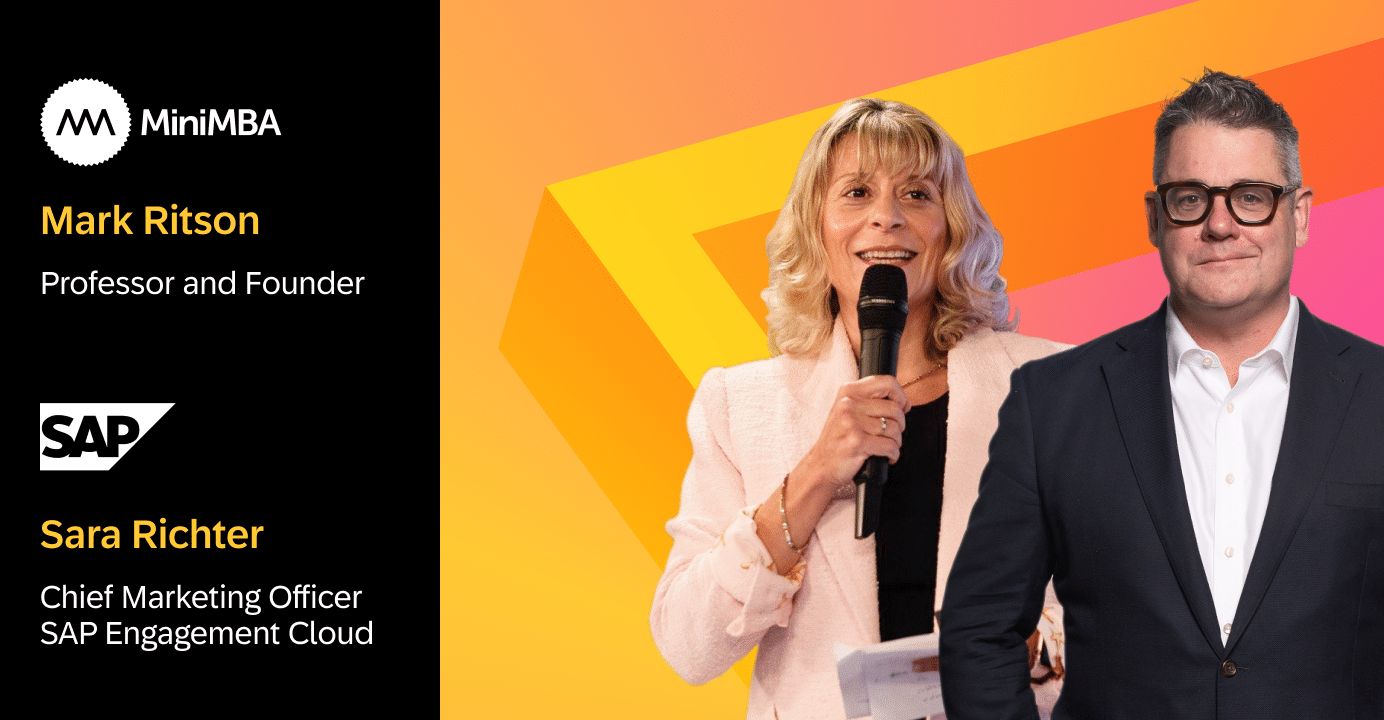
AI-empowered customers are re-writing the rules of CX. Mark Ritson cuts through the hype to reveal which trends actually matter and what they mean for brands.
So we've set some foundations for today. We started to think about engagement. We started think about the challenges that we're all seeing in the marketplace and how we are all trying to tackle engaging in the most meaningful way with our customers, activating our data. So with all of that in mind, we're gonna talk about the trends that are currently shaping customer experience. What's real? What's not? What matters most? I couldn't be more pleased to be joined by our speaker, Mark Ritson. I'm sure many of you are familiar with Mark, but those that are not, you should know that he's a fearless thought leader with a PhD in marketing and 25 years experience as a marketing professor at world renowned programs, including London Business School and MIT. He's been a global brand consultant for notable brands, including McKinsey, Subaru, Shashibo, Johnson & Johnson, Sephora, Amgen and WD-40. And I'm a bit jealous of this one, I must admit. He was even an in-house brand consultant for LVMH, the world's largest luxury group, working in Paris with senior executives from brands like Louis Vuitton, Dom Perignon, and Hennessy. He stays on top of the latest trends as a column writer for Adweek in the U.S. And the Drum in the UK. So without further ado, it's my very great pleasure to please welcome Mark Ritson. Great to be here. And Sara, thanks for that fantastic introduction. My job is really twofold, to share with you some of my own experiences and also talk about the reports. And for once, I think we have a report that is genuinely interesting and I encourage you to actually have a look at it. Some of the insights, in some ways depressing, but in a good way, they set some challenges for us. So in my session, here's what I'd like to cover. I want to talk about, just step back and talk about the origins of CX, the whole customer focus, and almost from the beginning, as you'll see of the discipline, which is nearly 30 years old now, that gap that Sara's already spoken about, the gap between the promise of what we should be delivering and the reality of what customers are really getting. Then we'll talk about why. So one thing that I think the report's very good at is really beginning to look at. What's causing the problems and what causes the reasons why companies aren't able to do it. We'll then address the elephant in the room, which is of course AI, what role will it play and how and where should we be using AI in the decade ahead. And then wrap up by looking at the promise versus the reality of where we sit right now. We're gonna come back to three questions that will be the backbone of my session at the first to what degree are you market oriented so i'd like to think about this and vote on this one please and we're gonna pick it up at the end. We'll talk about market orientation in a minute but to what degree do you believe your organization is able to see things from the customer point of view we've given you three options there. Be honest it's anonymous. Poor. Average for your industry. Or actually market-leading and a proper customer-centric, market-oriented operations. Number two, to what degree is your CX consistently managed across the company? One of the things you'll see in a minute is this idea of intra and inter-functional coordination to deliver organization-wide CX. So again, using those same three options, give yourself a score. And it isn't just, do we think we deliver a good service? It's do we have the capability across the organization to join it all up together? And then finally, your third question, where do you stand currently on AI's impact on marketing? So we'll talk about this one later on, but there are three sort of dominant perspectives, there's the civic perspective, which isn't necessarily the wrong one, that it will have a limited impact overall if we jump forward a decade or so. B, that it will be significant, that the impact of marketer and AI together will have a significant impact, or C, it will be total. And what I mean by total is that we effectively are going to remove the requirement to have marketing teams really require it all and we have a closed loop, fully mechanized system. Okay, let's talk a little bit about the last decade, and actually the last three decades of CX and that sort of promise and then the trailing reality that seems to have followed it. So we're almost, almost a 30-year-old discipline. Pine and Gilmore invented modern consumer experience in 98. And really, within a few years, Bain had coined this idea of a CX gap between the promise and often the production of customer experience and what consumers were actually receiving. And it's haunted us ever since. NPS arrives and I think gives us a good empirical metric in 2010. By 2016 Gartner really puts the emphasis on CX and by 2020, of course, with our little experience with COVID, we get that kickstart into the digital experiences that we all suddenly were already having, but we're having so much more of. Now, clearly we're in an era where everyone's asking about the impact that AI will have both on consumers. So, we've had this period where the organizations, for almost three decades, that we're all part of, have had a pretty strong focus on CX. The problem, of course, is one of what I always call market orientation. For me, market orientation is the most important concept in marketing. What it essentially means is, to what degree do we truly see our business, our products, our services, our communication, our experiences from the point of view of the consumer? Not what we think they think. But what they really think. Because the core lesson of market orientation is you are not the consumer. You cannot see what they see. You cannot experience what they experience because you produce it and they consume it. And so when I work with companies on this topic, I talk about this 180, a swivel that we have to do. Marketing and CX isn't about what we're doing to the consumer, It happens when we swivel things around and we see what does the consumer experience from their site truly experience from that point of view. And you see market orientation playing out literally across everything. The most famous example at the moment is, is McDonald's CEO. He's a fine CEO, but you must by now have seen his unfortunate video. He released a little video. Essentially promoting the big arch, his new sandwich, and he thought he obviously thought it was very good because you know, they, the team shared it. The impact in the market is disastrous because people are noting the fact that he clearly didn't or appears not to actually eat the burger. It's a perfect little example of, of how we think something is, is very good from a commercial corporate point of view. And yet, when it's received by the consumer, the exact opposite happens. And we see that playing out, that paradox of market orientation across communications, across brands. You know, we have this belief that our brands are super important in the lives of our consumers. Very often we miss that market oriented point that it's our whole brand. We work on it eight hours a day. We're obsessed with it. But when you spin it around from a consumer point of view, she has literally hundreds of brands in her life and we're much less important. And we come to mind much less than we perhaps imagine inside the organization. I love working with companies on competitive sets, because what you find over and over again is companies don't actually know who their competitors are. They think they know, but they've defined it from a company point of view. When you actually spin it around and talk to customers, what you learn is they're not competitors, they're alternatives and many of them come from different categories. Many of them don't look like competitors that the company thought they were competing with. But for our session today, the key recurring thing for me is market orientation and the impact on CX. Because over and over again in the report and in the data, what we see is companies that are delivering something that they think is adequate, and yet when we turn it around and we look at it from the consumer point of view, the consumer is giving us damning feedback. It's not there. And I think it's a perfect illustration of the challenge of market orientation, not what we're meeting out, but what is the consumer actually receiving? And so for me, the report is a phenomenal reminder of market orientation, Sarah will go into more detail later about how you can download it and I'm truly not f***ing you. We get a lot of industry reports. This is one that has, I think, spectacular insights within it and is worthy of your time. I want to pull out a few things from the report. As we go through my session. So first, we get this recurring story from consumers that they're fundamentally disappointed with the general levels of service that they get. They obviously don't speak about engagement. They talk about the pointy end of engagement in terms of the service they get, but note, first of all, the importance of the overall experience, exactly what Pine and Gilmore told us 30 years ago, it may be for at least half the market, more important than brand itself is the actual uh, experience that we provide for them. And yet, if we take one particular touch point, 58% of the consumers in the survey said that most marketing emails they receive from companies are simply not relevant to them. And, and I would encourage you to do this and to be, be a consumer yourself. Don't be a marketer for a few minutes later on, go to your inbox, pull out your junk email, or even just your non-important emails and gaze at that elephant's graveyard of corporate commercial marketing emails that are being sent out blindly by companies who are like, well, you know, we send out, we send an email to 8 million customers every day, right? There they sit, unread, completely pointless. A really sad indictment of the state of engagement and of customer experience. I've done it in this case for Qantas, which as I'm an Australian resident, I love Qantas. Don't get me wrong. I'm a very, very valuable customer to Qantas and when I say valuable, I would say, uh, $300,000 plus per year asset to them. Yeah. I'm right at the top of their tiers. I'm very brand loyal. I love Qantas genuinely, but I have to tell you, they send me inane nonsensical messaging that fortunately I don't see anymore because it's filtered out. But it's incredibly generic and to the point of the data, simply irrelevant to me. Another data point from the report, 37% of our consumers believe brands don't personalize to their needs. Again, I want to pick on Qantas here. So I've lived on a Qantas plane now for 20 years. They know everything about me. I have my health insurance with Qantas. I order my wine through Qantas, I travel everywhere with Qantas, my kids travel very conscious. I spent a lot of time with Qantas, right? They have enormous amounts of data on me. Um, you know, huge amounts, probably more than my wife has on me, right. This last Christmas as a gift, cause I'm one of their platinum one top hundreds, whatever they sent me a bottle of gin for Christmas. Let me tell you about how I feel about gin. I hate gin. I like generally drinking any alcoholic beverage except gin. It's the thing I don't like. I, I hate everything about it. And yet here was my Christmas present from Qantas who know everything about me, which was a bottle of gin. Yeah. It's a perfect illustration of not just not being personalized, but actually just completely failing the personalization test after 20 years and easily 2 million bucks, you still don't know anything about me at all. It's, it's, it's a slap in the face. And yet we get back to this central point. I am not alone. 46% of the sample say customer service feels impersonal and it feels impersonal because it, for the most part is impersonal. And the cost of that lack of engagement, the lack of personalization, the lack of what we would say in France, savoir faire and doing it well is gigantic. We, we estimate that more than a trillion dollars, the cost of poor customer experience. And we all know from the existing data that whatever the ratio, the cost of getting these customers back, having spent a lot of money and time acquiring them is sensationally high. So I think we're seeing, if anything, a widening of the gap, you know, that engagement divide that Sarah spoke about earlier is getting worse, not better, despite all the technology and focus that we're now applying to it. And SAP have coined this term, The Engagement Divide, the distance between what customers need in the moments that matter and what most organizations can actually deliver. So there is this, you know, I think growing chasm between the two. And I have to tell you, one of my big thoughts about this whole process is I keep hearing from CX professionals that AI is going to save the day, yeah, that AI is going help organizations close that gap. Personalized services, improved CX. That's entirely possible, but I have to tell you, it's the less likely bet. The more likely bet from where I'm standing is customers will use AI faster, more efficiently, more effectively to essentially do their own thing. And it will, if anything, make organizational attempts to offer service look even more second rate in comparison. I'd like to give you a personal example, straight from my own CX life. So I had a medical last year and it wasn't good. Like I'm not dying or anything, but it was like, you know, the medical, which was pretty extensive was kind of like, I'm 56, so you never expect it to be great. But it was kind like you're kind of, you're below average, even for a 56 year old relatively fat man. And so I took it quite seriously. And I got into my supplements quite a lot last year, and I really did change my lifestyle a bit for the better. And I use Thorne, so Thorne you may know are probably the most advanced supplement company in the world. They've got a really incredible portfolio of products and a very good website and an extremely efficient approach to CX. I've found them to be very good. So all my stuff was coming through Thorne, six or seven supplements. I had an idea in January, which was why don't I upload all of my medicals for the last three or four years into Claude, my friend Claude AI Claude and just see what Claude thinks. And Claude, first of all, did a, I would say five times better job than the medical team that usually look at my medicals and then got very proactive very quickly with me and said, look, your supplement choices here are all wrong. You need to change them. And it quickly gave me, as you can see here, the Ritson stack, which is my new collection of fantastic supplements, but my point here is only one now of my eight supplements comes from Thorne. The rest, thanks to Claude, have been moved elsewhere. And if you want a perfect example of how brands like Thorne are going to lose out to consumers like me, armed with AI, there you have it. I think we're being, consumers are being weaponized Through AI to be far more effective at building their own experiences separate from the companies. And I really worry we're missing this perspective. AI isn't exclusively for corporates. It also works on the other side of the divide. And my bet is it will make this bigger. And if you look at Sara's point, customer expectations are moving at a new speed with AI at their fingertips, people compare, decide, and switch in an instant and those micro-moments now define whether a brand wins or loses a relationship. You thought the customer was hard to please 10 years ago, weaponize them now with AI, you've got to run even faster because I don't think AI just works one way. So why do companies keep failing at CX? The report is fantastic on this. So let's go back and look at the gap that's been there pretty much since the start of CX. Look at Bain's original identification of the gap 20 years ago. 80% of brands believe they're delivering superior customer experience. 8% of customers agree. Perfect example of market orientation mismatch. If we jump forward 10 years, the very famous Capgemini study, which I cite all the time, 75% of brands in their survey thought they were very customer-centric, but only 30% of the customers of those companies agreed with them. So again, there was a sense of, you know, almost arrogance and certainly ignorance about what was really being delivered. And I really think with the new SAP report, what we have is a timely update 10 years later to basically confirm the same issue is there. 78% of businesses believe they deliver seamless CX and 25% of consumers agree. Give or take the odd percentage point in definition, what we're seeing is essentially the same gap. Yeah, we're not getting any better. If you look at the reasons behind the gap, they have been changing. To begin with, it was channel fragmentation. Then it was the fragmentation of data. Data has been more unified, as we'll see in a minute, but the organizational fracture around CX now appears to be the biggest single burden. The problem on data first. So brands are certainly investing in AI and investing in CX, but they, they don't have the data ready to build that system. When I talk about customer data, I often use the analogy of irrigation. Every company has data and it's almost like the water. Yeah. But before you start pumping water into anything, you need to have the channels of irrigation in place to make sure it goes everywhere, goes to the right places, is managed. What we find is most organizations don't have that infrastructure. 78% of businesses say AI is essential for retaining customers, but less than two in five are actually able to share their data with the CX or CRM platforms. The irrigation just simply isn't there. And if you look at the reasons behind it in the report, 60% of companies suffer from dark data. So they have it, but they're not using it. 54% can't access and use real-time data, so they're missing out on a huge trove of information. 55% say data isn't structured correctly. They just can't get added. And two thirds, it's a giant proportion, are still unfortunately dependent on third party data and haven't managed to create any kind of first party data pool. So we're falling behind in the data area and data is the essential ingredient. And there's a lovely quote in the report from Christian Wandel. Who runs performance marketing for CHRIST, which is Germany's biggest jeweler. When you have more data, you can learn more about your customers. Our challenge was that we had many CRM systems and silos for data collection. We wanted to be more efficient and improve communications with customers to increase repurchase rate. SAP Engagement Cloud was the best product we evaluated. It fit our demands to bring all the data into one tool, and that tool with an omnichannel perspective. So what we're trying to find are irrigation systems that can manage this information. So first challenge is absence of data. Second channel is many companies have got too much focus in the wrong places. It's a very common thing. One of my first ever big consulting gigs was working for a very famous car company who'd spent millions of dollars. Training all their salespeople to be customer oriented. And when I went in and did the analysis work much later, what I discovered was very clearly the central node in giving a dealership either good or bad service was the receptionist sitting in the middle of dealership. This was typically a woman in her early twenties who'd had no formal training in customer service or anything else, was usually high school educated, and if she was good, the service was good. If she wasn't so good, the service wasn't so good. They spent all the money in the wrong place and they'd missed what was essentially the most important touch point. And we see that same process to some degree going on here. If you look at the mismatch in the report between where consumers are experiencing brands and where companies are spending their time, money, and focus, what you see is a bit of a mismatch. If you looked at those first two examples, social apps and social content. Because they've essentially been highly promoted and focused upon by very large companies we all know the name of, they've occupied the thoughts of organizations perhaps a little too much. And we've ignored the other channels, basic online, mobile apps, and in particular in store, where actually there's still an enormous need to focus. This one is for me a particularly surprising finding. So only 40% of decision makers believe their departments are truly coordinated. And yet 45% say customer service feels impersonal as a result. So what we've got here is again, this mismatch. And I think intra-departmentally, so within each organizational department, what we find is many of them do not have the capability for engagement. So let's be clear what SAP mean by that. They've got this nice definition where for them, engagement really comes back to a combination of capability and outcomes. So they've pulled the two things together. And we look at this continuum within SAP where many companies are just reactive. If they're further down the continuum, they become proactive. And if they truly get it, if they really reach that zenith and almost no company does, we become predictive, which is the most lovely customer experience of all. They know what I want before I even know I want it. They anticipate it, right? It's almost a marketing myth now. If you look at how the different departments within organizations score on that engagement maturity. What we find is everything is back to front. So a department like procurement scores relatively well on its engagement. But the customer facing departments, customer support, for example, is actually among the lowest scoring in terms of their ability to engage with actual consumers. So we've literally got it the wrong way around. Quite a stunning statistic. And then challenge number four. We're finding that complexity is the enemy. And as we invent more tools and grow, complexity becomes a significant enemy. And here again, we face an interesting market oriented paradox. If you look at customers, they have one incredible superpower, which is no matter how many different things you throw at them, no matter, how many different media touch points, complications, departments you throw to a customer, when you look it from their point of view, they're instantly able to integrate all together in a single perspective, which is their customer experience. And yet when you turn it back around again, we have this organization of spaghetti, delivering all these different things in all these complex ways. If we have to replicate the simplicity of the customer and the simplification in order to match them and deliver proper CX and you see it in the data. What are the reasons why brands admit that there are barriers here to delivering you know, a better engagement and a better service. Top of the list, complexity within the marketing department. We're our own worst enemy. Lack of integration across systems, lack of visibility beyond marketing into the other groups, engagement, not an overall business priority. So the complexity and the barriers within an organization are stopping us doing it. And I really want to highlight Brian Niccol's work at Starbucks. I think he is the best CEO in America right now. I think is fixing Starbucks. And at the core of what Niccol is doing is very simply applying these principles. He's simplified the menu, the customer experience, the overall approach. I think what he's been able to do is take a classic example with Starbucks. They had one of the best apps, best as in did the most functionality in the market, but it was a **** show in terms of complexity for the consumer, a completely depersonalizing experience. Niccol, who is himself a former marketer, now CEO has gone in, he has simplified, he's given service the core visibility and he said the way we engage with customers is at the heart of our problems and as you probably have been following and trust me it'll get better over the next three years, what we're looking at is someone that is turning around Starbucks before our eyes, same source sales going back up and at the heart is removing complexity and delivering a better CX and it comes back to what Balaji's point has been, I think for the last two or three years. The brands winning in engagement aren't running more marketing campaigns. They're building engagement as a comprehensive enterprise wide capability where AI is grounded in everything else. So the key word here is enterprise wide. So with that in mind, let's look at AI and whether AI is the solution that many of us hope it will be. If we step back, you've got to, first of all, take a point of view on AI and marketing. And goodness knows, it's all we talk about at the moment. I think there are three perspectives, similar to the question I asked you at the start. There's the skeptical perspective. AI is just automation with better PR. It's not going to change anything. It's there. Okay, it is there. You can use it as a little tool. We're overstating the impact. And this really comes down to a marker that believes. A smart person is always going to be better, more creative, more switched on than even the finest piece of AI. At the other extreme, we have the zealots, and there's plenty of them around in marketing. AI will replace marketing entirely. We won't need marketing departments in the future. We won't need marketers, essentially a closed-loop, tech-driven system. The CMO, if she or he remains, doing little more than managing a tech system. And in the middle we have the pragmatists. You know, we see AI as a horse, but they still need a jockey to ride the horse. AI makes good marketers great and bad ones worse. AI is amplification. It isn't necessarily going to replace everything. These are three perspectives genuinely I see right now playing out. For me, the two extremes are, I don't want to say incorrect, but my guess is they will be wrong in the longterm. I think the skeptic is right about, we still need fundamentals. But wrong on the scale of impact that we'll see with AI. And I think the zealot also wrong in the sense that, yes, there is big change coming, but it isn't changed to the hundredth percentile. We are still gonna need that human AI dyad to be successful. So for me, the pragmatist is right. And I would say just because it's the middle path, I don't think it's gonna be a 50-50 balance between marketer and AI. I think AI will be. The dominant part of this relationship. And the reason I say that, if you haven't seen it yet, another report came out this week. Anthropic did a big piece of analysis looking at 800 different professions and looking at what each profession did and how much of that profession's work, ultimately, keyword ultimately, will be deliverable using AI. And as you can see, market research and marketing finished fifth. Now you would think at first sight that looks like it's mid table, right? We're in the middle. We're not That's the top 10 of 800 professions. We are in the top one percentile of what I would call vulnerability. 65 percent of our tasking will ultimately, eventually, be AI replaceable. So I think the pragmatist is right. There's still 35 percent of room simplistically for us but we expect a revolution and the revolution will come. So, where is AI working right now, specifically with thoughts about CX? I think already, and you see this in the report, 89% of our marketers said AI is already essential for acquisition and for targeting. I think it's brilliant at identifying human patterns from data inputs and I think identifying who to go after is already something that, you know, I think is becoming second hand. We've all talked about the second one, campaign efficiency and content generation. This is the year where we are now generating ads using AI, which are as good as, if not superior to, ads that were created without AI. I don't think it's the biggest part of the revolution, frankly, but 71% of retail marketers confirm they're speeding things up using AI. The other one that I think is gaining ground is product recommendations. Again, a dirty admission of the industry. If you ever visited even the biggest and most data customer-centric companies, their product recommendations were essentially poor. If you look at Amazon, for example, it really never got it. I've noticed an incredible uptick in the quality of recommendations. And again, we can point the finger at AI. And finally, yes, it's true. In terms of predictive churn and loyalty metrics, we are now beginning to use the complex algorithmic power of AI to really improve our ability to retain, and that, as you know, has enormous impacts on the bottom line. That takes us to what I think Anthropic would say is about currently about a 28% penetration of tasks. It's going to get to be 65% as we saw, but some things aren't happening yet. What's not happening yet? We're still a couple of years, I believe SAP will, I think we'll tell you it's a bit faster, Sara will disagree with me, real time operational engagement fusion. So being able to pull everyone together using AI, we're still a couple years away. The agentic revolution that I think is the real start of the process, still yet to truly emerge, although we talk about it all the time. The autonomous closed loop end-to-end journeys, still a bit away. And for me, the one I'm excited about, cross enterprise, AI decisioning, strategic frameworks, building the marketing plan from directly AI, it's coming and it's huge in its implications, but we're not there. So when I look at the impact of AI on marketing, I come back to what marketing truly is, yeah. And for me, marketing is three things. Yes, it's tactics and yes, it is communication. We have a terrible tendency in our industry and our discipline to start with tactics and particularly start with communications that the lesson of my teaching and training has always been step back, go to the other end of the spectrum and begin with diagnosis, understand the market. Understand the segments understand where we're playing and do that first with data Then we get to strategy so often missing from so many big marketing companies. My definition of strategy in marketing is very simple and I encourage you to adopt it because goodness knows we've complicated this one. You have a good strategy if you can answer three questions coherently. Who am I targeting? What's my position to those targets? And what are my objectives? Those are simple questions which are hard to answer. I find the vast majority of companies cannot answer those questions and cannot answer them coherently. So based on diagnosis, can you build a strategy? And once you've done that, then we get to tactical execution. My point is AI is already beginning to have massive impacts. In the area of synthetic data, those of you working in B2B will know this, we've reached a point where I think synthetic data is at least on par with a lot the consumer data we see. I think in terms of strategy, we now find targeting, positioning, objectives, all of the things essentially that we're looking at in terms of strategic development are being fed more and more by AI. And then tactically, we've already seen it, communications, yes, pro development, yes, and pricing, yes beginning to have an impact. But in the area of CX, we see, I think, a genuine opportunity for AI to offer that improved level of engagement and that cross-organizational feel. So let me finish with what I think is gonna be the link between AI and customer experience. So the first point is, as we said earlier, customers know what great engagement should look like and how they experience it. You know, they know what they're looking for, often unlike the organizations, seamless, connected experiences, personalized product recommendations. Localized content, highly personalized content. So using data to give me what I want and maybe why I didn't even know that I want it. So the consumer knows what they want. And yet at the same time, they're very skeptical that AI is going to help deliver that engagement. Marketers think 80% of the time that AI's going to add a lot of value to the CX experience. Consumers don't believe that. And I want you to focus on that statistic because it's super important. Consumers know what they want from really good proactive CX. They don't think that AI, is going be the thing that delivers it. We've learned from our data, it probably will be essential. So how do we answer that conundrum? Let me tell you a story by way of introduction. So I spent many happy years working for LVMH, the luxury goods company, at a very senior level, working with all the CEOs of all the great brands. And we have an LVMH house, which is basically the internal strategy team for the whole operation. And one of the challenges I was given by Mr Arnauld, the big, big, big boss was he wanted the whole of LVMH, all of its luxury brands from Dom Perignon to Christian Dior to Louis Vuitton to Tag Heuer to more embrace the customer, to embrace segmentation, because luxury brands had turned their back on marketing, at least on listening to customers. They felt we should tell customers what they want. And Mr Arnauld quite correctly said, that's too simplistic. I need us to also focus on customers some of the time. None of the presidents agreed with that. The presidents were opposed to research, segmentation, anything that came from what they perceived to be P&G consumer goods. It was a big challenge for me. I couldn't get any of them to buy into it. So in the end, we did something spectacularly clever and spectacularly successful. So we had a big dinner of all the CEOs of all of the luxury brands within LVMH. We had it in London at our headquarters, the LVMH headquarters. And we essentially brought these 45, 50 men and women together for a sensational evening, some speeches, some very senior famous people. And we served this spectacular meal. You know, it's a luxury house, which has many, many, many wonderful brands, often in wine and spirits. And so there were eight tables, very interesting table assortments from different brands sitting together. And it was one of the most amazing nights of my life. And in the morning, when we got everyone together for our big meeting, I said to them at the start, how was dinner? And even by their standards, everyone in the room said, spectacular. One of the best meals I've had, amazing wine, amazing company. And then I got out the data that we got from their survey, from their PAs. And I said, to them, we actually asked all of your consumers, we asked all you what you liked and what you preferred and what your tastes were. And then we clustered you using behavioral clustering, and then we found there were six different clusters. So we had six different tables and we went to a different Michelin chef and a different sommelier from some of the world's top hotels, we gave them the brief and we asked them to create a custom menu cooked just for you last night, a custom array of wines. That's what data is. That's, what the segmentation is. We never told you, you just had an amazing meal, but that's why. Data and segmentation can be so powerful and it was the start of a market oriented revolution within LVMH. Now, what is the point of this long story? I think this is how we use AI in CX. I don't think the front end AI stuff is really where the value is and I think the consumer is switched off. I think us talking about we've got an AI chat bot, we've generated all these ads using AI, what do you think? I think it isn't just not good. I think its negatively received on the part of the consumer. I think the paradoxical role of AI in CX is in the back end. Go back to LVMH. We didn't talk about segments. We talked about an amazing wine that was exactly what this person wanted that we got from doing the data and doing the segmentation. I think where we will see AI having its impact is in doing predictive segmentation, in real-time personalization, in all of the inventory stuff just being available at the right time, in protecting customers before we lose them. All of it is done by AI. None of it, is labeled AI. Now that's a challenge for you because right now everyone in your organization is being asked, how are you using AI? And so you're forced almost to talk about the front end, less valuable stuff. I think we get to a better place of maturity and better engagement when we use AI as a backend tool, seamlessly, inter-departmentally connecting everyone together, yeah? But the less we talk about AI paradoxically, and the more we do AI, the better our engagement and the better service will become. So let's return to the gap before I close. I believe that there is an opportunity here in the gap for each of you. The companies that, I mean, I was talking to Sara about this this morning. When you look at the report, there's, there're relative scores on engagement. And what you see is some companies are better than others. Some countries are more engaged than others, but what, what overall, what the data says is we still aren't closing that gap. Look at the gap as your opportunity. A competitive opportunity to win in the most important arena of all. Because so far the bar is low, but the rewards are enormous. Look at that data that SAP have revealed to us once again, 78% of businesses believe they deliver seamless CX and only a quarter of customers agree. I challenge you to do better. I challenge you to unite the organization to use data better and to create, for the first time in the 30 years of CX, using technology and using AI, but in a backend manner, a truly seamless, proactive, why not predictive experience for consumers. They want it, they respond to it, and so far in the third year history of CX, we haven't for the most part delivered it. And I do see I have to say SAP as a key partner in that process. And I remain significantly impressed by the capabilities of what SAP can offer and to fill the gap. All right, back to you, Sara. I've said enough good stuff about you, I think. You can never say enough good stuff, Mark. Come on. I think the report, I have to tell you, when you asked me to do this and you sent me the report I was like, oh my goodness, here we go. It's a great report. Congratulations. I think it's brilliantly done and there's a lot of insight. Thank you, Mark. That is genuinely appreciated. As was your session, which I think was fascinating and insightful. I hope everybody else got as much out of it as I did. The good news is it will be available on demand. So if you want to go back and listen to it again, because there was actually an awful lot in there, I think, to process and think about. And I love the idea of the challenge. I just think that's such a great place to end, to go away and think, how can you do something better? That's what we're all striving for. And that's what- I think that's what drives a lot of creativity in the marketing space anyway is how can we do it better? How can we bring something different to it? You're right Sara just I think that point's key why I don't want to sound negative about the gap or the divide I think it's opportunity right? That's what we've got to say to clients that it's so important and so potentially doable. The gap is your opportunity here, and I don I don't want to leave with it leave you with a negative thought I think its a great opportunity for those that want to take it. I absolutely agree. Let me pose a question to you, though, which I think goes really naturally from that. So you've asked, you've asked people to take it as an opportunity, as a challenge. So if you were looking at a leader, and they said, please give me that single piece of advice that's going to help me accelerate engagement maturity in 2026. What's that piece of advice? What should they do? What comes out from the data over and over again is I thought about it when I was reading it is there's an old joke, right? That marketing is too important to be left to the marketing department. And I think in the same way, I think we have to say the same about CX. What comes our again and again is that unless we can have a truly organizational wide belief in the importance and delivery of what we're doing, you'll never get engagement, right. I think, I was very careful in choosing Niccol at Starbucks, it's not easy, but it's easier when you're the CEO to bring in that cross-organizational focus and that's literally what he said from his first day in the company, right, was, listen, we're not doing it, we need to get everyone together, this isn't a marketing issue. So I think it's that idea that marketing has to market the importance of customer experience and get everyone involved in it and that is a difficult task. I couldn't agree more, but I think it's fundamental. And that sharing is how you understand a customer. I mean, there is, whether you call it customer centricity or all of the various things that we talked about, it's still about thinking about that and dragging your customer, kicking and screaming into the center of every conversation you're having about what you're doing as a brand. Look at what we've done in our discipline, right? We've got market orientation, customer centricity, customer obsession. We've even complicated the simple thing that was meant to be at the heart of what we do. And, and executives get really confused. It all means the same thing. It means exactly what you just said. That at the end of the day, the customer's in the center of this. And if you follow the money, all of that share price, all of that revenue, all that profit, if you've followed the money all the way, it comes back to those people who pay for everything. And for me, I'm 30 years in this game now. The great paradox of marketing is that what the people on this call see when they see their service or advertising or pricing, what they see is not what the customer sees. You cannot see it without data. You and I cannot judge this podcast because we're producing it. So we shouldn't bother and even think about it. We should look at the data afterwards about how we did. If you understand that, you're a marketer, but then you need the data to your point, and then you have to do something about it and bring the whole organization in together. As you see from your data and from all the way back to Bain's data, we've not managed to do this yet, which is stunning. When you look at how much money has been spent by how many companies, we still don't have predictive customer experience. Except as a very rare occasional moment, right? Your average, your engagement scores are 25, 30% for most companies, right. Everyone's failing at it. We haven't done it yet. Agreed. For the few that are doing it, what do you think they're doing differently? I mean, we can leave everybody with this thought. It always begins with market orientation, the importance of the customer and realizing we're not the customer. Then I think you've got to manage that data, right? Every company has too much data, but many of them are drinking from the fire hose. So putting in the irrigation systems that allow us to feed that data in the correct way I think has to be the second stage. And then the third one, which we've talked about too is, and then it's about making sure Marketing on its own does not have enough power or influence or impact to make this work. Service is a company-wide challenge. I'm going to make it the case for something that will never happen. We need more market-oriented CEOs. It's very hard when a lot of them come from finance because without that leadership at the very top, I think it's a real struggle. That's why Nickel is... Well placed, he's a marketer that now runs the company and he can pull everyone together. So for me, market orientation, data, and then that industry-wide acceptance that it's, you know, again, there's an old joke here, right? We've got to get finance and marketing and operations and procurement and logistics to work together, almost like they work for the same. Shocking idea, truly shocking. Right. Well, I am genuinely sorry to say that I think we have run out of time, but thank you so much, Mark, for your insights, for the time you spent, for sharing that, for spending the time to report and pulling out so many gems. I hope everybody has enjoyed this as much as I do. And Mark, we look forward to seeing you again soon. Looking back, we have spent the last hour or so really deep diving into the engagement index. And I thought it was so great to have Mark's external perspective on that data and then looking at it such a different way. And then how we can all take that and actually use that as a tool for ourselves to help us improve how we continually engage with our customers and how we continually improve. The experience that our customers are having with our brands. And I think it resonates with some of the things, hopefully, that I said earlier about the volatility of the world that we're currently in and the absolute fundamental importance of engagement in that world today.
Keep Up With Your Customers: Tech, Trust, and Real‑World CX Wins
Customers move faster than most brands. Hear how leaders modernize CX with AI, build trust, and turn real-world lessons into lasting engagement.
We're going to focus on tech trust and absolutely hardcore real-world CX wins. And I am delighted that I have such a distinguished panel of experts joining me for our next session. We have Sunny Neely from SAP, and he's going to help to connect the dots between our research and how Engagement Cloud helps brands move into the Engagement Era. We have Venky Naravulu from Sinch. He gets to see up close the operational realities of getting enterprise-wide engagement actually right, some of the things that Mark was talking about. And last but absolutely not least, Daniele Tedesco from Essity, who's representing brands who are already transforming and proving what great engagement looks like, but what it looks like at scale. So my pleasure to welcome all of you. And what I'd like to do first is ask you all to perhaps introduce yourselves a little bit with a little bit more detail than I was able to give. Daniele, maybe you could kick things off for us. Sure. Thanks, Sara. Thanks for having me. I'm Daniele Tedesco. I am from Essity, a global e-commerce process owner. And a simple way to describe my role is really with three S's. Streamlining, optimizing our e-commerce business processes internally. Speed, this is an external one focusing on accelerating our go-to-market, getting our shops up and running in our different markets and really focusing on the customer. And seamless. This is where we really touch that engagement part, so building that seamless customer experience across all of our digital experiences. And we really feel that, or acknowledge that Engagement Divide. And as a brand, as our different brands and as Essity, we really focus on our professional buyers as well as our consumers. Essity is not a household brand or household name I should say, but our brands touch one billion people every day, and that gives me goosebumps to think about it. One in every eight people are using our products, and our products are touching their skins. Our products range from incontinence to household products like Tissue Town soap and sanitizer, as well as medical devices, compression garments, we're in your hospitals or your airports and our factories and schools. So yeah, I'm happy to be here, excited to share more about my experience with engagement and then customer experience. Thanks so much, Daniele. And it's exciting to talk to a brand who really is everywhere we are all going. So that's really quite exciting. And Venky, can I ask you to spend a few minutes chatting a little bit about yourself and your experience? Absolutely, thanks for having me here, first of all. Thanks, Sara. And of course, hello, everyone. I'm Venky Naravulu. I'm the Director of Partner Solutions at Sinch. I've been at Sinch for about five years now. I come with about 20 years of experience at the intersection of digital communications, customer engagement platforms, and enterprise cloud solutions, how they come together to deliver those in a privileged experience across different verticals, Retail Healthcare Financial Services. At Sinch, my focus is product management of native integrated solutions with enterprise platforms, such as the SAP Engagement Cloud. Together, we enable brands to reach their customers across every relevant messaging channel, be it SMS, WhatsApp, RCS, and there are a dozen more. Sinch is a global leader in cloud communications and like Daniele said, even I get goosebumps. We power billions of customer interactions every year across various channels for thousands of enterprises worldwide. What makes our partnership with SAP Engagement Cloud particularly powerful is the combination of Engagement Cloud's AI-driven orchestration, the personalization engine, along with Sinch's messaging reach and also the reliability, collectively giving our brands the ability to deliver the right message on the right channel and at the right moment on a global scale. Once again, thank you for having me. I'm really privileged to be here. Pleasure, Venky. We're delighted to have you and thank you for that. So why don't we kick off our discussion and start talking about some of the teams that you are working with. And these are teams that are already operating successfully in an Engagement Era. And they're delivering, they have connected data. They've simplified around omnichannel, and Venky, I think he just touched on some of that. They are delivering real-time personalization, and they're doing a lot of that with intelligent automation. So I would love to look at a brand or an example where you've seen, where you really can focus on engagement and how it's really been done right. And where you looked at it and thought, wow, this is exactly what the future looks like. This is where we're going and where really successful brands need to go. Venky, could you kick things off? I have a feeling from chatting with you have an example that fits this question really quite perfectly. Yeah, so in terms of doing engagement right, the brands that are doing it right are the brands who are already adapting to the evolving dynamics of customer engagement ushered in by the AI driven technologies at the same time. So in fact, a recent Gartner article titled "Top Priorities of CMOs in 2026," they advise on a zero-based approach to channel engagement, meaning you have to start over; you cannot just rely on past successes, blindly speaking. So this better prepares brands to transition to the agentic buying in a scenarios and the channel engagements, which are rife with AI touchpoints. Now, just to quote the Loyalty Index, I know you all have got different stats, but it helps to drive home the point, 23% of consumers said batch-and-blast marketing actively damages their loyalty. So the brands that get engagement right are those who make a shift from broadcasting to customers to conversing with them. That is what means by engagement done right. So brands treat engagement as a continuum rather than a campaign. To throw in a quick example, a premium retail brand reaches out to a customer, for example, who perhaps recently browsed one of their favorite items, be it a dress they liked or a pair of running shoes, which was out of stock. Now SAP Engagement Cloud, with its collective capabilities, can trigger a personalized back-in-stock notification over any channel powered by Sinch for the specific product along with associated complementary products. And all of this is backed by predictive analytics like Mark also just mentioned, right? So the customer now is pleasantly surprised. Somebody is not throwing at them a message about a product, but they're throwing them with options to interact, and interaction is very common in channels like RCS or WhatsApp. Now the customer can now pose a question. They can ask a question about the durability of the product and the quality of the products or any other questions they may have. And this is where an AI agent already trained on a curated knowledge base of the brand's specific products and services, can do a fantastic job of answering a quick question in an automated fashion on the same channel. Say the customer then decides to ask a question which may need a human touch. The agents can do warm transfer, seamless, frictionless to a human agent who can then jump in and address the other question. So what happens here, they're going from conversion, from awareness to conversion within a few seconds. And that is what I mean by saying engagement done right. Now, there are three things that stand out in such an engagement, right? The customer data is unified. Once again, something Mark had brought up. So every message and engagement reflects a real context. And this channel is chosen based on the customer preference, not the brand convenience. Last but not least, have AI agents automate the personalized experience with the option to seamless transfer to a human agent as possible. Hope that helped answer that question. I think that was a great answer. Thank you very much. Daniele, I think you have a bit of perspective on this. Do you want to dive in a little bit? Sure, yeah. I mean, I guess taking from the other end of the spectrum, you know, Essity's products are essential and necessity, so that's where Essity comes from. So the other side of the spectrum of, you know, luxury brands is, you know, these products that maybe don't they don't have a lot of thought maybe behind the purchase process as the same as a luxury product. But engagement is still extremely important, and especially when we talk about our global incontinence brand, TENA. This is both in B2C, so it's found in retails, pharmacies, but it's also a B2B product where we're selling into hospitals and nursing homes. So we have this gambit of customers that we have to engage with all the way from the patient, the caregiver, maybe a loved one who's doing research, and then all the way to this professional buyer who's really task-oriented. The brand team behind this and all the leaders at TENA have really done a good job at compartmentalizing and segmenting these needs, and we've built a strong B2B and B2C e-commerce platform out of that. And I'm happy to share, you know, I can't share specifics, but the past two years that we've been live, we've been experiencing double-digit growth, and it's been phenomenal. And one of the successes around that and to hit on Venky's comments is, really, we focus on the fundamentals. The success is built on, rooted in the fundamentals, and it's not just AI for the sake of AI, similar to what Mark was talking about. We're really looking at product data, pricing, inventory, and maintaining simple things like customer identity. These are the things that we, these are the levers we pull to really hone in and drive that consistent experience and engagement with the customer despite the market, despite the touchpoint. And as a result, we've seen fewer ordering errors, faster conversion, and more repeat buying is what we're really driving for when we talk about our D2C solution. That's fascinating. Thanks, Daniele. So let me flip to our to our last of our panel. Sunny, I'm delighted that you've been able to join us. So I'm like, hi, so as part of this conversation, maybe you could start by intro-ing yourself in just a sec. But my thought as I was thinking about handing things to you is that listening to Venky and Daniele, there's a lot of commonalities between what they're talking about and the stories they're telling. And, for me, a lot of them boil down to this ability to orchestrate engagement across the entire enterprise. So maybe after you introduce yourself, you could tell us a little bit about how Engagement Cloud is powering those kind of experiences. Absolutely. Thanks again. Well, I'm Sonny Neely. I am a global industry advisor for the consumer products industry at SAP. Prior to SAP, I was a brand manager at Coca-Cola and Ferrero, so I'm kind of bringing a practitioner's perspective. I'm grateful to be a part of this panel. I think for me, when you talk about Engagement Cloud, I feel like SAP is in the most uniquely, the most strategic position to help brands connect operational data with customer data. And that's the only way they're going to be able to deliver the personalized omnichannel engagement, not just for marketing, but at scale and across the whole enterprise. And so, you know, what does that mean in practice? Well, I mean, we talk about the end to end all the time, because I'm not just looking at CX when I worked with consumer products, large, complex consumer products customers. They have to bring marketing data, but they also have to connect that with the ERP data, like inventory, pricing, supply chain fulfillment. And that's how you make this customer experience a business reality, right? So, this is all about brands tying directly to revenue, margin, like Mark Ritson was saying, these real metrics that affect the stream, that affect bottom line of these companies. And you know like Mark said, look the Engagement Divide is real, and it can be really expensive, too. So I think it's critical that we think about these different functional areas. I've worked, when I was working in marketing, you had to align very closely with finance, with supply chain, with commerce, et cetera, in order to properly execute and see these results. And I think just one example, right off the bat that comes to mind for me is Molton Brown, the premium beauty customer that we have. Molton Brown was in a very disorganized state, fragmented data, et cetera. And what they ended up doing is looking to SAP Commerce Cloud for its complete commerce capability, its personalization capability, but then integrating that with Engagement Cloud so that they could deliver all these new capabilities of Engagement Cloud, AI-powered lifecycle management, ease of use for testing, et cetera, but also have the ability to link that to the ERP to bring in those real business metrics, profitability, cost of goods sold, et cetera. And the results were stunning, you know, 20% uplift in repeat purchases, 5x increase in revenue from email, et cetera. So a fantastic story for how we were able to help a customer really bridge that Engagement Divide that we're talking about. Thanks, Daniele, I think that's a really, really fantastic example. And I think it leads us very naturally, I'd say the elephant in the room, but we've talked about AI a lot already today, and I think we'll probably continue to do it. But one of the things that Mark talked about, what is clear in the index, is that consumers are already embracing AI to simplify their decision-making. And on our end as brands, we're still figuring out how to truly operationalize it, to really get what we need from it. So I think the question that we're probably all ask ourselves a little bit is what's the balance? What role does AI really play in helping brands keep up with the pace of consumers in this Engagement Era? What does good AI actually look like in practice rather than, as Mark said, just talking about it for the sake of talking about it? Daniel, could you kick us off on this one? I think you've got some thoughts here. Yeah, absolutely, Sara. And I fully agree. I think AI is there, it's everywhere now. But when it comes to brands, and I think when the best brands and the best leaders who I hear talking about AI, effectively implementing AI are not talking about how... They're talking about how AI is empowering and accelerating their people, not replacing them. So this is definitely Essity's approach. Essity has worked really hard over decades to build trust and brand loyalty and brand equity on some complicated and taboo products like femcare, incontenance, and lymphoedema. So in general, Essity has a bit of a cautious approach to exposing our customers directly to Gen AI, but with that being said, in the background, we're utilizing AI every day and empowering our people to use AI. So what does that mean in practice? Our product and experience teams are using AI to automate configurations and content generation. So they're spending less time coding and more time optimizing the customer experience, and we're seeing that shift of like task-oriented to value-oriented, and that's the message that we're kind of trying to drum up and create excitement around it. I think there's a lot of opportunity as as discussed before to speed things up, what Mark is pointing out, but when the consumer sees that, it feels a little bit synthetic. It can feel a little bit like this is an AI agent. It's secondary, but when you use it maybe to create product content or really create segmentation behind the scenes, I think that's where the power really lies. And that's what we've been trying to really reduce friction and close that engagement gap, as you guys have been talking about. I think for me personally, I like to really focus in on what I call the post-purchase journey. I think this has a lot of opportunity for really streamlining and building a stronger experience at Essity, and we can leverage AI to empower that. So this is like, having empowering our customer service agents to answer complicated medical questions about our products, and not having to rely on a product manager, for example, or empowering our partner sales teams, these are our distributor sales reps, to really build a targeted portfolio of products that will best answer that janitor or that customer's demographic. So this is where we're leaning into and building some excitement about internally, and it's going to create some future growth. I think that's really exciting, Daniele. It's all about connecting across the enterprise, which is what we've been talking about really for the entire event, and I think that brought it to life really beautifully, so thank you. Venky, can I ask you to jump in? I think you have a pretty cool WhatsApp story that you could share. Just to basically set the tone here, I believe brands are already paying attention. If not, they better start paying attention to AI. But they should not adopt AI just because it feels urgent to check a box. Because if you do so, you will end up with automations that not only confuse your customers, you'll also frustrate your own teams. I'm trying to quote Gartner's hype cycle for AI technologies. This is from June '25, fairly recent, in my opinion. The title said, "AI has immense unrealized potential." And they also add that AI agents now are at the peak of inflated expectations, whereas the generative AI solutions are failing to achieve this unrealistic high expectation. So what does this mean for this Engagement Era? Meaning choose AI investments wisely. I think Mark also said, don't just jump in. There could be a lot of prep work done upstream which will reap the benefits downstream. To accentuate this point, there were two more stats that even Mark brought up. 84% of brands don't excel at differentiating themselves with personalization, and 40% of consumers said brands don't understand them. So all of these are opportunities where the good AI can be applied. And my recommendation is to apply it in bite sizes. No need to boil the ocean, start with those high-frequency engagement moments, which are ideal to optimize the customer engagement experience, plus you reap your rewards and you get positive feedback. So to give a quick example, there's a premium appliance machine for premium coffee machines, which are out in the wild in offices and elsewhere. So they came up with a very easy to address in a solution. They pasted a QR code next to the coffee machine, and any problem that occurs, you scan the QR code, you are instantly put in touch with skilled agents who are trained to address various questions, right? But it also is important to realize which channel was enabled. So they started with WhatsApp. So what does WhatsApp do? It is truly conversational by nature. But guess what? You can also take a video of what's going on with the machine, and you send it across to the agent, who can receive it in the same channel, and they are able to quickly address the problems. But imagine putting an AI agent here as well, which is already trained, going back to my example from a previous question. It's trained to address the most routine problems or issues or FAQs on these appliances. It can skillfully be handled by an AI agent. Once again, it will be trained on a curated knowledge base, so it minimizes hallucinations, right? And at any point, it can easily transfer to a human agent. All of this coming together is to basically saying, start narrow, you prove the value, and then you scale. And if you combine the Sinch's conversational messaging capabilities with, as I mentioned, SAP Engagement Cloud's AI-driven orchestration, the predictive analytics, all those things come together, you can make the progression, it is basically practical and also measurable to achieve those results. See, I knew you were gonna have a good story. Thank you very much. Thank you, that was great. I love the video on WhatsApp and that activation of all of this, it's amazing. Okay, let's toss this back to Sunny. Sunny, you are exposed to so many different customers across SAP. And I have a feeling that you probably have a couple of ones you can bring to the table for this conversation. So you talk about when AI is successful. I mean, if you can scale it, I think that's the key. If it's just kind of a niche solution, it might not have an impact, but you're going to really achieve the success and get over the hump if it can scale and start impacting those really meaningful metrics. And an example I love to talk about is Nike, where Nike really wanted to, deep in their customer relationships. They were thinking about segmentation, automation, and also customer lifecycle tracking, which they hadn't been doing before, but using AI, they were able to identify a lot of different facts about their customers, but also where they were in the buying cycle and start to understand what they specifically needed during those different stages. And so they created initiatives, campaigns around welcome when people join the platform, birthday, abandoned cart, or browse abandoned. And since the implementation of this this capability that required a lot of data and sophisticated AI application, but since implementation, they've seen conversion rates for these campaigns shoot up 110%, and proper segmentation has allowed them to target the right audience with the right message, so even purchase rates are up by 8%. So another example of how AI has been successful. And then, one other example I like to throw out, we often share this video, I mean, work closely with Wella, but, Wella recognized early on that AI is all about data, right? It's about connecting the data, and you're not gonna be able to do very effective AI without it. But by pulling in all this additional data, they were able to move from personalization to real hyper-personalization because of all the additional data points and insights that they had on the consumers, and they were able to deliver against a wide range, a broad array of customers, because they have small stylists, large chains of salons on the B2B side, they've got the consumer side with B2C. But even for this broad array customers, they were to deliver the right service products and even tailored experiences at scale. And it's cool because their philosophy is about empowering and making their customers successful. They say, "if you grow, we grow," and they're talking about their B2B business. And it really delivered valuable, tangible insights. One of the key AI breakthroughs was product recommendations, even where it might not seem obvious. And that was part of what led to a really strong uplift in sales for Wella as well. So another example of customers working to make AI real and not just an experimental phase. I love the Wella example and also the fact they have such a complex business because they're both B2B and B2C simultaneously, and they have so many different brands that they're also dealing with in so many countries, so the level of complexity is really quite large. If you haven't checked out the Wella story, I recommend doing it. I think it's a really, really interesting one in the way they think about data and the way they think about customers and the insights they bring to it, I think are really quite startling. So it's a nice one to delve into. All right, well, you don't do any of that terribly well, unfortunately, unless you actually can get teams to come together and get those teams that have come together to be thinking about a truly unified customer profile. It's not a new term. It's something that all of us in marketing, I think, have been talking about for a long time. The current climate makes it just that much more important to be thinking about it. And if your data is in silos and your teams aren't collaborating, you aren't going to be able to achieve this, and you're not going to cross the Engagement Divide as a result. But getting there is sometimes about tough conversations, rough relationship building across a business that sometimes may seem to have competing priorities. But to get there, you actually do get a truly single view of your customer and the benefits that come to that. But I think a lot of teams look at it, and while they absolutely recognize the value of the end result, they think, oh gosh, how can we actually go about doing this? What are the tangible steps that we can take to get from where we are today to get us on that journey and really make some real progress towards that unified customer profile and the benefits that we know it will bring not just to our brand but actually to our customers? Venky maybe you could kick things off on this one for me and chat a little bit about how channels can actually help because they can be leveraged to capture data and create even richer engagement than what exists today. On the unified customer profile, the challenge most brands face is not lack of data. I think they have a lot of data. The problem is the data are in silos, once again, something the report also identified. So the recommendation here is to identify a finite desired outcome that calls for a finite set of customer attributes to work together. No need to solve all the problems, right? For example, you can capture attributes that most directly influence the quality of the next customer interaction. For example, purchase recency, channel preference, the last support interaction they had, and what loyalty tier they belong to. Getting all of these connected to a single customer view first is important. And further, you can take SAP Engagement Cloud. It's already designed to ingest and activate data from across the SAP ecosystem already, commerce, ERP, service cloud, and so on. So that will be an ideal intersection of bringing this data together. And then in effect, this will reflect a real operational context, not just the marketing behavior, right? See, one thing that stood out in the index report was the trend loyalty. It said, one day you're trending and next you're forgotten. So what do you do? How do you capture related attributes at that time of moment, which is very important. This is where conversational channels could be very helpful. I think it's best to explain with an example. If there is a brand offering premium services, could be fashion, could be like a boutique spa, and I've seen this happen in the context of a boutique spa where the spa encourages their customers, existing or new customers, to scan a QR code or start a chat. It is either a QR or tap-to-chat widget on their website, to engage in a conversation and fill out what they call it as a fashion profile or the spa usage profile. So this could be in the case of the boutique spa, something like, how often do you use your spa? What are your preferred services? How much are you willing to pay? And if it's a multiple location facilities, then they will even ask, which facility do you mostly prefer? So imagine all of this happening in the context of this trend loyalty in a construct, so to speak. And capturing these attributes in a very easy-to-use channel like WhatsApp or even RCS these days, and ingesting those attributes into your customer profile and quickly turning around and using them to leverage and provide personalized products and services. That, to me, is a very meaningful application. Again, the conversational channels are conducive to leverage these quick interactions instead of waiting for email outreach and so on and so forth. Hope that explained the answer. I think it did, thanks very much. Daniele, you have some similar challenges and to some of the things I was chatting about with Sunny with Wella a few minutes ago. But I also know that you've managed to create a single strategy across the markets for managing your customer portfolios. You manage to stay GDPR compliant, which is always a challenge when you're working in certain regions. And you figured out how a brand, with one brand and many different touchpoints can actually engage with a customer. Can you chat a little bit about that for us? Yeah, the Wella example is near and dear to my heart. In a company like Essity, we have customers that interact and engage across multiple brands, multiple channels, multiple go-to-markets like the B2B and B2C. We sell in over 100 countries, right? So, getting engagement right is crucial. And a practical pain point is the worst thing we can do is treat our customers like a different person each time they engage with Essity as a company, right? So the steps that we took to build this was, creating a compelling and common vision with our business and brand leaders. So that a very simple way, it was one identity system across our markets and brands. That really creates that one customer, many touchpoints, one profile vision that everyone can buy into. It's simple, it's compelling. And then the second major step was, as you said, Sara, like minimizing that internal tension, right? Is moving the conversation away from solution to capability. What's really important to you as a brand? What's important to your customers? Owning that customer experience, perfect. Let us handle the solutioning. And that helped kind of reduce the friction and get us on the right track. As a result, we ended up leveraging SAP Customer Data Cloud, CDC, across not only our SAP Commerce Cloud templates and e-commerce solutions and web shops, but even our non-SAP sites, so like our pure brand sites to deliver one strategic vision for the company. And I think it's important. I think behind the scenes when I talk to our compliance team, GDPR is important, but you can't start with that with your brand teams. That's important because for our products, there's some sensitivity around that, and our customers are maybe hypersensitive to how their information is shared. But you can't lead with GDPR. You can't lead with these nuances that are important to us as a company. You have to start with talking their language. Couldn't agree more. Sunny, I think you've got another great example to share, but I think this one might be Ferrara, am I right? That's correct. Having worked in the candy industry myself for the parent company of Ferrero, I'm always happy to talk about this example. It's a fascinating success story. This is a company that is producing snacks. Snacks are consumed at all different kinds of usage occasions by all different kind of consumers. By leveraging, like Daniele, we leveraged the customer data solutions for SAP with them to create a unified profile for these consumers. And with that unified profile, bringing together all the different information, you can obviously treat them much more curated way, not like strangers every time they come in, of course, but you can also dig in and find these amazing insights that wouldn't have risen to the surface without it. And in this case, there was this realization that so many of Ferrero's consumers were video gamers and that they were eating Trollis and other Ferrara snacks while they were gaming. So there's this kind of almost new usage occasion that people hadn't really thought about, specific occasion that's actionable, right? So with that, you know, there's a great integration between Customer Data Solutions and Engagement Cloud. They were able to deliver personalized experiences, personalized video game-oriented sweepstakes and messaging to the consumers, who obviously would be very receptive because it's a passion point of the, established proven passion point of theirs. And when they did this, it was fantastic because you had this nearly 60% increase in contactable customers in the database, and you had a 20% increase in terms of open rates beyond what you would normally have in the industry standards. So just a great success, proving the value of unified data and the ability to deliver personalized experiences based off of it. I love that example, and they've discovered a whole new segment of customers, didn't they, that they didn't even realize that they had and they weren't serving in the way they could. It just opened up another world. I think it's fascinating. Great case study for understanding who your customer actually is. Well, and in an established category where, you've kind of got these swim lanes of usage occasions, and when you can find that new growth opportunity, it's really, it's rare and it's great that they will respond quickly to capture it. You know, so. Couldn't agree more. So we talked a lot about the data. So Sunny, I'm gonna stick with you if I could for a second, and let's look at the other piece of it because the data is absolutely critical. I don't think any of us would disagree with that. But if you haven't got the cross-functional alignment, you're probably not getting to the data, so Sunny, how do you start that? How do you get data sharing across teams? I'm glad to be involved. I mean, obviously as a marketer, I love the CX space, but this goes way beyond CX. And honestly, this is why SAP is so well positioned. I've been talking about this on LinkedIn. If you wanna do AI for your company, you need to do AI with your data, right? And where does that data rely for so many customers? It's in the SAP systems, financial data, things like profitability, cost of goods sold, operational data. So being able to leverage that treasure trove of SAP data is critical. And we think about it in kind of three layers. We call it the flywheel, right? Because they kind of interact with one another. But the bottom layer is the application. So you've got your supply chain application, your ERP, your CX applications. Those generate data in a layer that we call the Business Data Cloud. But it's not just kind of disorganized data or some big data lake. These are structured data products. Where the data is in a standardized format and can be shared across functions, so between marketing and sales and supply chain. And then it's on top of that layer that you have the AI layer where the AI agents can delve and capture the insights and perform actions on the data. So it's very exciting, and I think about consumer products, for example. A lot of consumer products companies are doing, they're trying to integrate marketing, trade promotion, which anyway works in consumer products and is such a huge investment, and retail execution, how you're managing your sales force in the field. I'm sure Daniele can identify, you've got this fantastic engine you're building for CX, but what if that demand, that increased lift that you're driving with that CX engine overshoots your available inventory, and you don't have a real-time connection. You can just go straight into a stock out and waste all of your marketing and sales expenses. On the other hand, what if you've got this massive inventory built up and you haven't right-sized your investment toward demand to make sure you can drive the velocity and go through that inventory? That's where the standardized data layer can drive the connections, the real-time connections, between back office functionality and your front office consumer and customer engagement. So to me, this is where the real, the big, big AI impact happens. I'm really excited as we see more and more customers tipping their toe and starting to look at how they can connect this. I think your enthusiasm is infectious there, Sunny, and I hope everybody else is feeling it. Can't wait to get their fingers dirty and actually go and solve some of these challenges and take the challenge that Mark threw to us at the end of his session about it being an opportunity and getting better because I think you've talked exactly to that and given something very practical that people could go do. Venky, I think got a slightly different perspective on this, and maybe you could chat a little about some of the team dynamics and how you think that comes to play. Cross-functional alignment is definitely integral for successful outcomes. And this is where most organizations also stall because the unified profile, it could be a marketing initiative, but as I think I made a note, marketing on its own cannot achieve its own. That's what Mark said. So it definitely needs a collaboration from IT, commerce, customer service, and operations. So my recommendation, as I mentioned before, find a single high-impact outcome or a use case that will require at least two teams to collaborate. So once again, my mantra here is start small and win big and then scale. For instance, you can connect post-purchase service interactions with the next marketing touch point. There's something even Daniele also brought up. So for example, say a customer contacts customer support about an order. You use that interaction to personalize the next marketing touchpoint. So what if it was a negative experience? So how would you handle it? Should you perhaps suppress the next broadcast email or different messaging that goes out? Or should you also kick off what is known as a win-back campaign for that customer? Could be personalized too, right? So such a small but tangible outcomes will provide valuable feedback in this case for both the service team as well as the marketing teams. Now, to recap, the cross-functional team alignment on a shared unified customer profile and a shared definition of what good engagement means is pretty important, and no doubt, this will definitely provide a consistent experience across all touchpoints. This directly impacts the metric, once again, quoting from the index report, 37% of the consumers are more loyal to brands that provide a consistent experience. So how do you do this is this cross-functional alignment. Love how you wrap that up, Venky. Thank you. Exactly that. Right. One more thoughts on this. Daniele, you have a totally different point of view on this, and I think it comes from your very personal experience of a role that began within an ERP project and now has expanded to all of these other things, including working with IT and delivery. Can you shed a little bit of light on that and your perspective for us? So my role was really born out of our digital transformation program, a really an ERP transformation program part of S/4HANA, RISE, and our journey. So alignment is in my DNA, if you will. And to quote Mark, marketing is too important to leave to marketing. I got to remember that one. I really like that. But I think that the thing here with what Sunny was talking about and building these like core capabilities in this data layer that's so crucial to build everything on top of. I don't think a pure marketing person really appreciates, unless they have some technical background, a PIM, for example, a product information management tool. And, fortunately, I stand on the shoulders of giants, right. So I had a global PIM initiative happened at Essity five years before I got started. So we were on that track of building, and now we've built customer data management tools, we've built consent tools as we're talking about. But when I talk to my peers that are are starting their PIM journey, I'm like so grateful for having that in place. Because once you build these capabilities and have these things that are so foundational, like a, as simple as a PIM, you can move super fast. You can adapt to the changing winds of AI very quickly. And now we're talking about Agentic Commerce, right? The core of Agentic Commerce is really having that structured machine readable data, if you will. So, coming back to where I was born, my role was born out of having this strong alignment, having this person that sits between business and IT to really help navigate and identify the key business processes and these new solutions that are coming into the market. Thank you. And I think all of your perspectives just demonstrate how, from different parts of the organizations, we're all coming at it from different perspectives. And we have different drivers and different experiences, all of which need to be taken into account if we're truly going to build that unified approach and think about it. And we all bring something unique to it that, to your point, if you haven't been in a specific role or a department, that you may not understand a piece of the puzzle that doesn't seem important to you, but actually in all of these things you want to do in fact hinge on it, and the data that comes from that may be absolutely critical to moving things forward with your customer. So thanks for that, that was really interesting Alright, let's bring ourselves home and come back and chat a little bit about the future, always everybody's, always a favorite topic, right, and of course the future of engagement. If we were all to get together in 12 months' time and have this conversation again, I would love to know what it is you think we'd be talking about and what's gonna change the quickest as more and more organizations move into the Engagement Era. And I know you're all gonna have really different perspectives on this, which I think is really exciting. So Venky, I'm gonna toss it to you to begin with. I have a feeling you have some thoughts about channels here. Fancy sharing this? Absolutely. I think it's appropriate to bring up here a quote from our CPO, Dan Morris, mentioned recently. We have moved on from an omnichannel era to a conversational era. So that's what we should keep in mind. This conversational era is where AI is front and center in various capacities, right, to collectively accomplish the desired positive experience in this engagement era. The CLA report mentioned email, SMS, and direct email, sorry, direct mail as the preferred channels for customers. But what is accelerating fast, and I see this on a day-to-day basis, is the rise of a channel like RCS as a genuine conversational surface, not just a channel, right, to reach out to somebody, because this is not just an upgraded SMS. They're interactive, the rich media environments where a customer can browse, query, transact, get support all within the same messaging app, but without downloading an app on its own, right? So this is very important to recognize and leverage. Of course, WhatsApp is also another inherently conversational channel, but I just wanted to mention RCS is rising. And a quick example to further explain this. Imagine a loyalty program member is getting an RCS message or even WhatsApp. This message is not just a notification because It is designed to provide that interactive experience. They can check their points balance, see the personalized product recommendation, maybe reorder a previous purchase, or escalate to a human agent. All of this can be done with those interactive experiences that is already inherent in this conversational channel. How do we make this happen, right? See, SAP Engagement Cloud orchestrates the intelligence behind it. If you recall what mark said, there is a lot of in the prep work done in the backend, in the back office. All of that come together to deliver that rich personalized experience, which is where Sinch comes in and delivers that experience on any channel the customer prefers. So the brands that get ahead in this engagement era are those who stop thinking of channels as just broadcast pipes, but treat them as relationship interfaces and ensuring that conversations stay seamless, whether it is in SMS or WhatsApp, and engaging them in an automated fashion, personalized, and also being able to hand off to a human agent at the right time. I love that, Venky. I love the idea that it's, you have to remember that engagement needs to be conversational. It needs to be two way. Otherwise, what's the point? I think that's, I think that's right. Thank you. All right, I'm going to flip to our practitioner point of view, which as we all know, is Daniele. So Daniele, before you start, keep us grounded here. We need, instead of blue sky thinking, I really like your perspective as somebody who's on the ground and getting your hands dirty with this. What's your perspective on this for a business? What's your team headed for in the future? And what are the key things that actually might not be realistic this year that you really see as initiatives for 2027 and perhaps even further? I really love Venky's description of the future's conversation. I think this is very true. I think when it comes to AI product discovery, comparison, and maybe eventually purchase, these are definitely a midterm future that you can see. What I believe is consumer adoption is still in the early trust phases of when it comes to the purchase part and the commerce part. And research is clear that customers rarely abandon a trusted channel. So when it comes to a commerce transaction. So, but discovery might shift and it is shifting, right? So, there's this wonderful opportunity, especially when we own, in Essity, we own a couple of our own direct channels. So, we can control some of the discovery part, and we can also outsource some of it and bring it back. So, in the next 12 months, I see the shift really going from consumer to professional. That's where I see expectations changing. Just like in B2C shopping experiences, we're all Amazon purchasers in our daily life. If you're a professional buyer, you expect an Amazon experience, right? And that's where we started our B2B learnings were built off of what consumers expect. I think the same shift is gonna happen with agentic and gen AI, where, especially around the discovery part, is professional buyers are going to have new expectations in 12 months that Essity, I believe, is well prepared to handle. It's going to take some time to do that final transaction autonomously, but there is going to be this middle period where you're going to be expected to really make these friction points seamless and and AI is going to help that, right? So, for Essity and especially our B2B health and medical or our medical assortment, excuse me. There's a really complex product assortment there. It's hard to navigate. One material has 500 variants. So these are the friction points that I think in 12 months, they're going to, consumers and professional buyers are going to expect to be much more smoother. And they're gonna expect kind of quicker answers, more accurate answers, and help navigate that purchase journey. I think it's a really exciting time, and I think really B2B has a lot to benefit from this shift. Thank you. I love the practicalities there, the hardcore... These are the specific things that people are going to be looking for, and they're things that we can all relate to, whether we're on the brand business side of things or the consumer side of things, because all of us here flip across that line all the time. Right? Don't we? So it's our expectations that we're hearing on the brand side as well, which I never fail to be amused by. But it is inevitable, right? But that's how it works. All right, Sunny. You could go blue sky here. So talk to us about what you think about the future. Where I'm thrilled, you know, I mean, when I joined SAP five years ago, you know, because as a marketing practitioner, I was attracted and I saw this cool vision of SAP being really one of the only companies that's in a position to integrate marketing and CX, I think with the back office and with the larger enterprise function. And I'm thrilled, of course, with Engagement Cloud becoming more integrated into the, into the SAP ecosystem. And my hope is we just see more of this connection in the future, not just with marketing and CX touchpoints, but as I was saying before, connecting with partner teams, commerce, finance, supply chain, and kind of teaching. This is something that Mark Ritson talks about is like speaking with a unified language. I think a lot of different departments can have their own kind of vocabulary and like, let's bring the unified language together so that marketing's impact can be recognized for what it is, a key driver in both top line and bottom line growth, and I think that's going to really be the linchpin in closing the Engagement Divide we've been talking about. Thank you for bringing us home beautifully, Sunny. Right, I'm afraid we have run out of time, which is a shame. I think we can all keep this going on this fascinating conversation. So thank you so much to our guests of Sunny, thank you, and Daniele for providing your thoughts, perspectives, and insights. I found it fascinating. I hope everybody else did, too. And please everybody, if you're interested in connecting with any of our panelists, please do so on LinkedIn. I'm sure they'd be happy to get in touch and continue this conversation outside of the event. And let's face it, if this panel makes anything clear, the Engagement Era isn't a theory. It's a reality, and it's one we are all living in today. And some brands are absolutely charging ahead, and others are hanging back a little bit, getting ready to try to get ready to make that leap. And the requirements are the right data, the right orchestration, the right technology. And if you have those things, then you can deliver connected, simple, real-time experiences that your customers expect.
London
From Strategy to Reality - Making Enterprise Engagement Actually Work
Customer-centric growth often stalls because data, KPIs and operating models are disconnected. Discover how leading organisations turn engagement into a measurable commercial engine that delivers real business impact.
I'm here with Christopher Dalley who is Director of Business and Wholesale Services at EDF, Linda Petherick, Chief Operating Officer at New Look. You've actually sat in the order I had your titles written down, which is very convenient. I love seeing your paper. Excellent. And Promise Akwaowo who is Process Automation Analyst at Royal Mail Group. So please join me in welcoming our panelists to the stage. Basically, we're here to chat about your experiences. And I'm keen to get into the nitty gritty of what you're actually doing and what your organizations are looking at. I think there's pretty broad agreement that customer centric growth is good and is something you should be aiming for. But I wanna hear about how you overcome fragmented systems, data silos, all the kind of issues that sometimes come up, especially as the pace of AI development seems to keep continuing faster and faster. So I'm kind of keen to just get straight into it. So can I kick off with Linda? Go straight in with New Look, which is obviously a retail physical goods provider. How do you actually make sure AI is genuinely helping you make a real difference? Sure, so I'm delighted to be here. So hopefully we'll do a few questions later. So look, just in terms of New Look, New Look is a business, we have over 9 million customers in the UK, just to give you an idea of scale. From a customer engagement perspective, we have over 300 stores and our business is a mix of online and store-based. In terms of our customer engagement and how we've got about it, we started about three years or so ago, building our enterprise data platform. So we were fortunate in having a bunch of people who'd been around the business a long time that actually understood data and where it sat. And we spent about 18 months putting all of our data into a data lake. And I mean, the time and energy investment in terms of getting to that place, I mean has been essential for where we are now. I would also say, I mean... and I'm sure many of you have been on similar journeys. I mean, you go back three years and actually it wasn't necessarily an easy sell to all execs and all directors in the business. Spend lots of money putting all your data in a data lake. Seemed like a relatively bizarre concept to some people. And actually you fast forward today and every other conversation is about data and AI and aren't we all glad that we did? But I think... recognizing that I think the first 12 months of the journey and actually being able to keep that sense of belief and harmonization across the organization in expending and focusing on that CapEx investment on that data lake and creating that foundation in the right way was hard yards at times, but I think and I look at it now, and I think this is important when we think about what comes next - and I'll just spend a couple of moments on that - is that if we hadn't spent the time and energy and the way that we had, having, creating a very clear data architecture and data vision that meant that all data was in the data lake, and we kind of had a relatively, kind of small team in comparison to many. I mean, we had 20 to 30 data engineers. Some of you will have hundreds of people. In terms of data engineering but we can compare ourselves with other people in our sector and indeed other sectors and actually architecturally what we've been able to achieve since the data lake's been in has moved exponentially above and beyond what others have because actually we were so clear in architecture and strategy terms around what we were building and solving for. And if I just could bring us up to today. You know, in the last 12 months or so, you know, just kind of other things could give you some parameters. I mean, we've put SAP Commerce Cloud into a place, Hybris. We have Databricks on top of Microsoft Azure in terms of our data lake. We work with Amperity, who is a specialist customer data platform. We stitched hundreds of millions, it might even be up into a billion, data items to create what was over nine million and analytic records of a customer. So now we understand if you are Linda at hotmail.com, LJP at hotmaill.co.uk, the transactions you've had in stores, we've stitched all that information together and that information is updated real time. So what we now have actually is an insight in terms of our customer cohort. And we'll come on later to what we're doing in terms the customer model that's being built on the top of that. And we see this as absolutely transformational in terms of business. In terms of thinking, not just in terms of improving cost to serve ratios, but also in terms of how you move the top line. I'm interested to ask a bit more about the, I guess, some of the data things and maybe the less sexy side of AI. The things that it's potentially a bit harder to convince at least non-technical executives of. How do you get the sort of buy-in for big initiatives that might not make that much sense to someone who doesn't actually understand the more underlying data, key technical component? Yeah, I mean, it's almost you forget sitting here today because the world's moved on so much. If you try and go to a board or an executive team now and say what we need to do is to be data-driven, they go, yes, let's be data driven. Whereas actually kind of going back three years or so, it was a kind of a different place. At the end of the day, I think, created that sense of belief that this was a direction that the world was evolving to and that certainly if you think obviously people in the room in different segments but certainly in the in the fashion sub-segment within retail I mean some of the biggest disruptors in our part of the market are data and technology companies that make clothes like a TEMU and a SHEIN, I mean they're data and technologies companies that makes clothes so let's not try and pretend it's just about what the old model was for whatever retailing is in our segment I mean the world's in the world shifting. So to imagine that you can just think about capabilities and ways of operating in the same way, to me would seem logical and actually that is the sense that the executive team and the board had is that actually being data driven was the right way to go. And therefore, I mean, we're private equity backed, but I mean they put a huge amount of money into enabling our data and tech transformation in pursuit of that. And Promise or Christopher, do either of you have any examples of ways that you've been able to push beyond sort of AI buzzword and discussion and into the actual real practical application? Yeah, definitely. Just before I move on, so I think Linda, you talked about the data-lake journey. Hasn't everybody been on one of those? Yeah. I don't know when I was starting and when it ended. I don't think it's ended, actually. I don't think it ever ends. I don't think it ever ends! But I certainly remember all those conversations around how much a million? Yeah. Get halfway. How much million? Another five, please. Yeah, exactly. Exactly. So that was definitely worthwhite investment. That's definitely enabled the foundations for how we proceed. I think one of the things that I've taken away from this is if you go back probably last 10 years, we've had automation. Do you remember when RPA and automation was the big thing? Then it was digital transformation. We all want to be digital CFOs. Then we got to AI. So when I reflect on how we're going to go on the AI journey, what I try to talk to the team about is... It's not actually an AI transformation. It's an outcome transformation. How do we put the customer outcomes at the heart of what we do? So we're not going to say we're going to do AI for the sake of doing AI. We're going, actually, we need to achieve this business outcome or this customer outcome. How can we use AI to enable that to be delivered faster? So that was the core of what was did. And I think if we look at, if I use an example of one of the challenges and one of things we're overcoming at the moment, we have a challenge with un-billed. So these are where customers we have who we've actually never billed. They've signed them up, some go back to 18 months. And the reason why they've never been billed is because there's so many technical preventions to stop the data passing through, or somebody going to site, or the data being lost in a service. And what we were doing, we were trying to work a lot of these manually, and that created lots of backlog, et cetera. When you get backlog, what typically happens, you just look at the most valuable customers and say, right, we're gonna put this bill through because it's the most, and then you keep putting these items back. So what we had to do was we had find a solution to that. So we created an unbilled AI agent. And that basically looks at all the data sources and it provides the next best action to every single account we have that's unbilled and that has got 99% accuracy and it's speeding up the process of doing it by about 60%. Promise, do you have any similar experiences? This is exactly a model that we use within our team. So I work with a team called the Rapid Automation and Digitization team and our focus is actually still in that area of releasing AI enabled systems and automation initiatives. One of the logic and theory that has really worked up as a model for us is really using the Microsoft narrative of rolling out initiatives on a bit by bit basis. First off, the idea is basically you want to really check on your inbound architecture. Just like Linda's mentioned, it is very, very important that our systems and data has that bandwidth to withstand the part where someone is actually raising or requesting for a thousand merchants, or how many types of parcels you want to get, especially when you're in peak in December, you don't want a situation where, because there is everybody asking for Christmas presents, we can't actually deliver, because we've actually introduced AI enabled systems and automation. So to do that, our model is simple. Why don't we create a centre of excellence? It has worked for us, which is basically what my team does. For every AI enabled system that comes out automation, we are actually like a point of contact. We create a system where we do a phase approach. We test it internally. We have solution engineers, software architects that actually just focus on ensuring that we do stage gates before we're rolling out into different teams. And most of our focus and project has been seated within the customer experience team because, of course, we want to ensure that the customers are happy to beat the competition that comes out there and that model has successfully helped us to scale a lot of time. When you work on a phase-by-phase approach, one thing I want us to also know when releasing AI models and automation initiatives, you are not supposed to just because of creating that whole model. You want to focus on outcome of what use is an AI enabled system or automation initiative. If at any point anything goes wrong, someone can audit it. Someone can actually fix it. So you want to be able to have that human in the loop type of direction where at any point we can actually fix things and it's been one of the successful use cases we've had internally as a team. I wanted to ask actually, similar to that note, Christopher, obviously EDF is a big company, it's an international company, you've got many different layers of different teams doing different important roles. How do you make sure that you're sort of aligned on a strategy without lots of people doing the same thing and wasting energy on that? Yeah, so I suppose for context, so the EDF UK business at the highest level is split into three different areas. So the nuclear business, the retail B2C business, and the business, which I love after. So that's the wholesale and trading area, and that's B2B area, so business supply area. So even within my area, the diversity of the types of people, teams, and activities and styles is completely different. The culture around the organization flips. Trying to get a trader who just likes to get on the trade to understand how a CSA feels, someone who's there advising a customer, is quite a challenge. So one of the things that we try to do to break down these barriers is we started to think about how do we move away from thinking about organizations and organizational structures and how we look at it from a customer journey perspective, because actually one of the most important things that try to get across early on is we're all in customer service. Our whole business is customer service. My role is customer services. The data engineers who are programming they're in the customer service. What's important is the end customer outcome that we're trying to achieve. So, although we might have organizational structures, our success and our targets and our KPIs and our measurements are all about how are we achieving that customer outcome that we are striving for, or the business outcome that we strive for. And that created great alignment with developing the ways that we try to achieve. Have you seen any places or sort of specific issues where that kind of alignment breaks apart? Totally, totally. I think when I took on the business, and I didn't save the business just me, but when I take on the business, it was quite fragmented. So we would go into places, go into different areas of the business and you'd see teams who were patting themselves on the back and have KPIs to say, my bit of the process is brilliant. I've done a great job. Met all my KPIs, et cetera. But the end outcome was failing. So just getting that alignment and trying to get everybody aligned to the goal that you're trying to achieve or the outcome they are trying to achieve. Rather than being happy and successful that your individual part of that process is working was quite a cultural shift that we had to try to overcome. Not to put you on the spot, but I saw both Promise and Linda nodding. So was that pure support or is that something that you've also experienced in a similar? Well, it's a hard two, but Linda go for it first. I mean, what's exciting when you go on a day-to-day journey is that, I mean huge, you know, you've lots of people enthusiastic in terms of wanting to get on board and experiment with AI and all these kind of things. I mean there's, I guess there's kind of two challenges as you go through that. I means one thing is there being true ROI and there's not the sense of I just want a new shiny object and make sure that my team is a shiny object. I mean, that's definitely a thing. And you can waste a lot of time and energy otherwise pursuing the wrong thing. So we were very structured around prioritizing what was ultimately going to move the P&L and could we measure it, and ultimately what was going to move cost-to-serve ratio, sale operating costs, and how to measure it. So I think that's kind of more on the business side in terms of prioritization. I think the other thing that... I mean, I still wrestle with on a day-to-day basis, is making sure, for me, the holy trinity of the enterprise architecture for across all of technology. So including the legacy, the data initiatives and data organization and what we're doing from a cyber information security and resilience perspective, those things keep in step. Because if they don't stay in step, what we are going to do is expect either. We are going to find there's going to be a blocker somewhere in amongst all of that in terms of scaling things out or we're going to introduce a risk that we don't understand. So I think there are so many things as we evolve through it that we're having to think about and I think the other dimension that certainly you know we're obsessing about and it may be different in different industries because actually my background in banking people thought about end-to-end processes more and efficiency across end- to-end processes. When you're in retail you're quite vertically driven, so you have a head of buying, a head of merchandising, ahead of finance and such like. So one of the things obviously we're driving through is how to think horizontally, particularly when you think about the application of AI and Agentic through those processes and how you can link together different solutions across those end-to-end processes to create differentiated outcomes. I mean that is requiring us again to rethink how we approach it in terms of governance. You know, what SMEs are involved, and actually people who are SMEs in data itself across end-to-end processes and how we bring that together. So that's every day. When it comes to the sort of horizontal thinking. Have you had any resistance to that? It feels like sometimes people like having their thing that they control. Yeah, I mean, I think the world, from my perspective, the world's reshaping. And as part of that, you know, we're all going to have to adopt different mindsets in terms of how we solve the problems. I mean you can't solve for everything at the same time. So I think, you have got to take, I mean, we've all got to kind of go on a journey around it and understand what the rationale is for doing it. I generally think if people can understand the business rationale and I believe strongly in the sense that people come to work with the right intention and want to do the best, you know, for the business. If you can then tap into the fact that actually what that's going to create for the business, how it's taking the business forward, that enables you to go through that change curve. But it's human nature that as you face into something new, different people have different ways of responding to that. Some people deal with it and go through that quickly, some people don't. But, I mean, taking everyone through is, I think, part of the job. Have you had, I'm sorry, dive in. I was just going to build on your point and pick up on Alex's point about he won't say processes anymore. So the reason why I find it quite funny is we were having the conversation a bit earlier and in my business I've tried to ban the word process because as soon as you talk about process you think linearly, linearly, and you don't actually think about - your mind is all matterly structured to say I have to do X, Y, D, go through that process and you actually don't think outside the box. And what's really important, especially in the AI world... Is you think of the circle, because you don't have to do stuff in parallel, you can do stuff in parallel or you can stuff in different time zones. So what's really important is we draw the circle and then we say, right, this is the information we need in this circle. And then we draw a circle around it, it's how do we get this outcome from all the information in the circle. And that's the baseline we use to build our business. And I think it's also almost like it's right-to-left thinking rather than left-to right. You have to start almost with the vision for where you want to go and reverse engineer it back into today because to your point, going that way in a linear way won't necessarily get you to that point, but you have to be very clear from a visionary perspective ultimately what your destination is. To support that, I think for us, myself and my team, and the narrative that we're actually pointing, is going to really focus on the ownership perspective. It might not be linear or in a circle, but you want to point where you're actually introducing AI models and automation initiatives. There has to be a level of ownership when it comes to the data and also coming to the pinpoint where we actually say, okay, if these guardrails actually fail us, what is the fail switch? Right, so it might not necessarily for us be a linear curve or circle, but we want to at every point have control as a governance body that actually says, OK, this is where this went wrong. We could fix it. But if we do not have pinpoints where we've actually standardized what we use as solutions across bodies of different teams, we most likely will not be able to do that. To add to the narrative that... Christopher, you were mentioning about really bringing AI without really, what type of handoff have we seen? The handoff could actually happen in many ways. You most likely find it when you are moving from, most likely say, okay, you're doing a discovery of releasing an AI initiative or an automation initiative and a client or a business unit says, this is what they want to do and your team, the guys executing this AI narrative into practice actually get a different description of what exactly that is. So how do we manage that handoff? You want to do a proper discovery analysis where you actually go in there live, watch these processes themselves, review documents if you have to, speak to many stakeholders that you have to document them, and most importantly, what benefits outcomes does it really give to the business, and what is the point of introducing automation initiatives if it doesn't really save us maybe 200,000 pounds per annum? But you want to really have those types of handoff, and we'll be able to then practically say, OK, it's a viable solution. We could do it, or maybe bring it another time. Yeah. You've all talked about sort of whole-team, horizontal, journey-wide views. How do you make sure that each different segment of your various teams has the right incentives to go towards the shared goal, if that makes sense? We haven't talked about matrixes yet. Yeah, tell us all about matrixes. On a serious note, again it's about making sure you have the right incentives and focus on the right outcomes. So in simple stuff like we changed our incentive scheme. We made sure people are aligned around end outcomes. We implemented a cultural program to help people understand what we're trying to achieve in the business. A lot more focus on those customer outcome goals, so a lot of it is actually cultural. Yeah, to support that. Other than just culture, it is embedded even in our ROI. The team wins, you win. Everyone got a bonus, 10%, 15%. And even as at this year, we've actually brought it from a very strategic level, where we have the director of AI and automation really leading strategic initiatives to ensure that the team is actually motivated towards that own goal. And we've also now had a thing where your goals and objective for the year is actually going to be about creating use cases of how you've embedded AI into the level of work that you do. What use cases did you use it for and how exemplary has it been in terms of bringing a proper outcome in the work that we actually do as a way of really creating value and putting team motivation to ensure that look, this is what happens when you actually accept the realities of AI. And another thing we've actually done again is creating semi-workshop sessions in between teams where they can actually get to do a simulation live and say okay this is my practical case study of the work that I do. Someone could probably be working in strategy, another person could probably be in data and we're using AI use cases to say okay how about we really manage this. So a lot really goes into that because governance has to also be there. What risk do we envisage? Have we considered that this week, how do we manage them? It helps teams to actually just work as a unit and say, okay, when we hit this mark in April next year, you're getting a 15% bonus because you've been able to really execute this in a real sense properly. It's quite interesting there because I suppose we would probably come at it in a different space and we wouldn't, we don't have an AI initiatives program. We don't have AI objectives. We have business outcomes, business objectives and AI will be the first tool we use to get to it. So we will never say we have an AI initiative plan. That just wouldn't exist. We'd have, we need to achieve this business outcome. What's the best way to do it? Let's try an AI-first approach to get to the business outcome. Rather than saying, we have some AI initiatives. But every business is different. I think that's what's important. The culture of the business, the rhythm routine of the business is different for our business, it's almost better not to talk about AI in that sense because it's just the way you work. It's just part of how you do things around here. And I think ours has evolved, to be honest. So to your point, Chris, I mean, as we had a data and AI program for the first couple of years, certainly when we were putting in the foundations that were required to establish what would be needed to be a data-driven business. I mean that was in program form, and the prioritization of initiatives was in program form. But we have shifted to the same point that you're talking to in terms of actually now it's inherent in the strategy. So if I think about the strategy exercise people went through four or five months ago, I mean, people are clamoring to understand how much data talent is going to be focused on the initiatives that they believe are going to drive the part of either the P&L that they're responsible for or the functional improvements that they are looking to drive. So demand far exceeds supply in terms of you know, what people are looking to do. But I think that is borne out of kind of successful use cases and successful impact. I mean, we had, I mean we improved our kind of working capital position just through one particular AI initiative by 40 million. I mean that was an extraordinary amount of working capital improvement just through one thing in the area of supply chain visibility. I mean if I look at another kind of again practical example, it's all these things and even the small examples, it's either the money or how cool it is inspires people to want to have these things in this area. I mean, one of the areas we've been working on is, I was talking to some people about it over lunch, it's actually around fit rooms. So when you design a garment, you have to fit it on a real life model and make sure that the garment fits as you'd expect before you go and make lots of them. And actually, that would have been six or seven people in a room with a model working out whether the sleeves are right length, you know, the... the skirt's the right length and it would take, you know, 10 days or so for all that information to be aggregated back and go back to the manufacturer of the garments. Now it takes three to four hours. You've got whisper, speech to text, there's one person in a room with a headphone and actually the next iteration of that AI that comes through will actually be able to help the person, the fit assistant in the room with model so hang on a minute the sleeve shouldn't be too short because actually from a returns perspective, where you actually find there's a high level of returns on that particular kind of shape of garment if the sleeve is a different length. So those things are really kind of fundamentally transforming, which is kind of more back to your kind of circle idea, is that thinking about how you solve the problem in a fundamentally different way. Interestingly, as part of that kind of speech to text, there were all sorts of things we had to work on in terms of accents, because actually different accents respond differently in terms of the accuracy of how that played through. So I think as we're all learning around the adoption of AI, there are new things that we're sort of facing into that may not have previously been a problem when kind of thinking about the activity itself. And I think just to touch on the points that you mentioned earlier, so it's definitely a journey, so it is definitely a journey, we've been on the journey and we've probably still got a long way to go but if I think about how we first started this, we were definitely like let's try as many AI tools as possible and we had we were patting ourselves on the back at the end of the yeaar, we we were supposed to deliver I think it was 50 AI tools and initiatives, we delivered 50, the adoption rate was like... 3%, 4%, 5% because they weren't being used, because we were just delivering tools and AI tools to say we've done them, and that's why we changed our whole approach. Yeah, I was gonna really had a bit there. So it really brings me to mind regarding one study that I read. I think it was a 2025 McKinsey statistics that talked about how we have about 80% of companies that are really introducing AI, but only less than one third of it actually scaling effectively that just juataposes that fact that one of the reasons when we want to talk about scaling at that point is we may want to take a step back to really have a conversation about what exactly is outcome for us as a business and that same question of do we even have the capacity in terms of architecture to do it? Do we have plans for change management? I mean, people are not going to trust an AI solution to do the job for them when there's literally no governance. We've heard stories out there in the public where people have said, my data actually leaked. I read one just two days ago saying that someone actually used AI to erase their entire stock portfolio outside, from the internet. So. How do you expect people to trust that if we've not established an internal type of governance layer policies and real cases where they actually say okay look this works and let's really have a phased approach to scaling otherwise we just wait with what we're using why don't we use if it's just this particular model we're using for now and these are the champions that are going to use it for now, see how it works, use it like a point of contact proof of concept I will go forward from there. I'm keen to make sure we have time for audience Q&A, so I'm about to turn over to that. But before we do that, I just want to quickly ask, ideally, efficiently, no offense, just keen to save time for them to ask questions, could you tell us a bit about what a proof point of success is for you when it comes to integrating AI? I mean, I'm sure some are more obvious than others, depending on how you're doing it. But how do you actually measure and present whether that's to your team members, to a board, that this actually worked? Yeah, so I suppose could say money, but I was going to pick a different example. So an end-to-end journey where an outcome is there. So one of the end- to-end journeys we have, which we were actually talking about earlier, is onboarding. So to onboard some of our larger field of region-based companies it might take 14 days. So we've set ourselves an objective of how can we get those 14 days to onboard to one day. And how we're going to do that is by reinventing the way to get to the outcome. Putting the data points into the circle and then figuring out the best way to point to each of the data points to get to that. Did anyone else have any thoughts? I mean, for us, it's a process of P&L. I mean the place of where the reality happens is the P&L. Does it actually save you money? I mean if you're expecting it to improve efficiency, have the head count come out, have they stayed out, or have they creeped back in under a different initiative? I mean that's where I think the kind of truth lies. I mean not to say you obviously have to experiment. I mean, this is... You know, I always kind of use the expression internally every day of school day, because it does feel like at the end of every day you've learned something new that you didn't know in the morning. And I think that's the mindset also the execs in the business do and have to have as we kind of go through this journey. So not everything will work. That's okay. We've learned that something along the way, what've we learned, make sure we distill it down and take it into the thing we're doing next. Two perspectives for me, from the customer experience perspective and then the operational perspective. The customer experience wants to really see how the outcomes actually affect the journeys of the customer. So, when they bring an AI and automation initiative to the front of me and say, okay, this is what they want to do, we are actually making decisions based on how many FTE savings am I actually having, how much in terms of... moneys am I actually saving? Am I saving about £140,000 by increasing the chat bot rights? Why wouldn't I jump on it? And how does it make the customer happy? The customer gets comfortable. In the end, that is success already defined by that initiative. That is already measured. You then want to look at it from the operational perspective in terms of team's outcome and ROI. So which is why I told you about having our measures and goals actually tied to AI initiatives you measured on a quarterly basis and you speak with your line managers and they're asking you, you present in cases and like this is how we've actually been able to achieve the entire business goal by really embedding AI into how we work. And in the end we get to really see the outcome. I'm saying this because I've actually benefited it. I got a 10% already. So yeah, that's how it's worked for us already. Have we got any audience questions? My question is around the expectations of the sponsors. I think right now one challenge is after you get the buy-in, the expectations are sometimes so high that it's almost a cult following forms around it. And the question is, how do you disagree with the results of AI? How do you sometimes say, you know what, we did it, this is the results, but my intuition says that this is not the right way forward, even when the sponsors are expecting you to go forward with it, because the investment has already been done. I think you have to be brave, but I mean, I think it's also important to understand how you're validating whether your solution meets your requirements. I don't think it doesn't really matter if it's AI or whether it's kind of old-fashioned kind of technology systems. I mean when you go through something, you want to make sure you understand, you know, why you're doing it, why are you spending your time and energy, and how you are going to validate at the end of it that actually it's delivered what you want. I mean we're having a big debate at the moment about, you know, deterministic. As I'm sure lots of you are, and thinking about which models we're using and actually if you need an answer that is the hundred percent answer, how close are you getting and how much checking is actually gonna be involved? Because for us, it's more about what is the true cost of it once you really factor everything in and obviously all the debates around tokens and actually how much is all of this kind of going to cost into the future. I mean, that piece I think we're all going to be grappling with right now is a number of the financial models around AI are shifting. That's going to give us also a different view in terms of ROI. But I think with execs, I think it's back to my point really around experimentation and innovation. Not everything will work and everyone has to recognize not everything will work because all I can guarantee, and I'll say to people is, I can absolutely guarantee two of the decisions we're making right now will be the wrong decisions when we look back in 12 months' time, guaranteed. So we just all need to kind of get comfortable with that. I think you've almost gone back to 2020 language, so my history is to... I've obviously spent too much time in business. But you go back to the 2020 language and you start going back to foundations of fail fast. Pivot. Iterate. You have to start in that sort of mindset to make sure that no matter what journey you're on, you always have to be prepared to iterate that journey or to pivot, but you have to set that foundation up in the beginning. You said the 2020 model, that's our start-up journey. We had very high boom start-ups that were really making things very, very fast. And that's exactly why we talked about strategic team that's called the centre of excellence, right? If we can't really spread it out, do we have guys that actually take responsibility to say, you know what, we have solution engineers in-house to really just test this internally, to confirm and say, okay, how do we validate this against the requirement that we've actually defined, right. When that happens, right, we then say, OK, we've passed the first phase, how don't we scale it on a piece by piece basis? It's like really raising a toddler. And you want the toddler to really just walk from here to that place. They don't make steps all at once. They make steps in bits. So they take one step in. OK, I can do it. Daddy, can you hold my hand one more time? That's the guardrail. Daddy, there's the guide rail. That's really the proof. Then they go there step by step. And it makes sense. And that's one model that I think we should really passed to any execs or anyone at all, there has to be a man in the loop to really guide how these decisions are really rolled out effectively. We've seen fines rolling everywhere because of that same reason. So we want to really support it, push it. However, watch it. I think we just have time for one more question. So does anyone have a question? We've got one back there. Well, we've got two. So I'll leave it to whoever gets a microphone first. Sorry. Is it working? Yes. Linda, you said it took 18 months to get all your data in a data lake. Yes. How did you manage business as usual in the meantime? And what value did you deliver along that 18 months? Yeah, so I think in terms of, I mean, we had a team that was kind of focused on that. I mean it might sound terrifying, but actually we were also putting in a new payroll platform, new till system and new order management system at the same time. So there's quite a lot going on at the time. So I think that that piece was less complex. I think what was important, as I said earlier, was the fact that actually our data was relatively organized in the first instance. I mean, if I go back to my sort of banking days 20 plus years ago, I mean there's an awful lot of data that can be disseminated in pockets all over the organization and sometimes just even getting to a place of organizing the data to start with can actually be a multi-year journey, so we didn't have that particular problem. I mean for us it was actually building out the engineering around how we were obviously approaching Azure and the Databricks build on top of it. I mean, as for me with any kind of the infrastructure kind of components, I mean you see a obviously a lower ROI associated when you have those kind of infrastructure phases, but I mean we were okay with that. I mean what we kept people very focused on was understanding what the use cases we were going to be building and what it was enabling and for us, the customer dimension to that, I mean, was the single biggest part of the top line growth. I mean, let's be under no illusion because if you can nudge a customer, every customer to buy one more item, I mean that's material in terms of the P&L. So we kind of kept everyone really, really clear and focused on what was going to be possible once we had that as opposed to necessarily worry about the kind of, oh, I kind of won that piece of journey, we kind got people to a place of realizing they weren't going to see very much for a period of time and they were just sort of going to have to go with that.
The Engagement Imperative - From Marketing Metric to Enterprise Value
In today's mature markets, growth depends on orchestrating engagement across the enterprise. Learn how engagement becomes a driver of revenue, retention and long-term business value.
Thank you so much for joining us today. I'm kind of keen to get straight into what does AI adoption actually mean for you. I think AI adoption comes in many layers. The very first, at an organizational level, obviously are people using it. And beyond using it, let's go one depth layer, are people understanding it. I'm conscious that everyone probably has used AI in their personal life or work life by now. Is that fair to say, in the audience at least, yeah? But how do we actually understand the difference between the world before GenAI and the world after GenAI? Has that truly been understood by people to really understand the end-to-end version? So, as an example, what's the risks? What are the governance steps that we now need to think differently with now that GenAI is in our world and changing a lot of our existing processes, a lot our existing servicing, a lot a our existing models, it's inherently as a capability changing everything that we know of. And are people comfortable in flipping everything they know on its head? So to me, AI adoption, a good and true AI adoption comes from not just digitizing legacy processes. I know you mentioned there's 11 channels on average, right? It's not just about, right, this process exists, or this is the way we do things today. How can we make it more efficient? How can change it to increase our revenue, et cetera? Instead of asking those questions, we should instead be asking also. What more can I do that I could never imagine? And to generate that customer value, that comes from three places to me, right? Innovation, scale, or trust. So how can we increase any of those things with GenAI being next to us? And I think somebody mentioned in the panel earlier as well, it's not just about the P&L. It's about the customer relationship. I think that's really important, and that's how you get AI adoption. How do you go from that adoption to scale? What's the intermediate step? What's the difference between someone that's just adopted AI and someone that actually scaled AI? I think that's a place a lot of organizations find themselves in right now, where there's a lot experimentation, a lot proof of concepts, have we all heard those terms everywhere? Lots of great ideas, but they're not at scale. And getting it to scale when you have lots of different channels or lots of legacy systems that are disparate and don't talk to each other becomes the hardest part, right? And that's when we all come back to the terms that we've been using for years for everyone who's been involved in data and technology for a while, which is enabler. Have you got the data foundations? Just on a side note, for anyone who's non-technical, I personally love cooking. Now, I love cooking and I love making different things. I hardly ever make the same thing twice. I will make new things all the time. It's a bit of a creative outlet for me in my home. But that's the difference. If you asked me to make that for 100 people, I would struggle. If you ask me to repeat it every week on a Monday night, I would really struggle because I'm not a professional chef. I don't have a professional kitchen, I don't have the professional chef mindset, I don't have the recipes. Do you see what I'm trying to say here? Going from experimentation to scale means that you actually need the foundations to enable you. So get your data foundations in place. Get organizational capability for people to actually trust the data. Because again, another saying that's been always here, not just with GenAI, is garbage in, garbage out. If your data, your intelligence layer isn't in place, your outputs aren't gonna be great. And if you have disparate systems that you've not invest in, connecting the dots together to create this intelligent data layer. You can't expect to have an incredible outcome. I'll just give you one simple example. If a customer, for example, for any of the companies that you're in calls you, and that's usually because something has failed, maybe they were buying something from a product and it didn't work out, the checkout failed, or whatever may have happened. They call you over from your customer servicing. Most of the time, people have to repeat themselves to explain the whole process and the situation. Let's ask ourselves why they need to. Should they need too? How can we enable them to, one, do they even need to react to the failure? Can we proactively reach them? It's basically starting to rethink everything we know and how we have all accepted servicing and everything else in an aspect of an organizational capability to be. Are you ever done? How do you know you've gone far enough in terms of scaling AI? Is there an end point when you can pack yourself on the back and move on? I think at the end of the day, it's all about measurement. So have you met the outcomes that you went out to achieve? And obviously, everyone wants more P&L, every company, to your point, at the end of the day. And technically speaking, there is no end to that, right? Companies progress on forever and ever. But you've got to have baby steps or bite-size deliveries. Otherwise, you'll never actually deliver anything. So, the measurement...I'd say it comes in another three layers. So it would probably be adoption from a customer perspective, not necessarily an organizational perspective. So customer adoption, customer relationship, and I would say, of course, the economic value. So adoption would look like, have they used it? How often have they use it? What's the retention? What's their repeat? Relationship would more be focused around the customer lifetime value. How loyal are they to our brand? How much primacy do they have with us, i.e. How much, in banking terms, that would be how much wallet share do I have for that customer? And then the third piece is, of course, economic. How can I gain efficiency, make my operations and cost to serve lower? But a combination of all three, because they're all focused on the customer value, actually bring you enterprise value. And obviously, Santander is maybe a more extreme end in terms of regulatory compliance and trust being key, but every organization we've heard from and will hear from wants customers to trust them. Is there a limit then to how much you can do? How do you know when to stop or what the guardrails are in terms what you don't want to do to avoid damaging any of those things? You're right, trust is very important in banking and in any regulated environment, but I think beyond that, my view would be something that's probably underestimated is focusing on behavior economics. What does behavior economics mean? Behavior economics is how consumers are in a certain culture. US behavior economics for consumers is quite different from UK behavior economics. I'm going to give you an example, because this is focused on the leisure industry. Let's take Zara, for example, that introduced its AI modeling for, you can upload essentially images of yourself and you can see yourself trying on clothes in those images or virtual reality that you've seen. There's lots of questions about how the AI altered the imagery of the customer, but in the US the adoption was far more than it was in the UK because UK in general, the culture for consumer behavior is to be more skeptical. And how is my data going to be used? Am I going to have control over it? So trying to ascertain what your branding position is and how you want to be seen by customers and mixing that in with what's the behavior economics going to be. Because, absolutely, it's a bold move, maybe it will trigger the uncanny value for some consumers. But it could also equally push customers and behaviors to a space that you want them to go into. So it's a bold move, but you need to kind of assess that against your own brand values of how you want to be perceived. I guess in addition to the behavior economics question, is there anything else that you see business leaders sort of misunderstand or maybe not factor in when they should about AI and customer engagement? It would probably also be, I'm just going to repeat that part, organizational capability. There's a lot of focus on AI upskilling and there's going to be some organizations who will have put objectives in place for all the people that work there to say right you have to use AI this much percentage in your day and your week and your month whatever the case might be. Obviously that's a choice for an organization. But still the underlying question is how can I actually change the behavior of my organization to create that customer value? How can I improve people's way of thinking about increasing customer value through innovation, scale, or trust? And I can give you another example from a banking perspective. But actually, any industry, now that I think about it. Everyone has quality assurance, yeah? Of some product or whatever it is that we're working with, that quality assurance, often times up until GenAI has been in place, has been based on the limited scale that we were able to take into consideration. So your quality assurance, your QA might be 10%, 1%, whatever the case might be. Is that fair to assume that that's how everyone has come to accept it in the past? Now that we have GenAI and at scale, you can do a lot more by appending with manual checks for QA. That's just one example. And obviously, that then feeds back into the loop of improving your customer journey, because what you find, you will hopefully use to improve and cycle back. How do you strike that balance between more relevant experiences? I know you mentioned the Zara example and things that you're not wanting to feel intrusive or enter any of those uncanny valley or potentially off putting situations that some people come up against. So obviously behavior economics is based on a lot of research, but then beyond that you should do testing. So customer research testing is really a place that we should all start to get a lot more comfortable with. Has everyone heard of A/B testing? But a lot less seen in practice though. We've all heard of it, but it's a lot seen in practice because it's, again, bold choices. But from my perspective, anytime I recommend people on how do you decide between two factors that could be equally plausible, depends on who you speak to, you start to go out and understand. Marketing teams do this really well in every company, I find. They often do A/B testing campaigns. The difference is now we need to start doing that in other processes, other parts of our companies because we can and get people to opt in. There's lots of people who are willing to test and willing to give their feedback because that's one thing everyone loves giving, poor feedback. So use that to your advantage, understand what works, what doesn't work. Is that kind of marketing, testing, focus, the biggest mindset shift that you think organizations need to be looking at when it comes to AI? I think the biggest mindset shift would probably be applying cognitive flexibility and being comfortable with being uncomfortable. Because nothing is going to be written in stone. Every day, there's something new coming out. There's research about agent to agent economy prediction to be in the next two to three years. It's already here. So every day, there's something new and drastic coming out that's going to change how your organization's gonna work or think. So we all need to get comfortable with being uncomfortable. And I would say it's not just for everyone in this audience, but it's for everybody; from the top of the organization to the bottom of the organization. I would encourage people to the question I think somebody earlier had asked, how do you convince board and CxO etc type of members, in funding and sponsoring the different AI initiatives, especially when they need to change, because you found something that doesn't work anymore against the hypothesis. That's been the case forever. Business cases have existed forever. You prove, you validate your hypothesis, and you move forward. But at the end of the day, as long as you're meeting the outcome, the customer outcome that you're looking for, it doesn't really matter that greatly how you're getting there, as long as it's within your guidelines. How much of this is like a social shift versus a tech shift or both? Are those things working in tandem or do you see them sort of sometimes going in different directions? I would say from a technical perspective, models are actually the least heavy lifting part of organizational change or transformational change to create value. I would say people are the hardest part in accepting the change around them. And how you get over that is obviously through many layers, but for me that's to make sure that people are supported and they know that they are supported. There tends to be a fear of AI is going to replace my role as an example. That's quite avid. I'm sure we all have seen that in the organizations that we work in. It's helping people overcome that fear because the fear of automation, taking technology, taking over jobs has existed for hundreds of years. Whether it was iron replacing wood or computers replacing paperwork, et cetera. That fear has existed a long time. It's just, you're just changing the name of the fear. That's it. I think for me, the best way to overcome a fear is to practice cognitive flexibility. Allow your mind to change what it's very used to, get comfortable with being uncomfortable. It is okay to not know things and try new things. And from my perspective, I encourage my team to try different roles. Go sit in a risk team, go sit in the compliance team, go sit the customer-facing team, go visit the branch, go visit the contact center, understand what it is like to be at an end-to-end process because only then will you truly deliver value. Otherwise, you're just going to look, this is my AI bit, this is my technical data science. I'm done, job done, move on. But that's not how you truly create value, because any delivery that moves from one place to another falls apart when there's gaps in between and people don't know each other's skill sets at all. So encourage that. Get people in your teams to shadow. Get people to understand that we are here to support them in creating that customer value through innovation scale or I would say trust. It's obviously a fast-moving space, but do you see many misconceptions coming up around how AI will change work? How AI will change businesses, customers that kind of thing? I think at this point no one really can predict the exact future. Like I said, one thing that was predicted to come in two to three years time was agent to agent economy. It is essentially already here. So I would say anyone who says that they know exactly the future of next year or whatever, I would take that with a pinch of salt because things are changing at a pace that no one has ever precedented or seen before. So it's okay to ask questions. It's okay to fear it. I would probably put it the best way I can think of right now is the walking escalators in airports. You are free to choose to walk on the path without the escalators, but you are making an aware decision that I am letting somebody else have an advantage over me. And AI and GenAI is a tool essentially in that mindset because you are using a tool to do a lot more. In my day with GenAI, I can do so much more than I did before because I understand what the pre GenAI world was. I understand and question what I'm using it for as well, ethically speaking. And my outputs are several times more, multi-fold, because I am able to harness the technology. Does it get harder? Obviously, you mentioned you understand what the pre-AI world was. When you have new and younger members of staff coming in who maybe don't have experience in a pre-AI world, how do you make sure that they have the right skills to know what a good output is and what isn't? Great question. So I think I'm going to take this as a personal example, actually. I studied engineering. And when I had studied, a lot of functions in different coding libraries already existed. But I remember my professor, he had said that we are not allowed to use the existing functions. We had to develop the basics of how to create those functions to be able to finish the project and the work that we were doing. And at the time, yikes, we were all very upset that we couldn't use these existing functions. What's the use of technology when you can't use it, et cetera, et cetera. But that's probably been one of the most valuable and teaching moments in my own life that I understand the logic of how things worked before, to be able to use and harness the technology that has come after it again and again and again. I'm not somebody who's just looked at the very basics. It's similar to calculators. We have them. But I'd like to think we can all do some math here in our heads. I'd like to think anyway. But we all do have calculators as tools. It's just baselining people. Because you wouldn't say to someone who was born 10 years ago, I don't actually know when calculators came out, but whenever they did, you wouldn't say to a child 10 years ago that they don't know how to count a little bit of math at least, even though they've always seen a calculator in age and practice. I wanted to ask from your perspective. Sometimes I wonder if it just feels like it's so intense because we're in it right now. Is this actually different to previous changes like the internet or other new technologies? Is it actually faster, or are we just of in the middle of it? Faster is an interesting word. I think sometimes we're also focused on the efficiency side that everything becomes, how can we make this faster? Maybe the question should be, how can I make this better? I can tell you from designing customer journey perspective, instead of speed and efficiency, sometimes it should act, well, all the time it should be designed around the weight of the moment. Because sometimes your customer doesn't need efficiency. What they need is more hand-holding. Maybe they need the human empathy. Maybe they need something else. Maybe they needed you to reach to them before a small issue becomes a bigger issue. It's around the weight of the moment for the customer, i.e. The journey, instead of, I want to get this done as soon as possible, end the call or end this servicing or end this process, make the onboarding for the customer in 2 minutes or 10 minutes or whatever the case might be. Yeah, I’d probably end it there. Thank you so much, Moushami.
Trust at Scale - Building Customer Trust and Loyalty in the AI Era
As AI makes personalisation commonplace, trust becomes the true competitive advantage. Explore how brands build lasting loyalty through transparency, relevance and meaningful customer relationships.
Thank you for joining us again. We're here with our second panel and final panel, which is about building loyalty in an AI-driven market. And I've got some experts here with me. We've got Irene Scopelliti, Professor of Marketing and Behavioral Science at Bayes Business School, Melissa Orchard, Global Integrated Brand Experience Innovation Director at Unilever, and we've got Mohsen Ghasempour, Chief AI Officer at Kingfisher. Thank you all so much for joining. I'm keen to get straight into it, starting on the theoretical side with our academic experts here. Irene, how has the psychology of loyalty changed in an increasingly AI-driven marketplace? I think there's a lot to unpack here, but at least a couple of core directions. One is whether consumers are still loyal to the same entities. We talked for ages about brand loyalty and marketers striving to achieve that status of shortcut heuristic in consumers' decision making processes. And now we are seeing AI increasingly taking that role of shortcut. Whereas before, consumers would not want to undertake a fully fledged decision making process every single time, would resort on brands as that heuristic for baseline need satisfaction, nowadays they can ask AI, what is the ideal solution to my problem? What will satisfy my need? And so the question that we may be asking ourselves is whether consumers will switch. From being loyal to brands to being loyal to the new shortcut in AI agent, in AI model that helps them navigate the choice process. And obviously, there's a lot of debate on whether loyalty is still relevant or if there's still room for brand loyalty in an environment like these where marketers may compete for a share of model rather than consumer attention. And on the surface, it may seem that obviously consumers need more fickle, but I think loyalty is not necessarily in decline. You may think of situations in which we could think of loyalty as simply repeat purchases. So if you observe that their consumers keep buying the same brand habitually or because it's available or because they are attached to it, that for us was evidence of loyalty. But now, this concept is going through a lot of stress tests, much stricter, because we may see loyalty as surviving only in contexts in which the consumer still wants to exert a preference when it's so much easier for alternatives to be visualized. So back in the day, I mean, I speak like this is already a thing of the past. We're still partly in that world. Markets helped strengthen loyalty because of two core features. One is that consumers have what we call cognitive misers. They don't have the mental resources to go through a fully fledged decision making process every single time they have to purchase something. And two, switching is costly. It has cognitive costs. And there's all sorts of frictions that come with switching, particularly when you're part of a brand ecosystem. And AI has kind of lowered these two barriers to switching. Because if you ask an AI to help you choose a hotel for a weekend in London for a family of three under 300 pounds per night, instantly and frictionlessly, it will generate a series of alternative, or it will tell you this is the right choice for you. And that means that loyalty, so if I'm loyal to a certain hotel chain, would need to survive a choice environment where an infomediary spits out a choice that they think is better for me. And so if am loyal, I need to overcome that and exert my preferences. So it's not that consumers are becoming more fickle, but there's more stress testing for loyalty, in that loyalty needs to survive. Contexts in which alternatives are way more salient, way more accessible, and way more within reach at a much lower cost. Turning to Melissa and Mohsen, how has the rise of AI changed the way that you think about loyalty in your businesses? So for us, loyalty is expanding in an AI space. Traditionally, our brands have always historically built a relationship between brand and consumer, but there's a new relationship now that we need to nurture and that's one with AI systems. And AI systems respond differently. They're looking for a mix of digital signals to be able to understand your brand, have reassurance and credibility for what your brand stands for. And also have evidence, that proof and evidence that it's looking for in terms of your claims. So that relationship is becoming even more important for brands to really understand and also navigate. We work with a partner called Profound, and they've helped us understand how our relationship exists with AI systems across more than 50 brands in 20 different markets, and so that we can get a deep understand about how that relationship is growing and nurturing what we need to do differently. And to be able to represent those signals that the AI systems require. And just also another insight that we've learned is just because you're a market leader or a leader in a retail space doesn't necessarily mean that you'll win in the AI space because those signals that the systems look for are different. So it's really important that if you're a really strong brand that you translate that strength into strong digital systems and signals. So that AI systems understand you, can find you, understand you and then also recommend you. Do you want to jump in, Mohsen? Yes, I can do quickly. Just a quick clarification. We are not a beer company, just if you're wondering. Kingfisher are behind B&Q and Screwfix, a home improvement. But for us, I mean, in reality, the customer don't really care what is driving the experience, right? And if it's AI or something else. So human nature tends to favor easier span. And AI is making that convenience incredibly easy these days to deliver. As a result of that customer expectation is rising. So, and then you look at loyalty, I mean, they are expert on the panel, but part of their loyalty at least is come back to the memory, that having a good memory of good experience, that is actually shifting, that's become expectation, right? As a result of that, I think customers are looking for something else to actually build that. And that consistency of delivering good service has become critical. Within Kingfisher, we have 50 plus AI services in production. Last year we announced 165 million coming to our personalization, which is, again, just try to be helpful and try to make sure we have a better experience. But at the end of the day, I think the loyalty is still there, but I think a shift. What is driving the loyalty right from a memory having a good experience to expectation of a consistent experience and I think that's something that actually driving many of our AI initiatives. And when it comes to the way that you're using AI, or that businesses in general can use AI, have customer expectations changed, especially around personalization? Like, are they expecting you to be using more AI to adapt things to them? I'm happy to answer that. I think from a personalization perspective, it's become table stakes. The capability that AI brings now enables every single company to offer personalized experiences. So personalization becomes table stakes, and the key differentiator becomes usefulness. Is your information consistent? Do you have really strong claims? Is it clearly understood by AI systems? These are all really important drivers in personalization. We've also done some interesting work with Amazon and Alexa to understand how do you become useful in shopping environments. And what we found is when you insert your brand in into shopping environments leveraging AI, you help consumers navigate choice, and it becomes really an effective, useful strategy for people, but also for brands. And so I think differentiation around usefulness becomes really important. And also we're really thinking a bit about moving from a targeting strategy to one that is around assistance. So that's how we're thinking about differentiation on personalization. Is there a risk, is there something you think about where AI personalization could go too far and become that kind of uncanny valley we heard about before with Moushami? Is that something that factors into your decisions? Again, I think it's really important that you're focusing on your quality of your information for your brands, having, making sure that you understand that consistency of information that you easily found and you understand AI systems drivers of choice. So I think that's where we're focusing to make sure that we understand that deeply, we understand how our brands are showing up in visibility and discovery and making sure that we're plugging those information. gaps very clearly. Mohsen, how are you thinking about making personalization meaningful for Kingfisher's customers? So, I mean, technically answering both questions, I think there's a fine line between being useful and helpful and being creepy, right? Especially when it comes to personalization. So, when you come to DIY.com and buy a drill and we can recommend you drill bits, that's useful, because you understand why you get a recommendation. But if you recommend something that you're just wondering, how do you know that? So that's where you cross the line. So I think when it comes to personalization, the expectation you ask is not even the question about expectation. As you mentioned, as Melissa mentioned, personalization is a commodity, everybody expects. The challenge here is the next generation expectation. So I mentioned on a few panel, I have a four-years-old and seven-years old son. So they don't even bother to touch the key on the switch on the wall. They ask Siri or Google Home to switch. And the four-year-old barely speak English. So that means expectation is rising, and that's why, for example, in Kingfisher, in December 2023, after ChatGPT, especially ChatGPT, right? So we launched our first public-facing chatbots on onsite agent, that was December 2023. Because although that's not going to revolutionize our business yet. But that's the way that the next generation is going to shop. They expect to explain, as Irene mentioned, they're not going to say, I need this particular drill. They're going to want to put off the shelf. How are we going to do that? So they expect to have instruction, the product, how you do this, you do video, and everything like that. So that's how we're driving personalization across countries. I'm quite interested in that generational question. Irene, is that something you have any thoughts on, how you figure out a strategy that works for all customers when you have teenagers, kids who are maybe second nature, to talk to a bot, and older people who might be less used to it? I mean, I think, first of all, a useful distinction that we could make here is between two types of personalization. What we may think more from a marketing point of view as the value-generating personalization, whereby value I mean value in the eye of the customer. So I don't know, Spotify recommending as a personalized playlist or the robot visor suggesting an investment product that fits our risk preference profile. So, this is a type of personalization that helps consumers navigate a complex decision environment. But then there is another view on personalization, another type, which we often refer to as micro-targeting, like targeted advertising. And on this front, I think it's harder for the consumer to see whether that personalization was enacted with their best interest in mind. Now. I want to be clear here, it's also true that the first type of personalization has a commercial goal underlying it, but I think what matters to us is how the consumer perceives it rather than how it's intended, and in the first case, it is much easier for the consumer to think about that as being in its own interest. And this issue is going to be amplified as we delegate more and more decisions, So for new generations that are perhaps... For whom perhaps it is second nature to delegate to an AI assistant or whatever will come next, thinking about whose interest is the agent acting on behalf of, I think is going to be key. And research in behavioral science has shown that consumers are very sensitive. Not only to the outcome of a recommendation process, but also what is the rationale for that recommendation, what data was used. And I think the demand for this transparency will be something that really creates a difference between poorly implemented AI and AI that consumers feel is acting with their best interests in mind. How do you make sure consumers feel that? I mean, is that about explaining straightforwardly this is why we're doing that? Is that something any of you have thought about? I mean, it's a complex question, but I think research suggested there are at least a couple of ways, and obviously the solutions are multi-determined. But one idea is, you probably guessed it, is transparency. And now, when it comes to AI transparency, it is easier said than done, because even the models themselves are such black boxes, even to minds that are behind the generation of those models. But I think transparency involving the data that we're used to formulate a certain recommendation, the data behind a certain outcome, and importantly also how the data was collected. Was data that was willingly generated by the consumer or is data that was inferred by the model itself? And this is such a big, big problem now that the gap between the data and the inferences that models can make is so wide. From our digital behavior, an AI can guess whether we have any mental health issue or what's our financial vulnerability status. So when this distance between what we think a company knows about us and what they can actually infer from the data becomes much more clear. So transparency about the data that led to an outcome and the data generating process, how that data was harvested so that consumers feel served rather than exploited by the process. And the second one, I mean, that's much more complex and require probably the interventions of policymakers, industry groups, consumer advocates, is the idea of assimilating AI agents to fiduciaries. And I think we will probably hold AI agents accountable to the same extent as we do with lawyers, doctors, or financial, people who decide on our behalf. And a lot of people anthropomorphize AI as well. So it would be easy to envision a future where we blame AI for wrong decisions. And AI probably, or whoever is behind the AI models, should be held accountable to some extent for those decisions. So, transparency on the one hand, and then treating AI agents as fiduciaries, and so expecting from them the same standards that we expect from human advisors. Melissa and Mohsen, do you have any real world examples of strategies you've launched or maybe things you haven't launched deliberately in order to factor in all the trust and loyalty concerns we've talked about? I think there are three guiding principles that we are leveraging and how we've built strategies to be able to have our brands thrive in AI environments. Firstly is being found. I think it's really important for us to understand how AI systems work so that our brands can be understood and found by AI systems. The second principle is then to be recommended and visibility alone is not enough if you need these AI systems to be able to select and choose your brand. And then the third is how do we then translate that recommendation into a conversion and an outcome. And thinking a bit about the AI native experiences that we're building for our brands, leveraging and scaling AI formats, building next generation technical infrastructure and also building closed loop optimizations cycles are really important for us and how we enable that strategy. So those three principles are where we're focusing on. And to be able to make sure that we found, understood, recommended, and then we're also driving value through the conversion. When it comes to making sure you're found and recommended, how much is that changing? I get the sense that a lot of these systems are changing really rapidly all the time. Do you have to be constantly reworking the strategy, that kind of thing? Exactly right, it's dynamic and you need to make sure that you've got a data infrastructure that is dynamic, that is accurate, that is updated with relevant information. And again, through our partner with Profound is like we've enabled this capability at scale just for our brands to be able to understand how are we doing and what do we need to do differently, whether that's create different kinds of content, are we being consistent cited across all of the LLMs and what does that look like? Are we not being ranked at all and why? So that is a practice that is really important for brand teams to adopt. It's a dynamic process that needs to happen ongoing and because the environment constantly moves and changes. So it's important for us to stay up to date and but also leverage it as a scalable muscle in our organization. Because Mohsen, is your experience similar? I mean, it's slightly different because again, I agree with everything mentioned, but not to simplify too much. And I know AI looks like a black box at the end of the day is a piece of software, right? So, and all the principle of the software development apply to this technology. Within Kingfisher, our approach was to be invest to build the in-house capability. Of course, we working with partners, but we have a 65 AI engineers at the moment that develop and deploy AI at the scale. And when you have that level of capability, then it's, of course, around governance. So you have to have a strategy in governance. But how you actually implement that technology that you use to implement those governance. Within Kingfisher, we come up with a platform we call Athena, for example, as an example for large language model. So we knew we're gonna launch, like, hundreds of AI agents, and we knew there was concern. So within a Tino platform, we have AI agent as judges of other AI agents, right? We have like a service that have 20 AI agents that one of them just do the task and 19 just review the task. So I think the same way that you architect a solution, you can actually invest to build something which is reliable. But again, you still need to be transparent. If you go to B&Q, go to HelloB&Q our AI agent, you can see there is a disclaimer, this is AI agent. You have to be careful, you have to do this, you have to do it, right? So it's not just one thing you have to do right, and at the end of the day, you're responsible. We say AI is just a tool, not the mission. So it is the tool we choose to use for our customer. So we can't just offload it that, oh, that was AI. We are responsible to use of data, how we use the personalization around AI agent, everything. It's a very dynamic ball, as Melissa mentioned, So you have to be on top of this constantly, right? But there's one thing that makes it more complicated, and we actually switched between these a few times. There are concepts of external AI agents. They're talking about ChatGPT, Gemini, let them do the shopping, let you create all the customer experience. There is an on-site AI agent, right? In one category, you have full control, right, and full responsibility. In one category, so of course you are offloading the controller to a third party, right, and that has consequences. So I think as far as you understand, I think you can navigate, but I think it is important to understand that different AI systems have different side effects. And when it comes to customer loyalty, is there a difference in terms of how much customers trust you? Does it help for them to know that you have your own internal systems? Or do people not care? I mean, so they do care when it comes to experience. So, and that's very important because when we're talking about the external AI agent, if you've got ChatGPT, they say I need a drill and then ChatGPT recommended the drill and you go buy it and that is a wrong drill, right. So that's going to a different experience. But if you go to DIY.com, which is a brand you recognize, you go through the same journey, then that's gonna be a different experience. The both from a technology point of view is AI, but how we fine-tune Hello B&Q to be very specific, make sure it's grounded, make sure there's checks there. ChatGPT is a general tool available that you can ask everything, right. There is a pros and cons to ChatGPTs more convenient because you use it. So, technically for customer also we need to have education that customer adoption, right, in terms of they understand and the challenge here is they boast like a chat interface. It's very confusing for the general public to understand what is behind it. I mean, we have to go through education of customer, we have to do our job, but yes, so some customer do care, right? It's in terms of what you share. So if, for example, if you want to do personalization through ChatGPT, That means we have to share your data with ChatGPT. Otherwise, they don't know you. But if you go to DIY.com, you already have an account. You have a tradeperson. You trusted us with your data. Therefore, we can predict, at the moment at Screwfix, we can predict for our trade people if they're going to run out of sealant three weeks before they run out sealant. We do that because we have a permission from our tradepeople to do that. If ChatGPT want to deliver the same level of experience. That means we have to share all of those data. And that's been become a challenge, right? Looking to the future, I know you mentioned some of this before, but if we move more into an era where, we'll have sophisticated AI systems buying things on behalf of customers, maybe without a customer even checking along the stage until whatever it is arrives at their door, how does that change how you think about loyalty? Does anyone want to kick off? Open to the floor. I'll start. I think there are two really big challenges. One, marketing will evolve obviously to market to consumers but also machines. So I think brands will need to think about how they do it and build strategies around doing that. And the second one is that purchase decisions are being influenced and sometimes executed by AI systems. So the questions then, I think, that we're then thinking a bit about, well, in these environments, how do you build for visibility to make sure that your brand is being visible and discovered? The second is around making sure that you've got a solid data infrastructure that is accurate and updated so that AI systems can pull on. Third is around trust, is how do you make sure that you maintain trust in systems that are being automatically recommending products. And third is differentiation. So in a world where these AI systems are automatically and really quickly assessing your product and its benefits against infinite other options, how do you differentiate? So, and I think the fundamentals of marketing will remain consistent. So you still need to have a really strong product, really good validation and proof and good sort of consumer advocacy for your product. But I think the real challenge is, how do you build for a collection of these signals coherently and thrive in these environments. I know you mentioned before that machines look for slightly different things than people do. Are we going to be in a world where you just have to have two different marketing strategies, one for machines, one for people, and they might not look the same? I think you'll have to have a marketing strategy that is expanded, that leverages these new drivers for discovery. Things like reviews, validation, proof. It's quite infinite, recency of information, consistency of information. So really having a deep understanding about these drivers of discovery is critically important because you need that machine to be able to choose your product. So it moves beyond just driving for attention, you need to be able to drive for selection and I think a deep understanding then building a holistic strategy that enables you to do that is critically important. Yeah, I think that's super interesting, because over the years, I'm a consumer psychologist. And we have developed quite a reasonable understanding of how human and consumer attention works. And if you have to market to consumers, I think we can deploy a lot of that knowledge and design messages that have a certain appeal. But now that we are facing a world where a brand needs to market to consumers and to APIs, and we don't know enough yet about that, and with models being black boxes. There's a lot of discovery and probably trial and error to make sure that the same, I don't know, brand image is conveyed in the same way to human minds and to machine minds. And that is something that's probably very challenging for people who have to do that job. And there's going to be a lot of learning by doing. Yeah, and I think brand advertising has also always been built around building an emotional connection with people. You still need that emotional connection, but now you also need validated evidence and confidence for machines because their logic is different. Mohsen, did you have anything you wanted to add on that? I mean, the only thing I would say, if what you just described happens that technically just tell your theory that I need a drill and then that agent go negotiate with the other agent and just buy it. So if that happens, and again, coming back to convenience, it's most likely that people prefer that way of shopping. It's going to take time, but if it happens, then what happens is you're technically becoming a fulfillment center. As a brand, technically when you see the order, when it comes through, you're not engaging. You're not trying to personalize. You don't do any of those. So you become a fulfillment center. And that's again shift. Again, there is emotional connection, right? But probably can go a bit more practical loyalty, right. That means, can you just do quicker delivery, last mile delivery. So the focus at the moment, when you look at Kingfisher, we have many strategies, personalization, loyalty code, right many things. And that can radically change. Because if you don't see many of those, and you can't have control of many of these functions, then the focus should be, okay, how fast you can deliver, how can you can fulfill, right? And then that probably becoming a decision factor for customer, because when they want to decide, okay, DIY.com, do that in 25 minutes, right. And I think that shift, and that's a very dynamic environment at the moment because it's a big decision. If a brand and organization want to actually follow that line that we are happy to handle, but again, we have to see what happens. I'm conscious of time and want to make sure you guys have time to ask any questions. So, does anyone want to put their hand up? What are you doing to take into consideration that when you go into personalization, potentially you're generating bias to me in the offering, in taking the assumption. Whereas myself, I'm a father, I am an husband, I do completely different things in the weekend than if I'm traveling or if I am at home. So how do you take all those things into consideration? Is it fair to sort of summarize, is your question essentially how do you make sure personalization is actually relevant and isn't skewed towards a narrow segment of someone's life? I think relevance is one. So when you develop it, the good thing about developing some of this technology because you actually face the scenario, right? So first of all, when we talk about personalization, there are different levels of personalization. So the one that we actually take into consideration, your father, where you live and everything, that's become one of the latest level. But the way that some of the techniques we use, we call it diversification. So that means if you have a certain level of personalization, then look at your purchase pattern and look at millions of people that they follow the same purchase pattern and they're just like okay you purchased these five these products therefore you're going to buy that one next. So if he is stick to that and keep doing this as you mentioned that can happen because we assume you're going to follow everybody's pattern. So what we do in those cases on 80% of cases we continue doing that, in 20% of the cases we actually add random diversity of recommendation. And then we collect the feedback. But this is a bit more technical way of building those algorithms, because when you're introducing those random recommendations, the customer interaction actually feedback loop us to how you're finding the algorithm. It's not perfect, but it makes sure we are not diverging that for all ways for people following the same purchase pattern, we're not recommending the same recommendation, right? Again, there are many techniques, but diversification is one that we actually randomly place on. Can I add? A different perspective is actually making sure that our claims are really clear, consistent and easily understood by machines. So if you go to an AI system and you ask a question it's giving you really relevant answers. From the work that we've done, we've seen that vague claims don't win in AI systems. Specificity does, evidence does, proof does. So it's really important that brands are very specific about what their products are, what they stand for, their ingredients are very clear and updated so that they can be relevant in terms of what is delivered to a query or a prompt. And we've seen that in some of the work that we've done where we have very clear, highly structured data, we're seeing better returns as a result. So I would say it's also in the information that you have and the product that you have consistently. And making sure that your claims are very, very clear so they're clearly understood. As a business, one of things we're talking and thinking about is how much more data do we want to expose to the likes of ChatGPT, all of the other AI houses out there. Because what you can see is that customers are now starting to go, I don't need to go to their website. I'm just going to get it done by talking to ChatGPT and they'll give me an answer and solution. Whereas typically from a retailer, from a business, you want to drive people to your website. So we're trying to have this debate to say how much do we want to expose ourselves to that and being dis-mediated or how much you want push people back to the website. So we had some debate with Google. I may be working very closely with some of these big players to understand the offering. And one of those, Google, are going to release agent eCommerce in the UK very soon, which is exactly what you mentioned. So it really, the debate is how you do this. Because at the moment, at least what Google did, or OpenAI did at Walmart, that they release this feature that you can actually do end-to-end journey within ChatGPT but they pushed it back, and the reason here is, the one way of doing this, that you just do end-to-end transaction with the ChatGPT, which requires us to share all the data. The second approach is that at the time when the discovery happened, so those third party to put the customer back to your website as a retailer. So technically, you don't do transaction within ChatGPT. You actually hand it over. And the third approach, which is the most appealing for a retailer, is an approach called A2A protocol, which is agent-to-agent protocol. And at that point, the customer doesn't need to share any data with GPT, that's all the third party agent talk to the retailer agent. In that way, you actually still own all the personalization and loyalty, but also GPT can do the discovery. The challenge is none of them has been established, all the protocol exists, but the decision of which one is going to be the route that all the retailers are comfortable with, at the moment is still on the debate. But there are technically possible ways of going around what you mentioned, if you just use the right interface between a retail AI system and the third party AI system. In some ways it's not just our business that might face the challenge. I think if you look at TPI's and Broker's, like companies like Money Supermarket, what would be the need to have them when they could just query through ChatGPT, through Open AI etc. But that's relying on that level of data to be shared. But that is a decision. So remember, there is a technology enablement, that there is the technology to be able to do it, that there's a decision that do we want to do that? Do we want create this? And that's what is at the moment creating debate, even in the very senior level. Hi, so a question: I'm working in marketing. I am really interested in behavioral science in terms of how marketers in-house can get that best understanding of what their customer journeys look like now with the invent of AI. Is it just that you need to go and talk to them and do research or are there other ways where you can start to see and understand how people are engaging with your company or brand? I think we are still facing the problem of black box. So every interaction with AI is somewhat unique. We know that research on AI in behavioral science are starting to identify certain patterns, where we're happy to delegate to AI, how we respond to mistakes that algorithm make, etc. But this research still relies on behavioral experiments. So it is done ad hoc to answer specific questions. I think if you have your in-house AI agents, that would be the perfect scenario for experimentation and ideally a development of a knowledge base of user behaviors. Yeah, unfortunately the black box problem is preventing us from having more answers that we would want. I think just also to build on that is measurements, so understanding about how your, as I mentioned briefly as well, is understanding how your brands are showing up in those AI environments and then optimizing that through different kinds of content, understanding what prompts people are asking and then serving contents to be able to see does that then change any of the metrics that are really important in the journey. From the work that we've seen is those environments are really responsive to making sure that your content is updated. And in line with what people are looking for, but at the same time having a really robust view of the prompts that people are asking around your categories is equally important so you can do that through research, but I think measurements is a really key element of understanding the journey. So like GEO measurement and that kind of thing, yeah. I would like to go back to the previous discussion around being able to allow agents to phrase for discoverability because I think that's a very important concept for you to be selected. If, for example, a brand then says, hey, I don't want agents to be able to crawl my data to then be able to recommend which, let's say, brand A versus brand B, how then does that come to an advantage for you? For context, I worked for the company where we realized that about 70% of our web traffic crashed because most of the users would stay on GPT or Claude to make a decision, right? And with Helter Skelter, say hey, what's happening, we're not getting traffic anymore, but we're getting users. We then realized that most of those users came from those platforms, as it would be. So it would not be a disadvantage for a brand not to then allow those data to be phrased because I think you mentioned that it then comes that ethical thing about which data you did allow, right? We did not get that disadvantage for your brand not to allow the agent to then phrase and then recommend. So can I just quickly say, I think we have to be careful, the word AI is very distracting. Because if you think about what is happening, it's a different channel. Right? ChatGPT is a different channel, Gemini is a differently channel. The question is, if your competitors are on that, do you want to compete there or not? The answer is if there's a competition there, if somebody is going to ask for a drill, we want to be recommended as a drill. So how you do that can be different. All right, so either. Through agent eCommerce, you share your data regularly, like Google shopping, right? The same way that you provide free to Google shopping you provide to GPT, to Gemini, or they scrape it, which don't have the latest information. The question is not, do you want to compete. Because you want compete, that's a competition, it's like a Facebook channel, right that's different channel, which is exist and is there, is not about, is it gonna happen, it is happening. But then the question is how you optimize your platform to be able to operate? Because you can't just rely on people not using those technology, because they will. The question is, how you benefit from those technology by understanding how they work? And that's why there are new businesses you mentioned Profound. Some of those companies just born that help businesses understand how you operate in the world of generative AI and large language model. But you have to compete if you want to be relevant. I'd just say that “brand.com” is a really important source of authority. So engines are looking for trust and they're looking for recency of information. So, but at the same time you need to do some work to be able to make sure that your brand.com is relevant for people, but then also machines and their specific actions that you need take to make sure that it's crawlable, that your metadata is in order and structured and written in a way that machines expect. So it is a very important source of authority, but so is all the rest of the information on your brand across the internet. So making sure that there's consistency. And that you're leveraging all of those levers is really important. So I think from our perspective, is brand.com is a really important source of authority where we go and tell our brand story for humans, but also machines and building those connections is equally important. Yeah, one last thought. I think, abstracting a little from this, I think something that is important to keep in mind is that we are currently in a scenario that involves what I think of as an intertemporal trade off. We want AI to have data because we want to have a share of model. But at the same time, at the moment, we are facing a situation where consumers trust models because they are unbiased, there's no commercial interest at play. But you can think of this as what happened with social media platform a few years ago. Yes, the service was offered for free. But at some point, commercial interest was quite obvious. And the same is going to happen, to some extent, with AI, unless regulation mandates that agents that make decisions on consumers' behalf should be independent. So I think trust is the key concept here. When we're giving away data today, we are working with a scenario in which consumers trust these models, because they have learned that they don't have a commercial interest. But that may change at any point in time, and we don't know when. So maintaining that level of trust is something that's going to be more crucial than we think nowadays.
Global Engagement Index Report
New research reveals a significant perception gap between what brands think they deliver and what customers actually experience. See where you stand.