

|
Key Takeaways
|
|
Treat the RFP as more than a vendor selection exercise. The best enterprise CX RFPs help organizations clarify business problems, align stakeholders, and build a realistic implementation plan before a decision is made. Balance structure with conversation. For the best outcome, combine formal RFP responses with demos, Q&A sessions, and open dialogue that reveals real business fit. Do the groundwork before issuing an RFP. Before issuing or even writing an RFP, do internal research to understand key metrics, SLA expectations, budget, and a clear timeline. This upfront work will help you evaluate vendors efficiently and avoid unnecessary delays. Choose partners who learn your business. Strong vendors and implementation partners arrive prepared, ask thoughtful questions, and demonstrate a genuine understanding of your goals. The best partners go further than merely checking off boxes. |
RFPs are common in the world of enterprise software. Truly successful ones, less so.
As the Head of Sales at BASE1 and in my experience as a consultant at SAP, I’ve seen well-run RFPs that get right to the heart of requirements, match enterprises with the right solutions, and build solid plans to launch those solutions. On the other hand, I’ve also seen how disorganized RFPs can significantly lengthen the decision-making process without adding the intended value.
But what exactly separates an effective RFP from the rest?
With this question in mind, I sat down with Michael Andrion from the Sales team at BASE1 on a BASE1 podcast to discuss some tips for running better RFPs. In this recap of our conversation, you’ll get a systems integrator’s perspective of what can go right, what can go wrong, and what purposes the whole process can actually serve.
Heads up: throughout this article, when I say “RFP,” I mean the document a business creates to solicit responses from vendors. When I talk about the reply to an RFP from a vendor, I’ll call it the “RFP response.”
Why do organizations still run RFPs?
Michael gave a great high-level summary for why organizations still regularly run RFPs:
“An RFP, or ‘Request for Proposal,’ is exactly what it sounds like: a formal request for vendors to propose solutions. There are really three different reasons for running one: to select a vendor, to describe the problem that needs to be solved, and to end up with a well-scoped plan for solving it.”
Let’s break that down in a bit more detail:
- Select a vendor: Obviously this is the goal, though you’d be surprised at how many RFPs end without a decision being made. An RFP may fail to result in a decision due to any number of reasons, such as an unexpected business acquisition, a change in budget, timeline issues, etc. Thorough preparation and buy-in from stakeholders can help ensure a successful outcome.
- Describe the problem that needs to be solved: An RFP can be a truly effective tool for internal interrogation, so you can find out what problems stakeholders truly need to address.
- Build a well-scoped plan for solving it: The RFP process, when done well, will give you answers to questions about timelines, pricing, and staffing.
RFPs can be driven by compliance requirements or internal governance, but they can also act as useful early discovery activities. Organizations use RFPs as a sort of first gate, or first hurdle, to see which vendors are worth having deeper discussions with.
What makes a good RFP, and what makes a bad one?
What separates a good RFP from a bad one is often finding the right level of detail.
If the questions are entirely basic or generic, the business might not learn what it needs to know. On the other hand, including too many questions easily results in counter-productive situations where RFPs clearly written by AI receive responses written by AI, which are then summarized by AI.
You want well-crafted questions that encourage vendors to give responses that your experts will actually read and that will help them reach the right decision for your business.
The Martech RFP Guide includes not only best practices for crafting the RFP but also a list of sample questions you can use and share with your stakeholders.
Find the martech vendor that's right for you!
How can an RFP achieve a level of open communication?
The simple truth is that open communication between business and prospective vendors creates better outcomes.
However, there’s a challenge that comes with finding the right level of detail: highly detailed, nuanced questions often invite exactly the kind of deeper, looser discussion that a formalized RFP process precludes. To whatever degree it’s possible — and that degree varies for good reasons, especially for regulated industries — think about whether the formality of the process is preventing the kind of honest dialogue that ultimately leads to better decisions.
My two biggest tips:
- Is it necessary? Ask yourself and your stakeholders whether you really need to go through the complete RFP process or whether 1:1 meetings and demos may be the right route.
- What’s the follow-up plan? If you do go through the RFP process, plan on doing a follow-up question and answer session afterward, and/or down-select to vendors that you want to give you that more personalized demonstration.
Going through the RFP process before the demo does come with certain advantages though, as Michael explained so well:
“If your first view of a solution is a demo, you could be seeing demo magic. But with an RFP, we have to tell the story in a way that shows that we understand the customer’s process.”
What does a business need to know before starting an RFP process?
RFPs run more smoothly when the issuing company has already done some data gathering.
Come to the table with:
- Key metrics
- Expectations around SLAs
- A ballpark sense of budget
With this information, you’ll be able to qualify (and disqualify) the right candidates more efficiently and effectively.
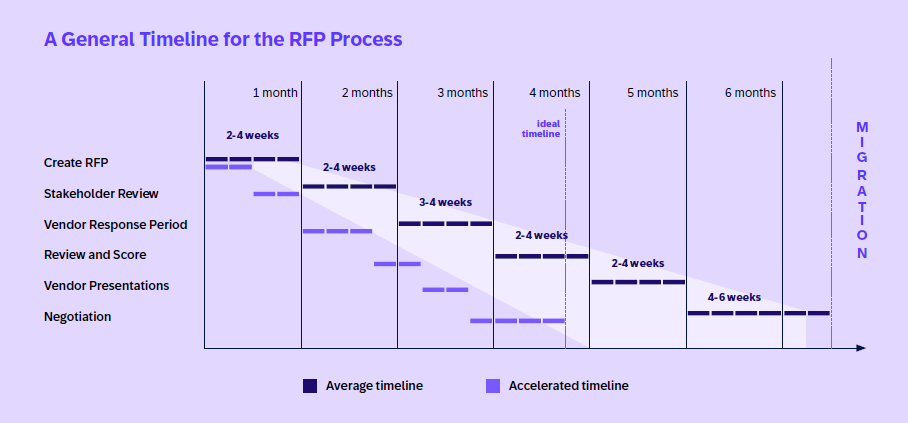
Beyond that, before you start an RFP, be sure that you have time to run one. It’s a time-consuming process, so if possible, start with your preferred go-live date and then work backwards from there. Here’s a general timeline from the Martech RFP Guide:
Do all RFPs have to follow the traditional format?
In the past couple of years, we’ve witnessed an interesting trend in the field: namely reversing or inverting the traditional RFP process. Rather than beginning with a detailed spreadsheet of requirements before moving to a demo phase, organizations first hold short demonstrations, introductory meetings, and high-level pricing discussions.
This demo-first approach allows both sides to evaluate cultural fit, communication style, technical dealbreakers, and business understanding before investing significant time in detailed documentation.
What distinguishes a strong vendor?
After the RFP response comes the evaluation.
The right vendor isn’t just the one who ticks all the functional and technical boxes and the lowest price tag, important as those factors are.
The right vendor is the one that’s willing to become a student of your business and dig into a day in the life of your stakeholders. A well-structured RFP can show you which vendors are willing to do exactly that, and to step outside of their comfort zones when and where you’ll need them to.
Michael had great advice for vendors responding to RFPs:
“I always say that if you ever get an opportunity with a customer, come in as a student of the customer. That means you come in showing that you've learned as much as you can about them before you meet them so that when you have that opportunity to talk to them you could tie-in a little discovery with them.”
Honestly, this is what businesses should be looking for in the RFP responses. Did the vendor go through the motions, or does the vendor truly understand your business needs?
What distinguishes a strong implementation partner?
Similarly, the strongest implementation partners demonstrate an understanding of the customer’s business before tying those requirements to any specific technology.
Here are the green flags to look for in a strong implementation partner. The partner should…
- Arrive prepared
- Ask thoughtful questions
- Share relevant customer stories
- Focus on being true partners rather than rote order-takers
My best tip: If you’re taking the time to involve partners in your RFP process, then challenge them to do some real analysis. Personally, I take challenging questions as a good indicator that the business is truly invested in making the implementation a success.
Final takeaway: It never hurts to ask a question!
At its best, an Enterprise CX RFP is an opportunity to improve communication, surface assumptions, encourage honest dialogue, and make better-informed decisions before implementation begins. Enter the process with eyes open and schedule planned, gather your key data and metrics before kicking off, and build a core set of meaningful questions.
If possible, have deeper discussions as soon as they’re relevant. Don’t be afraid to ask for numbers. And to whatever degree you’re able, shape the process to your organization’s specific priorities. Asking the right questions goes a long way toward getting the best possible answers.
For even more insights from Michael and myself, I’d encourage you to watch our full podcast session, and for more RFP process best practices and sample questions, check out the Martech RFP Guide.
Read this BEFORE you start your RFP!
About the author
Drew Messinger-Michaels has more than 14 years of expertise in digital commerce and marketing strategy. As Head of Sales and Go-To-Market Lead at BASE1 and through leadership and consulting roles at SAP, he has helped enterprises connect customer insights, experience design, and business strategy to drive growth and transformation. Drew is also an accomplished writer, podcaster, and researcher with a background in art history, media theory, and digital culture.