
When was the last time a brand sent you an email, an offer, or a recommendation that actually felt like it knew you?
If you struggled to answer, you’ve put your finger on something we call the Engagement Divide: the gap between what most brands believe they deliver and what customers actually receive. In his recent Engage with SAP Online session, Mark Ritson, Professor and Founder of MiniMBA made a strong case that the gap has been with us for thirty years – and that what’s new is the role AI now plays on both sides of it.
In this article, we’ve pulled together five trends from Mark Ritson’s session, grounded in data from the SAP 2026 Global Engagement Index, that we think will define customer experience in the year ahead. Let’s take a look:
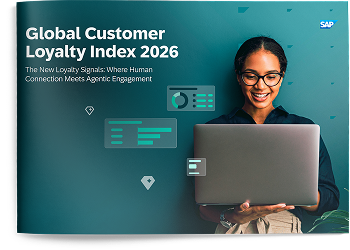
Get Your Copy of the SAP Engagement Index

1. The Engagement Divide Is Wider Than Most Brands Realize
The concept of customer experience isn’t anything new. In fact, as a discipline, it’s about to celebrate its 30th birthday. The gap between what brands believe they deliver and what customers actually receive has been with the discipline from the start.
Bain put the gap at 80% versus 8% twenty years ago. Capgemini measured 75% versus 30% a decade later.
The SAP 2026 Engagement Index finds the same divide today, but it’s widening.
What this trend asks of marketing leaders is honesty about where their brand sits on it, because the internal view of how well a brand engages is rarely the view the customer holds.
Closing the gap starts with measuring what customers actually experience across channels, not what your dashboards say you sent them. That measurement work, more than any campaign, sets the ceiling for engagement in 2026.
2. Customers Now Have AI Too, and They’re Using It to Route Around Weak Service
“AI isn’t exclusively for corporates. It also works on the other side of the divide. And my bet is it will make this bigger.”
Most coverage of AI in customer experience focuses on what brands can do with the technology, but this misses out a critical angle—how customers are using it in private.
Mark Ritson had built his supplement routine with one premium brand, ordering several products a month, and he was happy with those purchases. However, one day in January, he uploaded his medical history to Claude. Within an afternoon, seven of his eight monthly orders had moved elsewhere.
What’s striking is what this supplement brand couldn’t see. The conversation that cost them seven products happened somewhere they had no visibility, no opportunity to respond, and no idea it was taking place.
|
By the Numbers 30% of consumers have already used AI agents that decide and act on their behalf when buying from brands. Source: SAP 2026 Global Engagement Index |
The question worth asking is straightforward: If a customer’s AI looked at your recommendations, your pricing, and your service today, would it tell them to keep buying, or would it present a better alternative?
3. The Most Effective AI in Customer Experience Will Be the Kind Customers Never See
“I think where we will see AI having its impact is in doing predictive segmentation, in real-time personalization, in all of the inventory stuff just being available at the right time, in protecting customers before we lose them. All of it is done by AI. None of it is labeled AI.”
Marketers are spending a lot of energy on the front end of AI: chatbots, AI-generated ads, the badges and banners that announce “AI-powered.” Ritson’s case is that customers are rarely impressed by any of it, and that the real lift on engagement happens further back in the system.
He told a story about an LVMH dinner for the presidents of every house in the group. The seating was clustered behaviorally from a survey. Each table had a custom menu and wine pairing designed by a different Michelin chef and sommelier, briefed against the cluster’s preferences. The presidents called it the best meal of their lives. None of them knew it had been built from the ground up with AI-powered segmentation.
That’s where SAP Engagement Cloud is engineered to do its work. Predictive segmentation, real-time personalization, churn signals, inventory readiness, cross-departmental orchestration. The customer experiences the end result without engaging with AI on the front end.
4. AI Engagement Excellence Will Depend on a Unified Data Foundation
“Every company has too much data, but many of them are drinking from the fire hose. So putting in the irrigation systems that allow us to feed that data in the correct way, I think, has to be the second stage.”
AI ambition is running ahead of the data layer in most organizations. Even brands that see AI as essential to customer engagement struggle to feed it the unified, real-time information it needs.
Ritson’s analogy in the session was irrigation. Every company has data. Few have the irrigation system in place to direct it where it’s needed.
|
By the Numbers 78% of businesses see AI as essential for retaining customers. Fewer than 40% can share their engagement data with a CX or CRM solution. Source: SAP 2026 Global Engagement Index |
The implication for marketing leaders is that the AI roadmap and the data foundation are the same project. SAP Engagement Cloud connects customer signals with operational data from across the SAP ecosystem, so AI works against information that’s unified, current, and trusted before it ever reaches the customer.
5. Engagement Will Need to Become a Company-Wide Discipline
“Marketing on its own does not have enough power, influence, or impact to make this work. Service is a company-wide challenge.”
For most of the last 30 years, customer experience has been organized around departments. Marketing runs campaigns, service handles complaints, and sales closes deals.
However, from the customer’s seat, those boundaries are invisible—they experience your brand as a whole, not at a department level. And if that experience is clunky or disconnected, they’ll churn for one that isn’t.
This changes the job for marketing leaders in 2026, shifting the role from running campaigns to coordinating signals, systems, and actions across departments.
SAP Engagement Cloud is built for that work: it brings marketing, sales, service, and commerce together around a shared customer view, so the customer experience remains consistent regardless of which team last touched it.
Closing the Divide
The Engagement Divide has been with customer experience as a discipline since the discipline was born. What’s changed in 2026 is the size of the prize for closing it. AI on its own won’t get any brand there, but used in the right places, on a unified data foundation, with the whole business pulling in the same direction, it can move the needle further than any single campaign in a generation.
The brands that move first will set the new bar. The full picture of where the divide sits today, country by country and industry by industry, is in the SAP 2026 Global Engagement Index.
Get Your Copy of the SAP Engagement Index
Customer Experience Trends FAQs
The Engagement Divide is the gap between what brands believe they deliver to customers and what customers actually experience. The same gap has been measured by Bain, Capgemini, and now SAP across thirty years of CX research. The SAP 2026 Global Engagement Index finds 78% of businesses believe they deliver a connected customer experience, while only 25% of consumers agree.
How is AI changing customer experience in 2026?
AI is changing customer experience on both sides of the customer relationship. Brands are using AI to power predictive segmentation, real-time personalization, and cross-departmental orchestration. Customers are using AI to compare options, evaluate brand recommendations, and make purchase decisions on their own. The brands winning in 2026 are using AI everywhere customers can’t see it, while letting the customer experience the result.
What’s holding organizations back from improving customer experience?
Customer experience hasn’t improved measurably in thirty years because the discipline has been organized around departments. Marketing runs campaigns. Service handles complaints. Sales closes deals. From the customer’s seat, those boundaries are invisible. Until brands organize engagement as a company-wide discipline with unified data and aligned teams, investment tends to reinforce the existing structure without closing the gap.
What does “back-end AI” mean in customer experience?
Back-end AI refers to AI applications that customers don’t see directly. These include predictive segmentation, real-time personalization, churn signals, inventory readiness, and cross-departmental orchestration. Mark Ritson’s argument is that this is where AI delivers the most engagement value. Front-end AI (chatbots, AI-labeled ads, “AI-powered” badges) often reduces customer trust.
About the author