

The brands growing fastest in 2026 have something in common: they treat customer engagement strategies as a core business discipline, not a marketing afterthought.
And there’s a reason for that urgency. 82% of consumers say a brand has disappointed them, which means the gap between what customers expect and what most organizations deliver is wider than many teams realize. If you’re feeling that pressure, you’re not alone.
This guide walks you through 14 proven customer engagement strategies, each with a clear structure: what it is, how to implement it, a practical example, and the metrics to track. Whether you’re building your engagement program from the ground up or sharpening one that’s already running, these strategies will help you turn engagement into measurable retention and revenue growth. For a deeper dive, see our customer engagement guide.
What Is a Customer Engagement Strategy?
A customer engagement strategy is a structured plan for building ongoing, meaningful relationships with customers across channels and lifecycle stages. It defines how your brand communicates, personalizes experiences, and delivers value at every point in the customer journey, from first interaction through to long-term advocacy.
The building blocks of a truly effective customer engagement strategy include:
- Data unification
- Audience segmentation
- Channel orchestration
- Lifecycle automation
- Personalization
- Measurement
- Continuous optimization
When these elements work together, every interaction builds on the last. When they don’t, customers experience your brand as a series of disconnected campaigns rather than a coherent relationship.
Discover the Trends Driving Customer Engagement in 2026
Benefits of Creating a Customer Engagement Strategy
When customer engagement is done right, the benefits your brand can reap are significant.
Higher retention and lifetime value
Customers who feel understood and valued are more likely to stay with a brand. A structured engagement strategy helps you deliver consistent, relevant interactions across the customer lifecycle, strengthening the relationship over time.
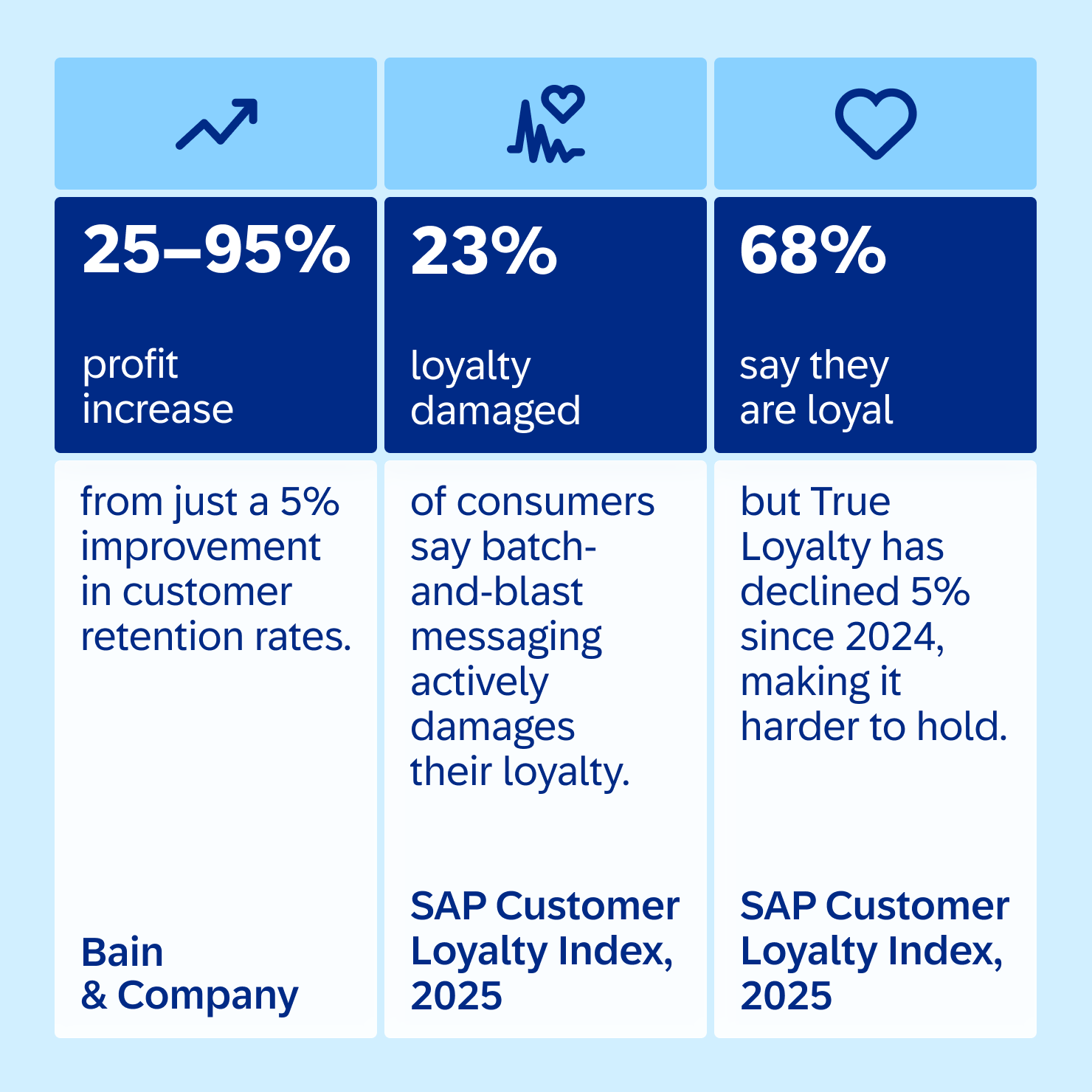
Retention has a direct impact on profitability. Research from Bain & Company shows that increasing retention by just 5% can increase profits by 25% to 95%, largely because retained customers buy more frequently and cost less to serve.
By guiding customers from first purchase to repeat purchase and beyond, a customer lifecycle marketing strategy turns one-time buyers into long-term customers.
More revenue per customer
Repeat purchase rate, AOV, and basket size all improve when your engagement reflects what customers actually want. When interactions are timely, relevant, and tied to where a customer sits in their lifecycle, they spend more per visit and come back more often.
The flipside is equally clear. 23% of consumers say batch-and-blast messaging actively damages their loyalty, which means generic campaigns aren’t just ineffective, they’re actively working against you. Structured engagement drives revenue because it earns the next transaction, not just the next open.
Stronger loyalty and brand differentiation
68% of consumers say they’re loyal to specific brands, but that loyalty is more fragile than it looks. True Loyalty, the kind built on emotional connection rather than incentives, has declined 5% since 2024.
The brands pulling ahead are the ones delivering consistent, personalized experiences that make customers feel understood rather than targeted. When you engage your customers with meaningful content at the right moments, you build trust, and trust is what turns satisfaction into loyalty.
14 Customer Engagement Strategies (With Examples and Metrics)
Ready to see the difference customer engagement will make for your brand? The below strategies will help you build a strong foundation for engagement, loyalty and retention:
1) Build an omnichannel engagement plan
What it is: A single omnichannel customer engagement strategy where every channel draws from the same, unified customer profile and personalizes content accordingly, so touchpoints feel connected rather than fragmented.
How to implement: Start by mapping your highest-value customer journeys end to end and identifying where channels overlap or contradict each other. Then build automations that carry context between touchpoints, so each message reflects what the customer did last, regardless of which channel they used.
Example: A customer abandons a cart on mobile. Rather than receiving a generic promotional email, they get a follow-up that surfaces the exact products they were browsing, with a link back to their saved cart.
Metrics to track:
- Cross-channel conversion rate
- Channel contribution to revenue
2) Segment by behavior and predicted lifecycle stage
What it is: A marketing segmentation strategy built on real-time behavior and predictive modeling rather than static demographic lists, so your targeting reflects what customers are about to do, not just data points like age and location.
How to implement: Build segments based on predicted lifecycle stage (first-time buyer likely to repeat, active customer at risk of churning), estimated future spend, and channel affinity. Then combine these predictive segments with real-time behavioral signals like browse history, cart activity, and email engagement to create audiences that reflect genuine intent.
Example: A lapsed buyer who hasn’t purchased in 90 days receives a win-back offer with personalized product picks. A first-time browser who just viewed three product pages receives a welcome incentive. Same platform, completely different journeys, because the segments reflect different intent.
Metrics to track:
- Segment movement rates (how quickly customers progress or regress through stages)
- Revenue per segment
3) Personalize content and product recommendations across channels
What it is: AI-powered personalization that combines purchase history, browsing behavior, and visual affinity to surface the right content and products for each individual, consistently across email, web, and mobile.
How to implement: Move beyond first-name merge tags. Connect your omnichannel marketing solution to customer behavioral data so product recommendations adapt to each individual in real time. The same logic should power recommendations in email, on your website, and in your app, so the experience feels consistent whichever channel a customer happens to be on. To scale 1:1 personalization with AI, let machine learning handle the matching between products and people.
Example: A customer who browses summer dresses on your site sees relevant recommendations in their next email and on the homepage when they return, not a disconnected experience per channel. Only 29% of shoppers believe brands personalize content to their actual needs, so even getting this right puts you ahead of most.
Metrics to track:
- Revenue attributed to campaigns using personalized content
- Click-through rate on recommendations
- Conversion rate uplift versus non-personalized variants
4) Automate lifecycle journeys with event-driven triggers
What it is: Event-driven automations that respond to what each customer actually does, so every customer enters the right journey at the right moment without requiring manual campaign sends.
How to implement: The highest-impact moment in a customer’s lifecycle is the gap between their first and second purchase. Get them past that threshold and the probability of a third jumps significantly, but most brands leave this to chance with a generic post-purchase email.
You can close this gap with some key lifecycle automations:
- A welcome series that drives account creation and first purchase
- An onboarding flow that nurtures first-time buyers toward that critical second order
- A win-back journey that re-engages customers showing early churn signals before they’re gone for good.
Leading email marketing solutions offer pre-built automation templates for use cases like abandoned browse, post-purchase cross-sell, and win-back give you a tested starting point you can deploy quickly and customize from there.
Example: A first-time buyer receives a post-purchase flow timed to their browsing and engagement signals, not a fixed marketing campaign calendar. Three weeks in, they get a personalized cross-sell recommendation based on what similar buyers purchased next. If they go quiet, an automated win-back triggers before they fully disengage.
Metrics to track:
- First to second purchase conversion rate
- Reactivation rate
- Automation-attributed revenue
Drive Growth on AutoPilot with The Omnichannel Guide to Retention & Loyalty

5) Use trigger-based messaging with send time optimization
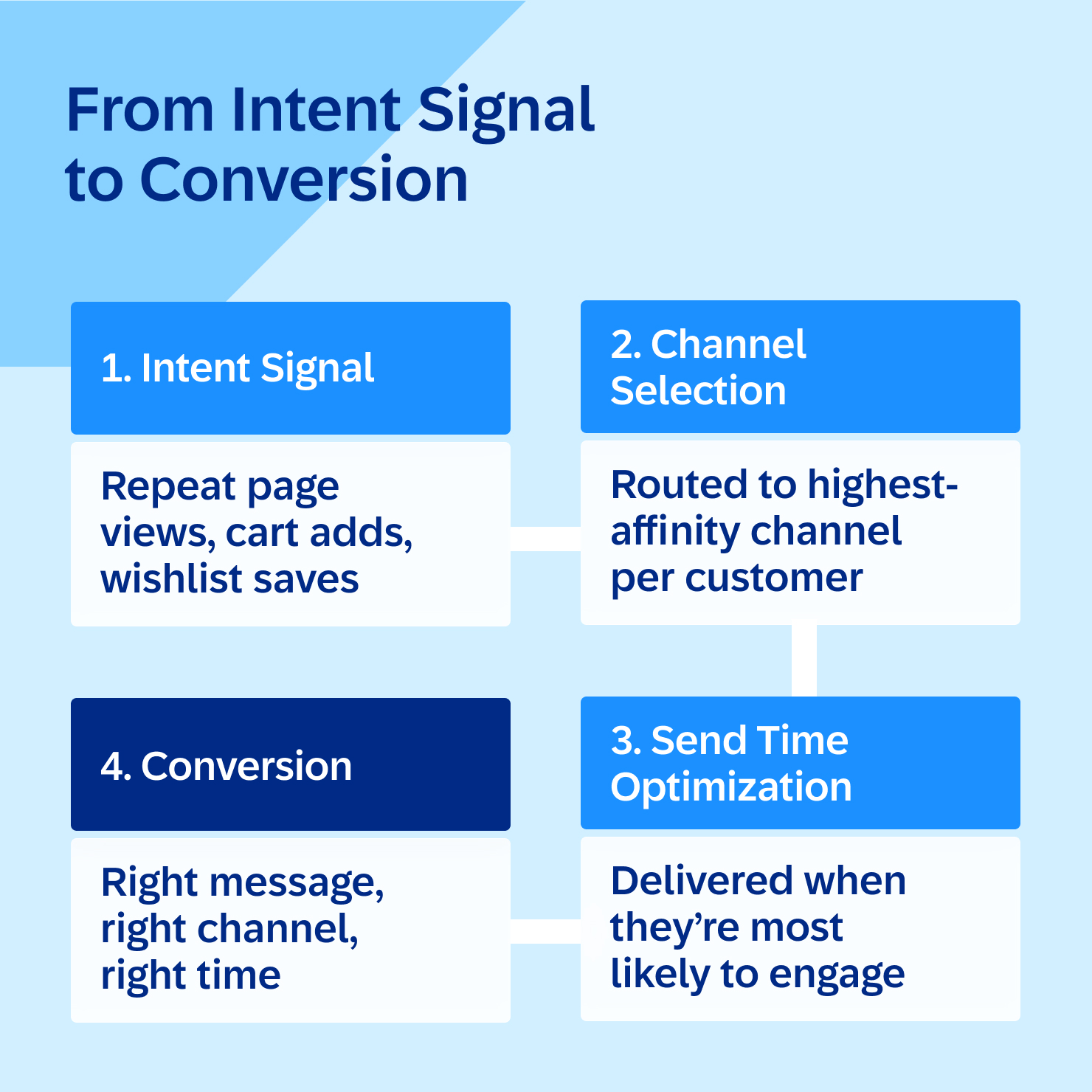
What it is: Messages triggered by real-time intent signals, delivered on the channel and at the time each customer is most likely to engage.
How to implement: A customer visits the same product page three times in a week but doesn’t buy. The right message at that moment can tip the balance and nudge them from hesitation to conversion:
- Configure triggers for abandoned browse, price drops, and back-in-stock events, and route each message to the channel the customer is most likely to respond on based on their historical behavior.
- Layer in send time optimization, which uses past engagement data to deliver each message when that specific recipient is most likely to open it, and you compound the effect.
Example: A shopper adds a pair of trainers to their cart but doesn’t check out. Two hours later they receive a push notification (their most-engaged channel) with the product image and a direct link back to their cart, delivered at the time of day they typically open notifications.
Metrics to track:
- Trigger response rate
- Time from trigger to conversion
- Incremental revenue from triggered flows versus batch sends
6) Design engagement around key moments
What it is: Planned engagement around predictable moments like seasonal events, product anniversaries, birthdays, and purchase milestones, giving you natural opportunities to show customers you’re paying attention.
How to implement: Not every interaction needs to be triggered by behavior. Some of the strongest engagement moments are entirely predictable, and that makes them easier to plan and harder to excuse missing. Map the key calendar and lifecycle milestones for your business and build automated campaigns around each one.
Examples:
- A birthday offer delivered via email and redeemable through a mobile wallet pass connects your online and offline experience in a way the customer actually notices.
- A geo-targeted push notification when a loyalty member walks near a store turns a digital relationship into a physical visit.
- A one-year anniversary message that references their first purchase and recommends something complementary feels personal because it is.
Metrics to track:
- Milestone campaign engagement rate
- Conversion rate per milestone type
- Revenue per milestone touchpoint
7) Strengthen loyalty programs with cross-channel engagement
What it is: Loyalty programs that go beyond enrollment and static point collection by embedding loyalty into your cross-channel engagement, so members stay active and progress through tiers.
How to implement: Consumers belong to an average of 16.6 loyalty programs, but only 55% of members are active. Enrollment is the easy part. The challenge is keeping members engaged beyond the sign-up incentive. Use automation to nudge members when they’re close to the next tier, remind them when points are about to expire, and surface personalized product recommendations based on their loyalty status and purchase history. From here, tie loyalty data back into your cross-channel reporting so you can compare revenue and retention from loyalty members versus non-members by lifecycle stage.
Example: A loyalty member is 50 points away from Gold status. They receive an automated email highlighting two products that would push them over the threshold, with a mobile wallet voucher ready for their next in-store visit. The result: a purchase that feels rewarding for the customer and incremental for you.
Metrics to track:
- Active member rate
- Redemption rate
- Loyalty program revenue contribution
55% are active
|
Enrollment is easy.Engagement is the challenge.Consumers sign up for loyalty programs readily, but nearly half go dormant after enrollment. The brands seeing real impact focus on program depth: tier progression, points expiry nudges, and personalized rewards that keep members actively engaged. The gap between enrolled and active is where loyalty revenue hides. |
8) Build referral and advocacy loops
What it is: A structured referral program that turns your most engaged customers into an acquisition channel, at a fraction of the cost of paid media.
How to implement: Your happiest customers are already recommending you informally. A referral program formalizes that with clear, compelling incentives for both the referrer and the referred. The timing matters: promote referrals at high-engagement moments like post-purchase or after a positive support interaction, when advocacy intent is at its peak.
Example: A customer completes their third purchase and receives an email inviting them to share a personal referral link with friends. The referrer gets loyalty points; the friend gets a first-order discount. Both feel like they’re getting a good deal.
Metrics to track:
- Referral conversion rate
- Referred customer lifetime value versus acquired customers
- Program participation rate
9) Add two-way conversational engagement
What it is: Real-time, two-way messaging through channels like WhatsApp, SMS, and live chat, where customers can respond, ask questions, and interact with your brand directly.
How to implement: Configure keyword-triggered automation workflows within conversational channels, so a customer who replies to a WhatsApp message with a specific keyword is automatically enrolled in a campaign, routed to a support flow, or served a personalized recommendation, all without manual intervention. When these conversations are connected to customer data, they become contextual and personal rather than generic.
Example: A customer receives a WhatsApp message about a new collection. They reply “SHOP” and instantly receive a curated product selection based on their purchase history and preferences, with a one-tap link to buy.
Metrics to track:
- Response rate
- Conversation resolution rate
- Downstream conversion from conversational touchpoints
10) Use web personalization and interactive content
What it is: On-site content that adapts to who’s visiting, using behavioral data and CRM segments to personalize the experience in real time, combined with interactive elements that capture first-party data.
How to implement: Personalize your website with overlays for first-time visitors to capture email opt-ins, embedded product recommendations for returning browsers based on their last session, and web push notifications to bring back inactive users with personalized offers delivered straight to their browser. Add quizzes, polls, and product finders to generate first-party data you can feed directly into segmentation and future personalization.
Example: A skincare brand uses a quiz to recommend a personalized routine. In 60 seconds, they learn more about that customer than a month of passive tracking would reveal, and the data feeds directly into email and paid social retargeting campaigns.
Metrics to track:
- Web conversion rate by visitor type (new versus returning)
- Data capture rate from interactive content
- Click-through rate from personalized web recommendations
Want to build lasting customer relationships? Read our guide on retention marketing tactics.
11) Invest in proactive support
What it is: Anticipating customer needs before they have to ask, reducing friction and building trust through timely, automated communication.
How to implement: 75% of consumers are put off by disorganized brands that pass them between multiple teams to solve a single problem. That’s frustration you can preempt. Build automated proactive touchpoints like order status updates, delivery alerts via push or SMS, and preemptive troubleshooting triggered by purchase events. These reduce inbound support volume and show customers you’re on top of things before they have to chase you. Connect your contact center to your omnichannel marketing platform, so when customers do need to reach out, the representative knows who they are, what products they like, and how to best serve them.
Example: A customer’s order is delayed. Instead of waiting for them to contact support, an automated SMS goes out explaining the delay, providing an updated delivery estimate, and offering a direct link to track the shipment. The customer feels informed rather than ignored.
Metrics to track:
- Support ticket volume (should decrease)
- First-contact resolution rate
- Customer satisfaction scores
12) Gather feedback and close the loop
What it is: A feedback system that collects customer input and, critically, acts on it, so customers see that their voice actually drives change.
How to implement: Post-purchase surveys, NPS checks, and in-app ratings all generate useful signals, but collecting feedback without acting on it can actually damage trust. 44% of consumers say brand interactions feel less personal and more generic than before, which suggests many brands are gathering data without using it to improve. When you close the loop by telling customers what changed as a result of their input, you demonstrate that their voice matters.
Example: Many customers flag that delivery packaging is excessive. You make the change, then send a follow-up email to everyone who raised the issue, thanking them and explaining the improvement. These customers feel heard, and engagement with your next campaign from that cohort spikes as a result.
Metrics to track:
- Feedback response rate
- Resolution rate on negative feedback
- Engagement trends among customers who have provided feedback
13) Experiment systematically (A/B testing and holdouts)
What it is: A testing framework that proves what’s actually working, using A/B tests for optimization and holdout groups to measure true incrementality.
How to implement: A/B testing subject lines or CTA placement is a good start, but holdout testing is where you prove real value:
Withhold a campaign from a control group and measure the revenue difference. Use audience reporting to compare custom segments side by side:
- How does your high-value segment perform differently from your re-engagement cohort?
- What’s the revenue gap between loyalty members and non-members?
These comparisons surface the insights that drive your next optimization.
Example: You run a win-back campaign and it shows strong revenue in the campaign report. But when you compare against a holdout group, you discover that 60% of those purchases would have happened anyway. The holdout proves the campaign’s true incremental value, and that reshapes how you allocate budget going forward.
Metrics to track:
- Incremental lift
- Statistical significance
- Revenue impact of winning variants at scale
Unlock in-depth reporting with our guide to customer engagement analytics.
14) Measure engagement with revenue-linked reporting
What it is: A reporting framework that connects marketing activity to business outcomes, so you can see which strategies are driving growth rather than just generating clicks.
How to implement: Build a reporting structure that ties your strategies to revenue contribution. Layer in customer lifecycle analytics to visualize revenue by lifecycle stage and identify where customers are dropping off or accelerating. Use revenue attribution with configurable lookback windows and multi-touch models to understand how each touchpoint contributes to a conversion.
What to review and when:
- Weekly: leading indicators (open rate, click rate)
- Monthly: behavioral signals (purchase frequency, lifecycle stage progression)
- Quarterly: key customer engagement metrics (retention rate, customer lifetime value, revenue per customer)
Common Customer Engagement Mistakes to Avoid
|
✗ DON’T |
✓ DO |
|
Blast the whole database Same campaign, same frequency, same content to every customer regardless of engagement level or lifecycle stage. |
Segment and suppress Tie frequency to engagement level and predicted channel propensity. Your most active customers earn more messages; your quietest get fewer. |
|
Personalize on incomplete data Email recs that ignore in-store purchases. Web content that doesn’t reflect mobile browsing. Channels working from different views of the customer. |
Unify data across channels Every touchpoint draws from the same customer profile. Online, offline, email, mobile, service — one view, one experience. |
|
Report without holdouts Campaign shows strong revenue, but you can’t prove how much was incremental. You’re optimizing for correlation, not causation. |
Prove incrementality Withhold campaigns from control groups and measure the revenue difference. Use revenue attribution with lookback windows to see true impact. |
Turn Customer Engagement Into Long-Term Growth
Customer engagement strategies work best when they’re treated as an ongoing discipline, not a one-time project. The 14 strategies in this guide span the full lifecycle, from acquisition through advocacy, and they compound over time as your data deepens and your automations become more sophisticated.
The brands closing the Engagement Divide are the ones that connect customer data across channels, personalize in real time, and measure what matters. If you’re ready to put these strategies into practice, explore SAP Engagement Cloud as your customer engagement solution.
Customer Engagement Strategies FAQs
Still got questions about customer engagement? Browse these FAQs to find your answer:
What is a customer engagement strategy?
A customer engagement strategy is a structured plan for building and maintaining meaningful relationships with customers across every channel and lifecycle stage. It defines how your brand communicates, personalizes, and delivers value throughout the customer journey, with the goal of driving retention, loyalty, and revenue growth.
What are the four types of engagement?
The four types of customer engagement are emotional (the feelings and trust a customer has toward your brand), contextual (the relevance and timeliness of your interactions), convenient (how easy you make it for customers to interact with you), and social (community, advocacy, and peer-driven interactions). Effective customer engagement strategies address all four.
What are the four pillars of customer engagement?
The four pillars are data (a unified, accurate view of each customer across marketing, sales, service, and commerce), personalization (tailoring content and offers to individual needs and behaviors using AI), orchestration (coordinating interactions across channels and lifecycle stages through event-driven automation), and measurement (tracking revenue-linked KPIs to understand what’s working and what’s driving growth).
How do you measure customer engagement?
Measure engagement using a layered reporting framework: leading indicators like open rate and click rate, behavioral signals like purchase frequency and lifecycle stage progression, and outcome metrics like retention rate, customer lifetime value, and revenue per customer. Revenue attribution with configurable lookback windows helps you connect specific campaigns and channels to actual conversions. No single metric captures engagement, so use a combination and review at different cadences.
What are examples of customer engagement?
Examples include a personalized welcome series that drives app downloads and first purchase, an abandoned browse automation that follows up across email and web push, a loyalty program that triggers tier-upgrade nudges and points expiry reminders, a birthday offer redeemable via mobile wallet in store, AI-powered product recommendations that adapt across email, web, and mobile based on visual affinity and purchase history, and a WhatsApp keyword-triggered workflow that enrolls a customer into a campaign automatically. Each of these turns a routine interaction into a relationship-building moment.
Discover the Trends Driving Customer Engagement in 2026
About the author
Ellie Quacquarelli is a Strategic Consultant & Team Lead at SAP Engagement Cloud in London. With 10+ years of experience, she helps businesses develop customer-centric CRM strategies and measure ROI in an era of evolving email privacy. Passionate about enhancing customer experiences, Ellie specializes in driving meaningful audience connections across marketing channels, working closely with brands to optimize engagement and long-term retention.