
|
Key Takeaways
|
|
Most ecommerce challenges start with a reasonable campaign decision made without the order, stock and service record. Put that record in front of the person building the campaign before anything is sent. Connect order and returns data before you scale AI. A recommendation model trained without order and returns data can put a returned product back in front of the customer who sent it. Test your real-time triggers and inventory rules before peak season. At Black Friday volume, a promotion built without live stock levels reaches the whole segment before anyone notices that the product it features is down to two sizes. |
A Black Friday email goes out with a discount on a womenswear retailer’s whole winter boot range, and by lunchtime the service team is reading the replies. Some come from customers who bought the same boots at full price the week before, and some from a customer still waiting on a replacement for a damaged pair. The boot the whole email is built around, the one on the hero banner, is down to its last two sizes.
Most ecommerce challenges start the same way: the marketing team makes a reasonable decision without the order, stock or service record in front of them. Inside a lean team stretched to capacity, nobody has time to check every send against three other systems by hand.
What’s changed is the speed. Shoppers compare prices in seconds, some now hand the comparison to an AI assistant, and peak season compresses a month of decisions into a frenzied weekend.
The six ecommerce challenges I’m going to give solutions for all trace back to that missing record, so the good news is that once you start fixing that, a lot of the downstream challenges become less challenging. Let’s get into it.
What are the biggest ecommerce challenges facing marketers today?
Let’s talk about the top challenges e-commerce marketers face, and how anyone who’s ever nervously watched their conversion rate (so, all of us), can solve them.
The biggest ecommerce challenges for marketing teams sit where customer data meets the rest of the business:
1. Customer and ecommerce data is fragmented across systems
The data exists, but it’s duplicated, delayed or locked in formats the team can’t use.
2. Customer intent moves faster than the campaign schedule:
Shoppers signal what they want in the moment, and a campaign on a nightly or weekly schedule answers days later.
3. Marketing, inventory and fulfillment aren’t connected:
Promotions, recommendations and sends go out without reflecting stock, orders or returns.
4. AI runs on incomplete customer records:
Recommendations leave out orders and returns, and shoppers now use AI of their own to compare you.
5. The same customer looks like three different people:
A subscriber, an app user and a buyer, with nothing linking the three records.
6. Disengagement is spotted too late to do anything but discount:
A missed reorder shows up weeks before anyone sends a win-back offer.
The first three challenges around data, real-time intent and inventory are about how marketing teams treat the customer record itself, and the latter three – AI, cross-channel recognition and retention – are about how those gaps show up during campaigns.

Challenge 1: Fragmented customer and ecommerce data
Every team knows this one: that feeling when you have multiple records of a single customer. Take one skincare brand: three records of Helen Walker – one from a guest checkout, one from the app, one from a loyalty sign-up at a store counter. In a single month Helen receives three welcome series, then a “first order” discount the week after her fourth order.
She replies to that one: “This is my fourth order. Do you not know who I am?” Nope. Not in any way that matters to her.
The team can’t personalize for a customer they’re counting three times, and no one on the team can say which of the three Helens the next campaign will pick up.
Most ecommerce brands have more data than they can use. SAP’s Global Engagement Index 2026 found that 66% of brands still rely on third-party data, 60% suffer from dark data, collected but unused, and 55% agree their data is too unstructured to use effectively.
The problem shows up in a few recognizable forms:
- Duplicate profiles: one customer, several records, none of them complete.
- Disconnected data: browsing and email engagement in one system, purchases and returns in another.
- Delayed data: a nightly sync that leaves this morning’s order out of this morning’s segment.
- Unstructured information: service notes, reviews and product data the team can’t query.
- Consent and preferences: permissions held apart from the profile, so a send can’t check them.
Each of these is a reason a segment looks right in the campaign builder and reaches the wrong people.
The solution: Create a unified, actionable customer profile
Start by deciding which record wins when two disagree, and merge on that rule before you build another segment. Then connect two kinds of data to the same profile:
- Customer data: browsing, purchase history, loyalty status, preferences and engagement.
- Operational data: inventory, pricing, order status, fulfillment and returns.
With connected customer data that’s analyzed across your CX and operational systems, including your ERP, our dear Helen, the frustrated skincare customer, gets just one welcome series, and her fourth order counts as her fourth.
If your first-party data strategy needs work before any of this, start with what first-party data is and how to collect it.
Challenge 2: Slow response to customer intent
A shopper views the same espresso machine five times on a Sunday evening, adds the matte black version to her cart just before 11pm and closes the tab. The homeware retailer’s browse-abandonment email goes out on Tuesday morning, by which point she’s bought the machine elsewhere and it’s already on her kitchen counter.
That browse-abandonment signal is GOLD to the homeware retailer for only a few hours, and the trigger runs on a two-day schedule.
In SAP’s Global Engagement Index 2026, 54% of brands say they can’t access and use real-time data. That gap costs more at peak, and SAP’s AI-driven holiday shopper strategies playbook argues that “your campaign plan must shift from predictive planning to adaptive.” Its advice for big shopping events is to “Tighten that 3- or 4-hour cart abandonment trigger down to 15–20 minutes”. On that timing, the espresso-machine shopper hears from the retailer before she’s closed her laptop on Sunday night.
The signals worth acting on in the moment:
- Repeat product views and time on page
- Category exploration
- Add-to-cart and checkout initiation
- Price sensitivity, such as repeat visits to a sale page
- Declining engagement
- Purchase completion
Purchase completion is on the list because it should stop things. A shopper who has just bought shouldn’t get the abandonment email for the same item an hour later.
The solution: Use event-driven journeys and real-time personalization
Real-time event triggers start a journey the moment the customer acts. With marketing automation built on behavior-driven journeys, you can set up:
- Browse and cart abandonment triggers timed to the signal
- Dynamic segments that update as behavior changes
- Next-best actions and predictive product recommendations
- Dynamic offers for price-sensitive shoppers
- Suppression the moment a customer converts
For the peak-season version of this setup, the holiday marketing strategies guide covers timing and sequencing week by week.
Challenge 3: Marketing disconnected from inventory and fulfillment
Let’s return to that womenswear boot email for a second. When the team pieces it together afterwards, merchandising has known since Wednesday that the hero boot is down to its last two sizes, the service team knows who’s waiting on a replacement, and the order records show who bought at full price the week before. None of that reaches the segment or the marketing team who built it, because none of it is connected.
Personalization built on a partial record is what turns a relevant offer into an insulting one. The SAP and Foundry CIO research reported in The ERP Advantage puts a number on it: 74% of brands say “inventory visibility and allocation is the greatest CX execution slow down.”
Without operational data, campaigns end up:
- Promoting products that are out of stock
- Recommending sizes that are no longer available
- Discounting high-demand products that would sell at full price
- Advertising products held up by fulfillment delays
- Sending promotional emails straight after a return or a service problem
Peak season makes every one of these worse, because stock, pricing and order volumes change by the hour.
The solution: Connect customer and operational signals
The ERP Advantage names five operational signals that change what a campaign should do. Each one maps to a rule you can add before peak:
- Purchase truth: completed and returned orders. Stop promoting a product to someone who just bought it, and never retarget a product they sent back.
- Inventory reality: live stock and availability. Pause or swap a promotion when the featured item runs low.
- Fulfillment experience: order status and delivery timing. Hold promotional sends while an order is late or a service case is open.
- Business optimization: margin and overstock. Put high-margin or overstocked items forward instead of whatever is top of the merchandising list.
- Lifecycle growth: what was bought, when, and what’s needed next. Time replenishment reminders to the product’s real use.
Some of this is available out of the box. Product Catalog Updates in SAP Engagement Cloud trigger campaigns automatically when prices drop or items come back in stock, so the customer who missed the last pair in her size hears about it the day it’s back.
Challenge 4: AI built on incomplete data
A recommendation pilot’s first week looks great on clicks. Then someone opens the top recommendation for one of the brand’s most loyal customers: the toaster she sent back two weeks earlier because it scorched one side of every slice. The return is logged in the order system, and the model has only her browsing and purchase history to work from.
Without the returns data, her record says happy toaster owner.
AI adoption stalls on the same data foundations. In the Global Engagement Index, 33% of enterprises say cybersecurity and privacy risks limit their ability to scale AI, and 32% struggle with data quality and availability, as well as integration with existing systems.
Ecommerce AI now covers:
- Predictive segmentation
- Product recommendations
- Generative content
- Real-time decisioning and journey optimization
- AI assistants and agentic AI
Each of them depends on the customer profile underneath it.
The solution: Build AI on connected data and clear use cases
Start from a customer problem you already know. Most teams already run the journeys where AI pays back first – abandoned browse, post-purchase cross-sell and upsell, and win-back – and a good AI marketing solution comes with ready-to-use tactics for each, aligned to acquisition, conversion or retention.
In SAP Engagement Cloud, your team uses AI segments in those tactics to define the audience, with each channel picked by the customer’s likelihood to engage there. For a coffee retailer, that could mean asking for a segment of customers who’ve bought the same beans at full price three times in a row and would pay less on a subscription.
Your team sets the goal and approves the offer, and AI builds the segment. For more on where AI fits, see these AI marketing use cases.
Preparing for agentic commerce
The customer side of AI is moving too. SAP’s holiday shopper strategies playbook reports that 21% of consumers already use AI systems to help make decisions and purchases, rising to 43% among Gen Z.
An AI assistant comparing your product with three others works from your stock, price and delivery data exactly as published. As the playbook puts it, “Agent-driven shopping will expose organizational weaknesses, such as fragmented systems, delayed data, and siloed governance.” Your stock and order data now has two audiences: your customers and the software shopping for them.
Success story: How Pour Moi grew their active customer base by 16%
Lingerie retailer Pour Moi needed to scale personalized customer engagement with a lean team. Their key objectives were to re-engage existing customers, nurture VIPs, and attract new customers through an integrated omnichannel approach.
Pour Moi implemented SAP Engagement Cloud, with a focus on first-party data across digital touchpoints. The solution enabled:
- Advanced audience segmentation for targeted re-engagement and win-back programs
- VIP customer identification and look-alike targeting
- Personalized email campaigns with dynamic content control
- Automated birthday campaigns through Web Forms integration
Once the campaigns were live, Pour Moi’s customer database grew to 1.2 million customers, with opt-ins increasing from 650,000 to 800,000. And in the first month, they saw a 16% growth in active customers.
“One reason that we wanted to use the ad and web channel elements is because we can be cohesive with the marketing message, and can target different types of audiences. Not only can we retarget in that way, but we can also find and create a segment of our top VIPs.”
Challenge 5: Customer recognition across channels
A customer signs up for a furniture retailer’s newsletter through the pop-up, and the welcome email offers her a new-subscriber discount on a sofa: the model she bought from them three weeks ago, still wrapped in plastic in her hallway because the delivery team hasn’t been back to assemble it.
On the website she’s new, in the order system she’s a customer, and nothing links the two.
Consistency across email, SMS, web, social and stores depends on recognizing the same person in each.
The solution: Orchestrate omnichannel customer journeys
Customer journey orchestration works when teams have:
- One view of the customer: data from every touchpoint joined into a single profile, so the three Helens become one.
- Real-time signals: journeys triggered by what the customer did today.
- AI-powered personalization: content and product recommendations chosen for each customer.
- Automation across channels: email, SMS, social and web in the same journey.
- Custom triggers: journeys that start on specific customer behaviors or business events.
With omnichannel marketing run from one solution, you can put owned, lower-cost channels first – email, then SMS or web – and move to paid ads only for customers who haven’t engaged. This way, when a customer responds in one channel, the next message in every other channel reflects it, so nobody gets the same offer three ways.

Challenge 6: Late detection of customer disengagement
A customer has ordered the same large bag of dog food from a pet food brand every five weeks for a year. In week six there’s no order, and nothing happens. Her first message from the brand is a “we miss you” discount in week 16, and she answers it: sorry, but she’s been on a subscription with another brand for two months.
Face, meet palm. The missed reorder in week six is the signal.
Retention gets harder when customers can compare alternatives in seconds, when generic messages get ignored and when discounting eats the margin a returning customer was supposed to bring. In the Global Engagement Index, 58% of consumers think most marketing emails they receive aren’t relevant, and 37% believe brands don’t personalize content to their needs.
Disconnected experiences add friction on top, and they do here: her last bag arrived four days late, and nobody from the brand followed up.
The solution: Identify and respond to disengagement earlier
For a customer who reorders on a cycle, the purchase record already holds the trigger. The dog food customer orders every five weeks, so a reminder in week five and a check-in in week six – with an apology for that late bag first – would reach her ten weeks before the discount does. Set the trigger from each customer’s own reorder interval, and keep the discount for the customers a reminder doesn’t bring back.
For customers without a buying cycle, predictions of what each customer is likely to do next, including churning, give you the same early warning.
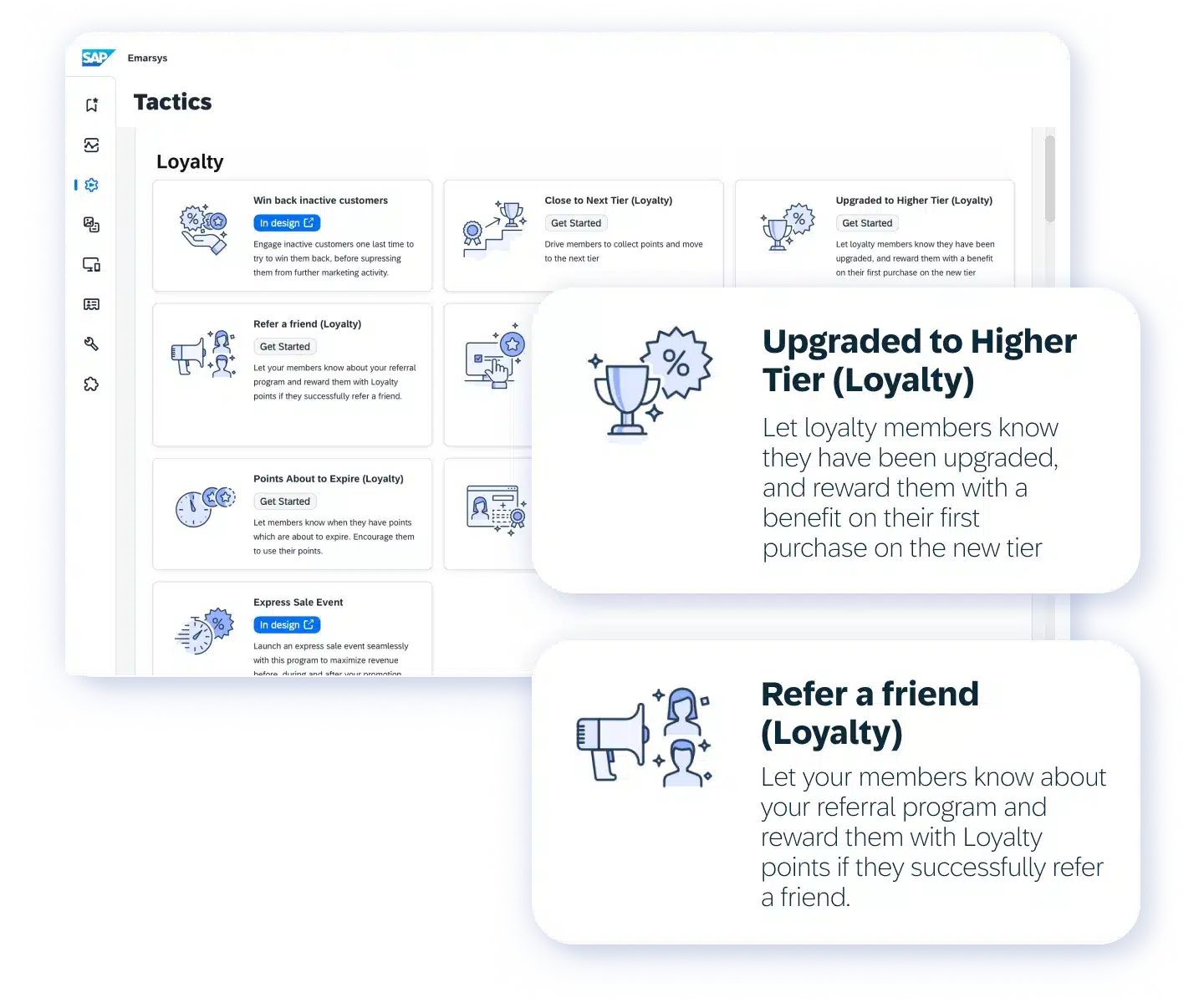
SAP Engagement Cloud’s loyalty capabilities add drag-and-drop loyalty content based on your connected data – tier status, points, offers and rewards – to the same journeys. For the full win-back playbook, see this guide to re-engagement campaigns.
Send the boot email again
Send that womenswear boot email again, this time with the record. The full-price buyers get early access instead of a discount, the customer waiting on a replacement gets a delivery update, and the banner features a boot you can still ship in every size.
Start where the boot email goes wrong. Before your first peak send goes out, check one promotion against three records: who bought the featured product in the last 30 days, which sizes can still ship, and who has an open return or service case. A lean team can run this check with the people it already has. Whatever that check turns up is the first connection to build.
SAP Engagement Cloud connects customer insight with operational signals – orders, inventory, fulfillment and service – so every recommendation, offer and send reflects what’s true for that customer right now.
Frequently Asked Questions about Ecommerce Challenges
For marketing teams, the six main ecommerce challenges are:
- Customer and ecommerce data is fragmented across systems
- Customer intent moves faster than the campaign schedule
- Marketing, inventory and fulfillment aren't connected
- AI runs on incomplete customer records
- The same customer looks like three different people
- Disengagement is spotted too late to do anything but discount
Most trace back to one gap: offers and sends decided without the order, stock and service record in front of the person deciding.
Start with the data the other fixes depend on. Merge duplicate customer profiles, connect operational data such as inventory, order status and returns to your customer data, and trigger journeys on real-time events. Then add AI one use case at a time, starting with journeys you already run, such as abandoned browse, post-purchase and win-back.
The most common are promoting out-of-stock products, recommending unavailable sizes, discounting items that would sell at full price and advertising products held up by fulfillment delays. Each happens when campaign decisions don't reflect live stock and order data, and 74% of brands say "inventory visibility and allocation is the greatest CX execution slow down".
Consumer products brands selling direct face the same six challenges, and replenishment timing adds one of their own. Products like pet food, coffee or water filters run out on a schedule the purchase history already shows. The challenge is connecting that purchase record to your journeys, so the reorder reminder arrives a few days before the customer runs out.
About the author
Mikkel Tophoj has worked in digital marketing for 11 years with a focus on strategy. As a Services Consultant at SAP Engagement Cloud and previous roles at agencies, he has helped Fortune 1000 brands across all industry verticals connect their data to create dream customer experiences and drive measurable results. Keeping up with innovation, he is focusing on how AI can amplify marketing efforts. He holds a BS in business administration with an emphasis in marketing and a minor in economics from CU Denver.