
Table of Contents
1. Default loyalty is losing its disguise
2. 89% say AI influences their loyalty – but read the fine print
3. Your supplier relationship is now under continuous review
4. The trust hierarchy buyers actually care about
5. What B2B marketers should do now
6. What this means for suppliers
There’s a debate happening inside every B2B buying organization right now, and it sounds a lot like the one happening inside every selling organization too.
On one side: AI agents are going to make procurement faster, smarter, and more objective. They’ll surface better alternatives, compress evaluation cycles, and eliminate the friction that kept buyers locked into suppliers they’d outgrown.
On the other side: if AI can evaluate every supplier in seconds, surely loyalty is about to nosedive?
But here’s what SAP’s B2B Buyer Loyalty Index 2026 – a study of 2,295 enterprise tech decision-makers across the US, UK, Germany, and Hong Kong – actually found: loyalty isn’t declining. It’s growing.
The share of B2B buyers who consider themselves loyal rose from 71% in 2025 to 77% this year. Those who say they have a favorite supplier they trust went from 72% to 75%.
Interestingly though, 69% of those same buyers say they’d switch suppliers if an AI agent found a better option.
Simply put, this means that though AI is making it easier for buyers to re-evaluate their suppliers, the fact that loyalty is growing anyway suggests the buyers who are staying are increasingly there by choice.
Default loyalty is losing its disguise
For years, a significant portion of B2B “loyalty” has been a byproduct of complexity. Migrating a deeply integrated tech stack. Retraining a team on new software takes months. Procurement cycles are slow enough that the classic “if it ain’t broke” mentality sees suppliers outstaying their welcome.
The BLI tracks this as Default Loyalty – buyers who stay because switching is too complex or expensive. It’s still the single largest loyalty type at 64%. But it dropped four points from 68% last year. Adaptive Loyalty – loyalty driven by market buzz and trend-chasing – fell too, from 24% to 20%.
What grew? The types that require actual earning, aka:
- Strategic Loyalty: built on trust, shared goals, and mutual value rose from 35% to 37%.
- Legacy Loyalty: grounded in long-standing relationships and institutional investment saw the biggest jump, from 21% to 27%.
The direction is clear. As AI gives buyers full visibility into alternatives, the loyalty types built on barriers and hype are weakening while loyalty types built on substance are doing the opposite.
Buyers aren’t becoming less loyal, they’re becoming more discerning about who deserves it.
89% say AI influences their loyalty – but read the fine print
The BLI’s most striking headline number is that 89% of B2B buyers say a supplier’s use of AI positively influences their loyalty. That’s extraordinarily high, and it would be easy to read it as proof that AI capability is now the primary driver of supplier preference.
It isn’t – or at least, not on its own.
When buyers are asked what actually builds loyalty, the top answers are exactly what you’d expect to see:
- High-quality products: 38%
- Consistent experiences: 32%
- Strong reputation: 31%
- System compatibility: 30%
- Clear pricing and payment terms: 29%
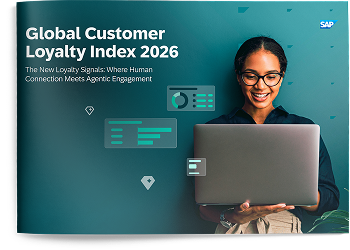
We saw exactly the same trend in our Global Customer Loyalty Index 2026 – while we’re busy discussing agents and autonomous procurement, buyers overwhelmingly care about whether the product is reliable and the experience is consistent.
AI matters because it can make those fundamentals visible and verifiable at scale – not because it replaces them.
The BLI doesn’t prove that AI capability alone creates loyalty. It suggests that AI amplifies whatever’s already there. The good news here is that if your product is strong and your experience is consistent, AI agents will surface that to buyers faster.
The bad news however is that the opposite is also true, in the age of AI, negative customer reviews can be surfaced and aggregated just as quickly.
Your supplier relationship is now under continuous review
Here’s a number that should change how you think about retention: the average duration of a positive B2B supplier relationship is 4.5 years. That sounds stable, right? Four-and-a-half years is a lifetime.
But the evaluation model underneath that number is shifting. The BLI found that:
- 88% of buyers trust AI-generated supplier recommendations.
- 71% already use AI to research or shortlist vendors.
- 30% use independent AI systems as their primary source for researching suppliers this year – not analyst reports, not peer referrals, not your website. AI.
The old model gave you a window. You got evaluated at contract renewal, maybe during a competitive bake-off once a year. Between those moments, incumbency protected you.
The new model is closer to a continuous background audit. AI agents can compare pricing, evaluate service quality, check compliance records, and flag alternatives – all without the buyer picking up the phone.
That matters for how we think about engagement. When 67% of buyers say they feel more loyalty toward a supplier’s AI agent than toward a traditional account relationship, they’re not saying relationships don’t matter, they’re saying: “Consistent, data-backed performance earns more trust than a quarterly business review and a nice dinner.”
That’s an uncomfortable finding for anyone whose retention strategy leans heavily on relationships rather than results. But it’s worth noting what this actually demands of suppliers – most organizations have product data in one system, service history in another, pricing in a third, and marketing in a fourth.
When a buyer’s AI agent evaluates you, it’s assembling a picture from whatever fragments are publicly consistent. Problem is, for most suppliers, those fragments don’t agree with each other.
The trust hierarchy buyers actually care about
As Tom Goodwin, AI and Digital Transformation author and industry thought leader, puts it in the report: “As AI takes on a greater role in purchasing decisions, brands don’t become less important. They become more important. Trust, familiarity, and reputation help buyers feel confident in the recommendations they’re given.”
That confidence has conditions. When the BLI asked buyers what they want from AI, the answers clustered around three themes: human control, transparency, and efficiency:
- 34% require a human fallback when AI handles purchasing tasks
- 29% expect the final say on decisions
- 27% want the ability to reverse AI decisions
- 27% prioritize data transparency
- 26% expect to review AI outputs before action is taken
And when loyalty breaks, the causes are operational, not abstract:
- Disjointed experiences: 28%
- Quality decline: 26%
- Data breach: 25%
- Irrelevant upselling: 24%
- Reduced access to humans: 22%
That 64% who have switched suppliers after a security incident is unpacking.
In a world where buyers are comfortable with AI handling routine purchases (78% say they are), a data breach is not just a compliance headache, but a loyalty crisis too. Stands to reason – the same buyers who delegate more to AI become more sensitive to how their data is handled, not less.
Our consumer research this year found a similar pattern. The Global Customer Loyalty Index 2026 showed that 60% of consumers want shared control over AI – not full human control, not full autonomy, but a middle ground where AI acts and humans retain oversight. B2B buyers are asking for the same thing. They’re just more explicit about the terms.
The practical rule of thumb: AI earns trust in B2B when it handles the predictable and routes the exceptions to a human who has full context.
What B2B marketers should do now
• Audit your loyalty. If your retention depends on switching costs, integration complexity, or the fact that procurement is too busy to re-evaluate, that isn’t loyalty – it’s friction. And friction is precisely what AI agents are designed to reduce. Understand where your real loyalty lives so you’re building on the parts that will hold.
• Make your data easy for AI to consume and understand. Your product data, service records, pricing, and proof points need to tell a consistent story across every surface an AI agent might check. If your sales team quotes one figure, your website shows another, and your case studies claim a third, AI will notice before a human would.
• Don’t hide your people behind your AI. Buyers want automation for the routine – reorders, compliance checks, pricing lookups. But 34% require a human fallback, and 22% say reduced access to humans is enough to break their loyalty. The practical test: when a buyer’s situation gets complicated enough that they need a person, can that person see everything the AI already knows?
• Treat data governance as a competitive position. With 64% of buyers having switched after a security incident and 29% saying they’re more loyal to suppliers who handle data responsibly, your security and governance posture becomes a powerful retention tool.
What this means for suppliers
The BLI paints a picture that should be encouraging for anyone whose product is genuinely good and whose operations are genuinely consistent.
The buyers who said they’re more loyal in 2026 than in 2025 aren’t naive about what AI can do. They’re choosing suppliers because AI has made it easier to verify that those suppliers deliver. That’s a healthier form of loyalty than the kind that depends on inertia or habit – and it’s more durable, too.
SAP’s Autonomous Marketing and Engagement proposition frames this as “people set the direction, AI executes.”
In the B2B context, I’d add a qualifier: people set the direction, AI executes – and increasingly, AI also verifies. Buyers and their agents are watching whether execution matches the promise, continuously, in real time.
For suppliers, the question this research raises isn’t “how do we prevent AI from disrupting our customer relationships.” It’s simpler and harder: “If every buyer’s AI agent evaluated us tomorrow, would we pass?”
The ones who can say yes won’t need to worry about loyalty. They’ll have earned it.
About the author
Paul Cordasco is a product marketing and sales enablement professional with nearly a decade of experience in enterprise software, specializing in CRM, Marketing & Advertising technology. His work spans go-to-market strategy, messaging, and executive storytelling for complex technology solutions, including emerging AI use cases. Paul is based in New York City.