

Built inside your stack.
Not bolted on to it
SAP Engagement Cloud runs natively inside your SAP infrastructure. Your governance model. Your security clearance. Your support path.
Your marketing team's engagement platform is running outside the SAP infrastructure you govern.
Every sync outside that infrastructure is a data residency question, a DPA surface, and a maintenance cycle your team owns.
SAP Engagement Cloud is part of the native SAP Autonomous Customer Experience (CX) suite with shared infrastructure, governance framework, and support paths. That means most of the integration work is already done for you, with pre-built connectors ready to configure rather than build from scratch.
SAP BTP
Integration layer
ISO 27001
Certified
SAP CIS
Identity & auth
1 vendor
Relationship

Download the Technical Reference.
SAP Engagement Cloud: Integration Architecture & Governance Brief.

Calculate Your Integration Cost.
See what your current third-party martech architecture is costing IT — integration maintenance, compliance overhead, incident response.
A solution your marketing team runs. Infrastructure your team already governs.
Every organization runs a customer engagement platform—the system deciding which customer gets which message, on which channel, at what moment.
In most SAP environments, that's a third-party vendor sitting outside the stack: custom API connections into SAP data, its own identity layer, its own DPA. Whatever role IT had in choosing it, the integration, security, and maintenance work now sits with your team.
SAP Engagement Cloud is that same solution, built natively into SAP Autonomous CX Suite: the same infrastructure, governance, and support path your team already runs.

SAP Engagement Cloud is built to close that gap, not add to it
SAP Engagement Cloud replaces the third-party tool in your environment with a platform that sits inside your existing SAP architecture.
Same governance model. Same DPA. Same support escalation path. No new surface area for your team to manage.

Third-party tools land on your team.
The Status Quo Problem
When an organization adopts a standalone engagement platform, IT ends up owning the integration maintenance, the security review cycle, and the support escalation path.
That ownership is structural, not incidental: your team carries the resolution timeline for a vendor relationship it may have had limited control over. That doesn’t resolve itself over time. It compounds.

Customer data leaving the perimeter you control.
The Data Governance Problem
Every third-party sync moves customer behavioral data, contact records, and purchase history outside the SAP environment your team governs. Each endpoint is a new data residency question, a new DPA surface, and a new audit exposure.

One vendor. One compliance cycle. One stack.
The SAP Engagement Cloud Difference
SAP Engagement Cloud operates inside your existing SAP infrastructure and governance model. The integration layer is SAP-managed. The identity layer is SAP Cloud Identity Services. Your existing SAP DPA covers it. Nothing added outside the perimeter your team already owns.
What third-party martech actually costs IT
The Technical Debt Pattern
The hidden cost of a standalone customer engagement tool is not the license fee. It is the structural debt it creates in your environment.

Accountability Gap
Your team inherits the risk
When a third-party marketing tool breaks, the escalation lands in IT. Your team owns the resolution timeline but had no role in the vendor selection. That structural disconnect does not resolve itself ocer time. It compounds.

Integration Debt
Custom connectors no one documented.
Every third-party engagement platform arrives with a point-to-point integration that becomes a maintenance liability. When the vendor updates their API, someone on your team discovers it from a broken production workflow.

Data Governance
Customer data outside the perimeter you own.
Behavioral data, contact records, and purchase history leave your SAP environment every time a third-party tool syncs. Each endpoint is a new data residency question, a new DPA to negotiate, and a new audit surface to manage.

Compliance Overhead
Parallel security reviews, every renewal cycle.
Third-party marketing platforms require independent security assessments, separate DPA agreements, and compliance reviews outside your existing SAP governance cadence—every year, for every tool marketing has added.
How SAP Engagement Cloud fits inside the infrastructure your team already owns
Integration Architecture
Integration runs through the SAP Integration Suite. Identity and authentication run through SAP Cloud Identity Services. Your existing DPA covers it. No new middleware. No parallel compliance track. No additional vendor relationship for IT to manage.
As AI begins making more routine marketing decisions, such as choosing the best channel, timing, and content for each interaction, it operates within the same governance framework as everything else. The same identity controls, compliance policies, and data residency protections remain in place. Governance is built into the foundation, not added later.
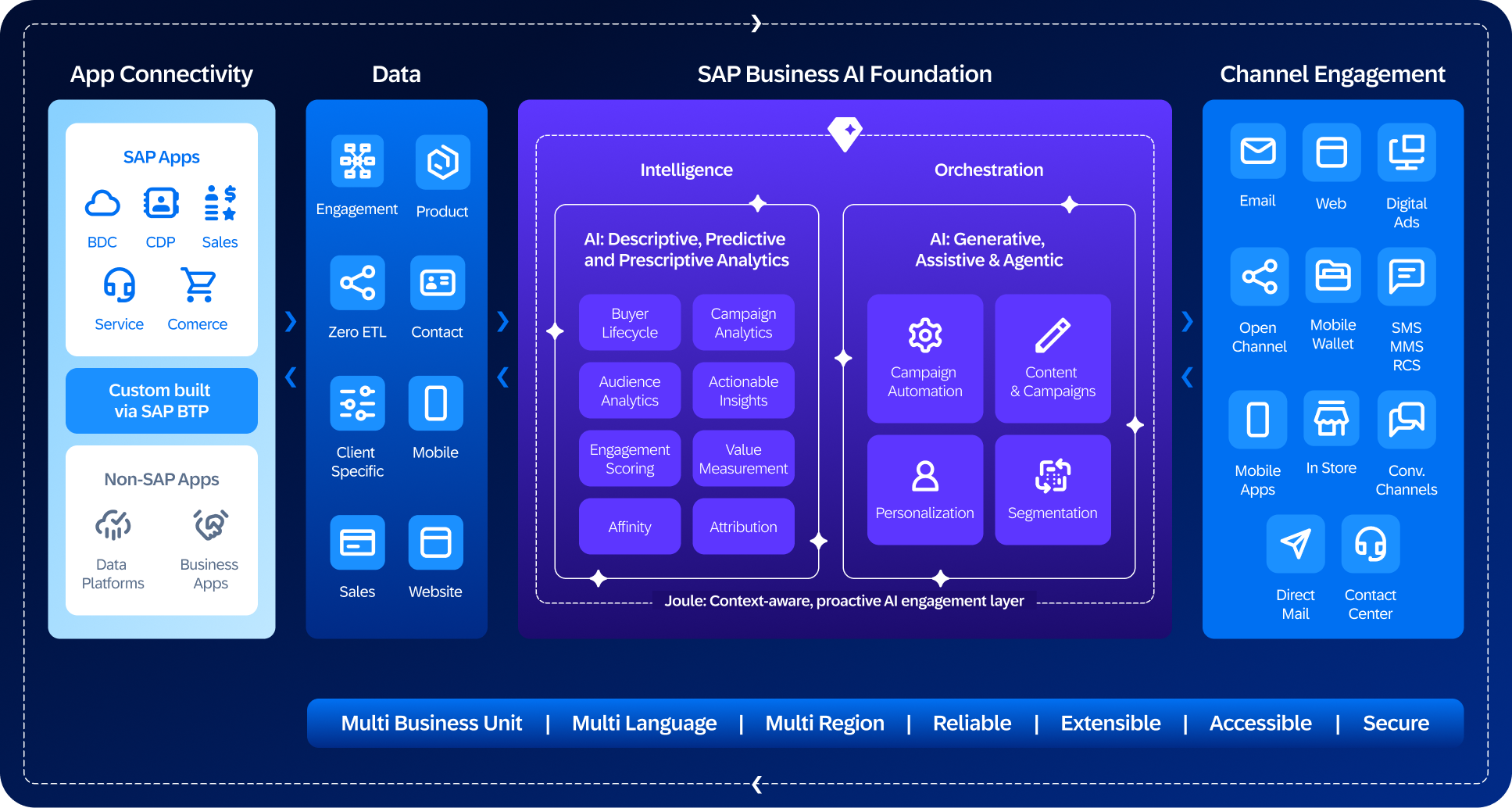
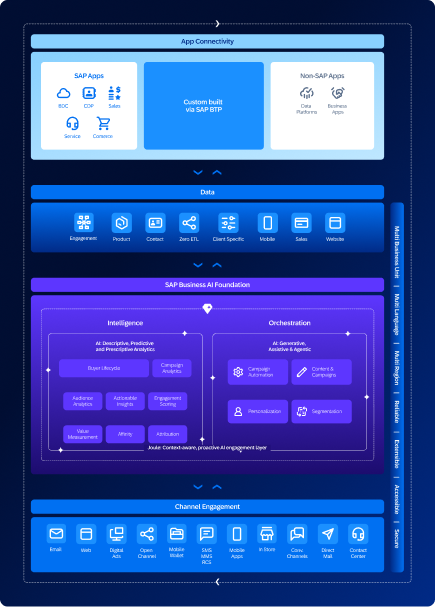
What connects, how it connects, and what your team doesn't have to build
Integration Details
Below are the technical specifics of how SAP Engagement Cloud connects to your existing environment.

Contact & Account Sync
SAP Sales Cloud
Contact records, account data and CRM opportunity information sync from SAP Sales Cloud sync with SAP Engagement Cloud via the SAP Account Engagement service.
OData service → SAP Integration Suite iFlow
SAP Account Engagement (out-of-the-box)
OAuth 2.0 via SAP Cloud Identity Services
Extension scenarios via Groovy-script iFlows
SAP Account Engagement (out-of-the-box)
OAuth 2.0 via SAP Cloud Identity Services
Extension scenarios via Groovy-script iFlows

Identity & Access
SAP Cloud Identity Services
Authentication runs through SAP Cloud Identity Services—the same IAM layer governing your broader SAP landscape.
SAP Cloud Identity Services (CIS)
OpenID Connect / OAuth 2.0
SCIM-based user provisioning
Single sign-on across SAP CX suite
OpenID Connect / OAuth 2.0
SCIM-based user provisioning
Single sign-on across SAP CX suite

Data Residency
Customer Data Within SAP Infrastructure
Customer behavioral data, contact records, and engagement history are hosted within SAP-managed infrastructure—covered by the SAP Trust Center, your existing DPA, and SAP's regional data residency options.
SAP-managed cloud infrastructure
Regional data center selection available
Covered under existing SAP DPA
SAP Trust Center compliance posture
Regional data center selection available
Covered under existing SAP DPA
SAP Trust Center compliance posture

Commerce Data
SAP Commerce Cloud
Sales order data and commerce behavior feed into SAP Engagement Cloud via SAP Cloud Integration, enabling purchase-triggered automation without any third-party ETL pipeline.
SAP Cloud Integration OData pull
Order events → engagement automation
SAP Commerce plugin for Engagement Cloud
Real-time and scheduled sync patterns
Order events → engagement automation
SAP Commerce plugin for Engagement Cloud
Real-time and scheduled sync patterns

API Access
REST API & Webhook Architecture
SAP Engagement Cloud exposes a REST API with OAuth 2.0 authentication. Webhook nodes in the automation engine support real-time event-driven integration with downstream SAP or custom systems.
REST API · JSON payload structure
OAuth 2.0 + WSSE authentication
Outbound webhooks for event triggers
Developer docs: dev.emarsys.com
OAuth 2.0 + WSSE authentication
Outbound webhooks for event triggers
Developer docs: dev.emarsys.com

Security Operations
Patch & Vulnerability Management
SAP manages the security patch cycle for SAP Engagement Cloud. Critical vulnerabilities are patched on a priority weekly basis. Incident management aligns to ISO/IEC 27035.
CVSS-based vulnerability scoring
Priority patches: weekly cadence
Incident management: ISO/IEC 27035
Continuous malware monitoring
Priority patches: weekly cadence
Incident management: ISO/IEC 27035
Continuous malware monitoring
Built on the compliance framework your organization already runs
Compliance & Governance
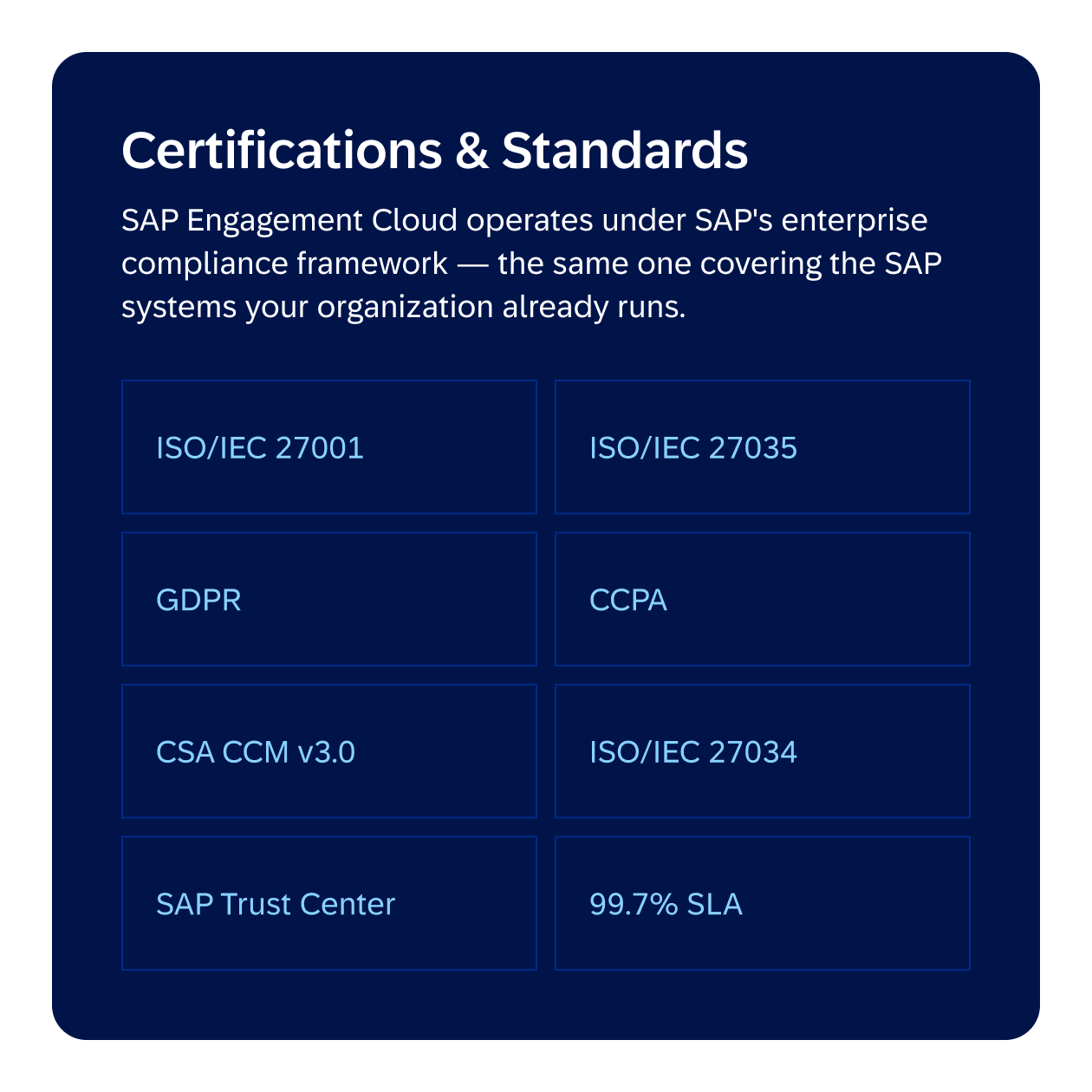
ISO/IEC 27001 Certified
SAP Engagement Cloud operates under SAP’s ISO/IEC 27001 certification — independently reviewed, not self-attested.
GDPR & CCPA
Consent and preference management is native to the platform. Data subject requests, retention policies, and processing records are managed within the SAP ecosystem.
Single DPA, Single Vendor Relationship
Your existing SAP data processing agreement covers SAP Engagement Cloud. No incremental DPA negotiation, no separate vendor legal review cycle.
Note: Verify scope with your SAP account team. Most enterprise SAP DPAs include SAP Engagement Cloud by default, but contract scope may vary by agreement version.
SAP Trust Center
Security posture, uptime, compliance certifications, and data residency options are documented at the SAP Trust Center — your governance teams already know where to look.
99.7% Contractual SLA
Production availability is a contractual commitment with defined service credits — not an aspirational target in a marketing slide.

Two ways to go deeper — on your terms.
Download the Architecture Brief
A technical reference covering integration architecture, data residency, identity, and compliance posture — formatted to share with your team or include in a vendor evaluation.

Run the TCO Calculator
Enter your current integration hours, engineer cost, and vendor review cycle. Get back a specific number — what your current architecture is costing IT annually, and a directional savings estimate if you consolidate to SAP Engagement Cloud.
See how this fits your SAP environment
Request a demo built around your integration, data governance, and compliance needs — your SAP account team will follow up to set it up.