OMR 2026
Find out how digital leaders and global brands
are shaping the future of customer engagement.
Available now on demand!




Stream OMR’s Best Customer Engagement Sessions

Personalization without Limits: The AI Marketing Shift
Jessica (SAP CX CMO) explains how AI can close the “Engagement Divide,” mapping its evolution from assist to orchestration —while Flaconi shares its 5-year AI journey scaling personalization globally.
I'm Jessica, I'm the CMO for SAP Customer Experience. And I want to start by talking a little bit about our experience as marketers. As marketers, we're trained to deliver the right message to the right audience at the right time. This is our North Star. But up until now, it's been conceptual. Until now, where AI has finally put this within reach. So... What's holding us back? First, customer behavior has changed so rapidly. In the days of Mad Men, for example, you captured intent only after you created an ad campaign and ran it on television. Your customers then joined you in person, and you worked through an opportunity with them. 20 years ago was the advent of email marketing. At that point, we were working on identifying opportunities to use targeted digital advertising. And now a customer can move from discovery to fulfillment all in a single chat experience in less than a minute. Second, we have to get our house in order. Our generation still operates in silos with data aging in the corners of our ERP, our marketing systems, and ultimately, all of the different components of our CX capabilities. When you are able to actually bring together the foundation and the data, you can now do incredible things that were not possible before. Third, we have dabbled when it comes to AI, but we have not jumped in. We're testing, we're trialing, but...we have not yet actually taken the opportunity to optimize our AI capabilities for what exists today. We're using opportunistic AI to do things like simple efficiency, driving opportunities to use subject line generation, which we'll talk about in just a minute, but we haven't entirely captured the opportunity to use AI in the way that it really can unlock our business. So, why is that? Is it because we're afraid? Is it we've only focused on the low-hanging fruit? I'm not sure why it is. But I'm excited. And I'm looking forward to talking today about how we move forward in that way. So, here's the thing, every one of us in this room has been told repeatedly that our data is our most valuable asset, and most of us, if we're being honest, are struggling to actually use it. To harness it, to act on it, not because we don't care, not because the foundation was not built. The gap between the data we have and the experiences that we can actually deliver, that's what we call the Engagement Divide. When the gap is not closed, customers and the brand both lose. Only 22% of brands even recognize they have seamless experience problems. And yet 82% of customers are dissatisfied with brands and feel that they have been let down. On top of that customer pressure to perform, 78% of brands cannot practice real-time AI optimization with their campaigns. AI is compounding this divide faster than most organizations recognize, with customers already using AI to compare, shop, and ultimately purchase inside of chat. This is not a marketing problem, though. It is a foundational business-wide problem. The divide is real, but there's good news. Marketing teams are actually the ones that can solve this problem. Marketing and sales is the number one function using AI in enterprise today. AI adoption is represented by 42% in marketing. And that's 66% of revenue impact. This is not a coincidence. We know that CX is where AI creates the most immediate and measurable return. You are the ones using AI to change your business. Winning means going beyond co-pilots though, beyond chat bots, and leaders are moving towards agentic AI orchestration. Because this is the very near future. In 2027, 50% of routine work is expected to be completed by agent powered capabilities. In one year. The shift is already happening, but I want you to think about it in three stages. First, we have assist. We've already been there. These are the things where we're asking chatbots for answers. It's the obvious ability to use AI to give us information that we could easily do on our own. Next is execute. Agents are taking action when prompted. They are doing the work that we would have done before and often they're doing it better than us. And orchestrating. Is the next phase. Agents coordinate entire end-to-end processes across systems autonomously in real time. These capabilities simply did not exist 18 to 24 months ago, and it's the next phase that's going to allow us to do things that are better and more advanced than we have done in the past. The brands who will win are not the ones who have it all figured out today. They're the ones building the right foundation right now, making smarter bets and moving with intention. And this is what the foundation looks like in practice. We're removing silos, we're removing fragmentation, manual handoffs, disconnected data, and customers using SAP Customer Experience will have a role-based AI assistant across marketing, sales, commerce, and service. All in one unified platform, the same data foundation that agents can support decision making for customers to optimize CX experiences and I have someone today who's deep into her AI adoption journey and I'm excited to sit down with Julia and discuss the experiences that she has had with her adoption of AI inside of SAP Customer Experience today. Hi, Julia. Hi, Jessica. Thank you a lot, also, for the possibility to be here. I'm very excited for our chat now. Thank you for joining me. So we've discussed a little bit about your journey with SAP and AI specifically inside of Engagement Cloud. So when your team first started talking about AI, not the hype, the real internal conversation, what did that actually look like for your organization? So actually, I would say we started working with AI or thinking about AI already five up to six years ago. And I would this was a time where AI or usage of AI was not really common. So for us, it was something new. We didn't really have the trust in it, but we saw that we sometimes need an optimization. One example at this time was the segmentation. So we did segment everything very manually. We had a lot of campaigns each week running to so many customers. And we see that we didn't really fulfill the need. Sometimes we had enough data, but we also sometimes had the challenge that customer always get similar campaigns because they had this purchase experience. It was very hard for us to do cross-selling, to also introduce new brands to our customer. And that's why we decided, okay, we have to look for something new, for something maybe that's not really common. And then we found an AI solution that helped us with that. But even when we started testing it, we were not really convinced that this is the right direction because AI was so new. And normally when I'm working with a tool, I want to really understand everything. So having an AI that doesn't talk you, how things work was a little bit hard for us. So that's why we also tested a lot. I would say we tested AI logic for nearly one year. To be really really optimistic and really really convinced that it is a performance uplift, a speed uplift and it was like this so that's why we decided years ago to start with AI and when I look on today AI is like a daily business for us so we have so many AIs introduced for content creation, for translation, for automation of our campaigns so that we are really happy now that we started five years ago and are on the point where we are now. And when we spoke yesterday, you talked a little bit about the first use case for AI that you tested and you tested it for a year to validate that it actually was performing better than the human experiences, right? Yeah. So tell me a little about that specific use case. Yes, so we noticed at Flaconi we have a huge internationalization strategy, meaning we get more and more countries each year, which is kind of challenging. On the one hand, because of scalability reason, you get more effort to create a very good experience for all the countries, but also on the other side, different countries have different needs, so you have to fulfill the needs to have a very personalized communication. And one thing we did, for example, because we noticed that in countries like Poland or Czechia, their name day is very popular. So in Germany, it's not the case. So we normally don't celebrate our name day. We only celebrate birthday, make big parties. But in this country, also the name day has the same level as a birthday. So that's why we decided last year, okay, we have to create an automated name day campaign for the countries where it's relevant and celebrate all the names we have in our database. Match the perfect name day for it and use also AI to add additional content to it that the customer really understands why is my name day today, why it's celebrated, and this performed very well. And I think this is a good mixture of using AI in combination to optimize personalization and this is the use case that performs very well and is a win-win for us and also for the customer. I love that story because I think it's so practical that thinking about the experience that you want to have across each of the different regions does require a level of personalization that is super time-intensive and intentional but also really relevant and it actually results in better experience for your customer and actually I think we talked about the outcomes that you saw were significant so I love it. Tell us, moving further into that, tell us what personalization at scale actually meant for your business. What was breaking down and what made you realize it was time to do something differently. I think this was one example where it was time to do something different, to see, okay, different countries have different needs, we have to change something. Another example also comes from the internationalization. So we see the more languages we have to offer and have to prepare, the more less efficient we are working. So that's why we also decided, okay, we have work with translations, also with AI to speed up, but still have a high level of quality for the AI. So that's why, for example, we started beginning of this year testing the SAP AI translator to have directly in our campaigns the possibility to have a German campaign and translate it to all other languages. This is nice because we can speed up. We can still have a high level of campaigns, also personalized campaigns, and have a good experience in every country. Yeah, I love that. And the campaigns that you're running, you used to actually have to localize them with spreadsheets. You would sort of upload them, localize them, and then track and make sure that they were all getting executed effectively, right? Yes, yes, so we work like two things. The first thing is we directly work in SAP with the AI translator, and the other thing is we have own tables because we want to be very fast. So normally when we create a campaign, we don't use block targeting or block templates anymore. So we directly worked with tables. They get imported via relational data into the tool, and then got very dynamically to the right place in the email, and our effort is only to make a testing and check if everything is well. So speeding up like this with the help of AI is perfect for us. This is also the way to go for the future. And one of the things that I'm really excited about is the level of personalization that we're able to bring to our customers through our new partnership with Google. And we talked about this a little bit and showed you a little yesterday some of the image generation that we can create, the dynamic content that can be created. Based on all of the information that we have about the individuals, you could actually do incredible levels of personalization. And I think that we'll continue to roll out more and more capabilities that allow for really deep personalization in an automated way. And that's sort of that agentic orchestration that allows us to really advance some of the capabilities. So I love that you're doing language customization, subject line generation. You're really pretty far in the path of allowing AI to take on some of tasks. Where are you trying to go? What does the next chapter look like for you in terms of AI for your team and customers? The one thing where we definitely want to go, so we have these table imports, we have relational data and we are very fast in setting out the different campaigns for each country. But this year, seven more countries will be edited at Flaconi, so, we will have to be even faster. And our goal is now if we have one email sent out, one push notification sent out that we only have one campaign in total. So, meaning everything is totally personalized by the customer, by the country. And we, in the end, only send one email instead of 19. And this is a huge step for us in being more scalable and use this time for strategic topic to optimize personalization and everything around. And I think one other part goes a little bit in how to orchestrate better your different channels because we are using a multi-channel approach, meaning we have different channel, not only email marketing, and sometimes you cannot really see if you maybe overload the customer because you get the email then you get the push in the inbox and it's too much information for them you see it sometimes then drops in dropping unsubscribe rate but not always you don't always see this so you cannot really see if a customer is annoyed by your way of communication and having in the end an AI that maybe helps us to orchestrate to the really really important channel of this one would be something really nice for the future. Customer journey orchestration at scale with AI. Yeah, definitely. That's a great example of how we could envision helping customers to evolve the way that they engage their audience through all of the channels that are appropriate, but ultimately improve the experience for their customers and to your point, reducing things like the unsubscribe rates and allowing for better experiences. As you build toward that AI vision, how is your work with SAP helping you get there? Yes, so actually we have quite a long time together with SAP, so Flaconi is turning 15 years today and we work together with SAP for 13 years, so nearly from the beginning, and we tested so much during this time. So we work with a lot of AI solutions that SAP is offering us, so meaning the AI translator, a subject line translator, a product finder that we are very fast also in executing the campaign. And what I like the most is that we always have also the possibility to take part in the beta testing. So that we are really integrated before a new product is live, we can test it, we give feedback. And then this feedback, we also see that it's really reacting on the feedback. So meaning in the end, we see that the feedback we give is really relevant for SAP. And in the and then the end product is maybe more and more interesting for all the different customers, because there are so many different industries and every industry has their own needs. And we are very happy to take part into beta testing. One beta testing we are doing at the moment is the new product recommendation. And we also see there huge potential. We really, really love it. And this is very, very nice. And what you also mentioned before about the Google AI cooperation between SAP, I think Joule is the right name for that. We are really, really excited because this will save us so much time and also would scale up our personalization to a new level. Because imagine you have a very personalized campaign created by, for every customer. So it's nearly a one-to-one personalization. Having this AI-generated image combined with the data from the customer. You already have an SAP. Also adding a prompting to make it more specific. I think this is the really next chapter for us. We are very excited to test this anyway in the future and then to integrate it. Fantastic, I love the way that you guys are embracing AI and moving down the path of not only using AI for use cases that are really relevant today, but starting to envision what orchestration looks like really moving into that third bucket and adopting AI that is going to not only allow you to improve the experience of your teams and your customers, but ultimately do things that you weren't able to do 12 months ago, right, and you're embracing it in a way that I think really reflects your team's culture as well. Yes, exactly. So thank you so much Julia for being here with me. Thank you for spending time with us and thank you for being such a great partner in innovation. I am also so glad to be here with you for having the long partnership together with SAP. So also thank you for that.
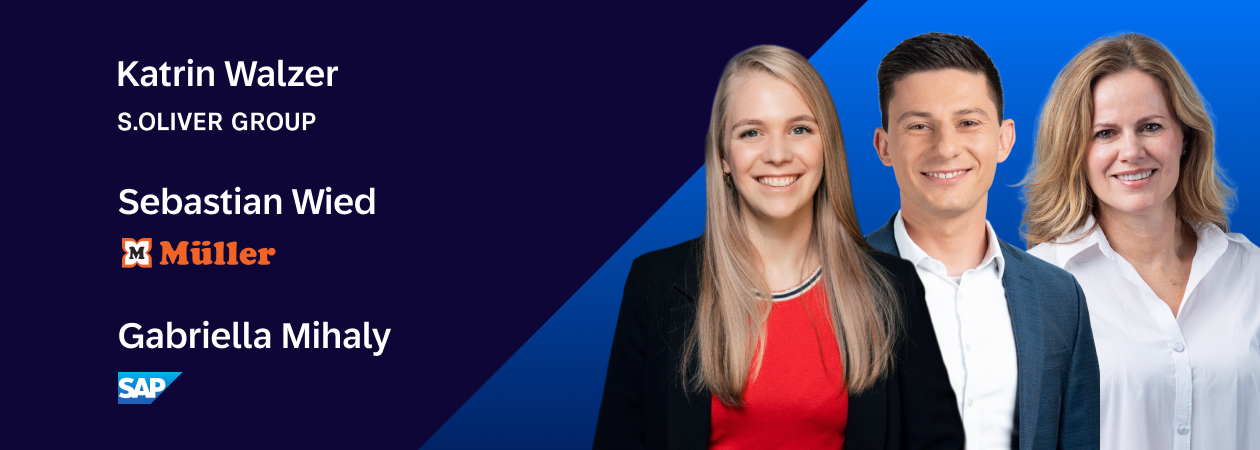
How to Scale Personalized Engagement and Loyalty with AI [S. Oliver Group-Müller]
S.Oliver nearly doubled revenue on basket abandons by adding one tweak. See how they and Müller scale AI-powered loyalty without breaking trust.
So welcome. Today, in our masterclass, we are going to answer the question, how to scale personalized engagement and loyalty with AI. My name is Gabriella Mihaly, and I am organizing similar events at SAP like this. And I have the absolute pleasure to welcome today Katrin Walter from the S.Oliver Group and Sebastian Wiet from Müller. Would you like to introduce yourself? So I thought thumbs up, does it work? Yes, thanks. Okay, so my name is Sebastian. I'm representing Müller today. Müller is a multi-category retailer based in Germany. And to give you a short overview in numbers, we do more than five billion euros in revenue and which is gained by more than 35,000 people from more than 120 nations, and the two numbers which are always very interesting and point out to me is that yes, we do have 190,000 SKUs on our stock. So no marketplace, no e-concession behind that, and more than a quarter million transactions per year. Gabriella if you could So, on the map you can see we're active in nine countries, in middle Europe, in Eastern Europe and in Spain, especially on Mallorca. And we have around about or almost a thousand stores. And to me as the representative of the e-commerce of Miller, we do have an e-commerce solution for Germany, Austria and Switzerland. Thank you. Katrin, would you like to say a few words about the S.Oliver Group? Hi, I'm Katrin. I'm the head of CRM and Loyalty at the S. Oliver Group. And at the same time, I am a mom of an adorable one and a half year old little daughter. So you can be sure that my relationship management skills are approved on a daily basis at the moment. At S.Oliver Group, we are bringing together six strong brands under one roof, of our House of Brands. We're creating millions of interactions yearly across all channels. And to give you a little idea and an impression about who we are, I brought you a little film to introduce ourselves. By the way, it totally matches to today's panel since this film is fully AI generated. Thank you, fantastic videos. Before we dive in how you are actually utilizing SAP to drive customer loyalty and retention, I also would like to share a few interesting facts. We have carried out a research at SAP. We asked 15,000 people across the globe, both marketing leaders and consumers. And what we found is that there is an engagement divide between brands and consumers, 22% of brands realize that something is not fully right. With the customer experiences they are creating, but it's only 22%. And 82% of consumers say they are already disappointed with a brand in one form or another. So this is the gap, the 60% wide gap is what we call the engagement divide. And until you recognize that there is divide and is growing with quite a big pace, it's quite difficult to close this gap. So this distance, what does exist between what brands can deliver and that consumers feel that they get in the moment that matters the most, this is the engagement divide. So this is growing and it's there, but what is even more surprising when we realize how much AI is contributing to this gap. We always, as marketeers, we tend to underestimate how much consumers are already using AI because they're using AI to compare, to research, and sometimes even if AI says so, they can switch brands in seconds. So this basically makes whole customer loyalty and retention into a hyper-competitive battlefield. Also, the other problem is that 78% of brands say that their data is fragmented, so they cannot practice AI optimization in real time. And also 46% of brands say that they are unable to connect their data in a meaningful way that would be accessible and available in real-time. So what can we do? That is the question, right? It would be quite easy to say, and I think also as a marketeer, I've been prone to that. That if I just launch another campaign, if we just try another channel, if I convince my boss to buy that fantastic tool, then all will be fine. But reality is, what we find, is that the companies or the brands that are winning are the ones who treat engagement as a holistic across the company. Enterprise-wide discipline, where it can be connected: marketing, sales, commerce, operations, services. So they treat it as a whole discipline. And SAP Engagement Cloud, and formerly, I think most of you have known it as emarsys. Here in Germany, we have a lot of history. So SAP Engagement Cloud is exactly designed to do that. Basically, our platform is designed to help you to turn every interaction. Into an opportunity to scale those customer interactions, to deepen the relationships, and really to drive business impact. So SAP Engagement Cloud, we also started out as a emarsys. We started out a very simple email platform. And now as SAP Engagement Cloud, we are an enterprise-wide platform that really turns this engagement, unique engagements, into real, true customer interaction. So the goal is simple. To help you to do that. And how we do that, you can really turn real-time data activation. You can also drive AI-powered personalization and also seamless experiences across every channel. So now, I think we talked about some interesting facts. And you also heard a little bit about our product. So now let's dive into it and see how it works in reality. Okay, so we know that there is this engagement divide and we also know that it's quite a big problem for the brand. So Sebastian, our research also shows that 51% of companies are unable to connect their data properly. And for Muller, who we saw in operate so many countries and has so many stores, I'm sure you can relate. So what are some of the challenges that you face with delivering those personalized experiences? Well, I can fully relate because I, to be honest, we are part of the 51% right now. To give you a quick impression where we stand right now, what's our status. So we bought a CRM suite a couple of years ago, but to be honest, the integration and all our omni-channel processes has failed. So with SAP emarsys, or the SAP Engagement Cloud. This is our second attempt. And the challenge that I see is we do have a kind of a fragmented software landscape right now. So there is some legacy from the past which we need to fix. Second, there is in the nature of our business model of an omnichannel retailer, we need to connect those offline and online data. And to give you an example, with our Müller app, we know 30%, maybe 40% of our customers. The rest is unknown. And in the app itself, there is no behavioral triggers, so no personalization, no real-time personalization yet. And so I think the third challenge is that we need to change ourselves and the way we work Also, because we need to get rid of the highly manual effort that we put in some bulk emails and go to the automated triggered ones. Yeah, Sebastian already mentioned it's quite difficult to get it right because even it's the second attempt for Müller and we also heard sometimes email can be a challenge as well. There's also a very interesting fact that came from our research that 57% of marketing emails are perceived as not relevant and only 15% of consumers open email beyond the subject line. So it's quite scary, right? So Katrin, from your point of view: why do you think mastering these more meaningful customer moments in real time are critical to business value now more than ever before? When I'm thinking about my own inbox, I do not remember the last email I received. What I do remember is a brand that showed up at the right time and with the right context. And this is what meaningful customer moments are all about. So especially in fashion retail, you can buy nearly anything almost anywhere. So the decision is often taken by the price. But price alone will never be the reason why a customer will really come back. So what truly drives growth today is when the experience around this initial purchasing process is special, or at least so seamlessly and so positively that you as a customer would actually tell a friend about it. Then here is exactly the point where you're able to make the difference. And I'm being really honest with you, we didn't figure out this magic yet as well. So this is what we're basically doing every day. I would like to give you some examples of our latest projects. Last year we tried out AI-based send time optimizations. So the goal is not to send one email tool. All the customers globally at this one time, but to figure out when the customer is most likely to open the email. And with this tiny adaption, we could reach an increase of our opening rates by three percent points. Another project we realized last year was to include the whole channel mix into our journeys. So we took the basket abandoned journey and included the preferred channel of the customer. So today it might be possible that you receive your little reminder about your basket via an in-app message or a push note or maybe a layer on your website and this was actually huge success since we were able to nearly double our revenue of our basket abandoned journey. So coming back to your initial question, I think it is more critical than ever before to realize this moment, marketing, since we're living in a world of endless choice and the market is so price-driven that you have to find a differentiation. And we already see how much we underestimate that our consumers are already out there and using AI left and right. So we have to make sure we keep up with them. Also, one good news that we found in our research that it's not only on marketing anymore to come up with a true personalized engagement with our customers. So Sebastian, and what changed for you internally when your team realized that engagement is not just a marketing metric, but it's really a business performance indicator. Well, we are kind of in the transition right now, because the old way was that based on the interests of some departments, especially of the Purchasement Department at ours and the commitments that we do with our industry partners, that was the baseline for all our communication and mailings, notifications, and so on. And that plus some engagement-optimized content pieces that we send out for the communication with our customers. But none of them had actually a revenue impact at all. So we added a basket abundance campaign maybe three, four weeks ago because we're just starting it. And we also launched a soft opt-in campaign last week. And this is nice to see because now we do have some campaigns with revenue impact. But I mean, overall, it's still a marketing metric, right? So what's changing now is that something which Katrin already mentioned, we need to set limits to the communications per day, per week, which we do with our customers. And this limit brings us to a point where we need to switch the focus away from the internal interest that we have of a purchasing department and others to a customer lifetime value. And it is therefore the whole understanding how we do that and what we are doing with focus groups and so on is going to change. And we heard that you're already experimenting with some great ideas, but still what we know is that this engagement is still breaking. So let's understand a little bit more from an operational and technology perspective why is this engagement currently breaking. We found also in this fantastic research that 59% of companies suffer from so-called dark data. This is data that is being collected but actually never being used. And also 52% of those brands say that their data is too unstructured to use it effectively. So this leads to a silent turn. These are customers who just leave. You're not aware of them. They just simply disappear. So are there any moments in your customer journey, Katrin, where you feel this particularly vulnerable to this disengagement today and why? I think the biggest disengagement risk is not an angry customer, it's indeed an invisible one. So when we're searching for disengagment reasons, we often search for this one broken touch point in the journey. But usually and in reality, it is never this suddenly engagement that breaks, it's engagement that fades quietly. When a customer is becoming invisible in the journey, that this is exactly what happens. For S.Oliver, our journey becomes more or less fragmented when it comes to the omnichannel experience, to be honest. In the digital channels, we do have the strong loyalty and engagement rates. We understand the web behavior of a customer and are doing quite well in personalizing. But in our physical retail stores, our identification rates are still below 50%. That means that every second customer is leaving our store without leaving any kind of digital footprint. And here is exactly the point. Where this fragmentation is happening and where the customer becomes invisible. And this has serious consequences. We might think the customer is inactive at this point, even he is the most loyal one at all. We lose preference signals, we lose context, and personalization is becoming somehow guesswork. Product recommendations become less relevant. And communication feels a little bit generic. And here, engagement fades. And I think this is exactly how a silent churn looks. I mean, every second customer, that's quite a surprising fact, right? And it's quite a big challenge. Try to learn and try to reach those. And especially, as you said, because they might be your most loyal customer. So it's a quite a difficult one. Sebastian, also at Müller, as you showed, you have 1,000 stores across nine countries. So I'm sure you also experience some of these dark data syndrome. Where are the areas that you have identified that maybe you can turn these dark data moments into opportunities? And actionable insights that would personalize your customer engagement more. And we experienced the dark data moments as well, and especially by merging data, because we do have a lot of data, to be honest, because we have a lot of digital touch points with our customers, but we're also facing some challenges, like a S.Oliver, because as I mentioned earlier, we know around about 30 to 40% of our customers. So more than just every second customer walks out of physical stores without a digital touch point. And I mean, of course, it's based on the on the omnichannel case with offline online data that we face. But to give you an example, which points out to me every time I see it, I'm a huge Lego fan. So I bought myself a Lego art set a couple of months ago. To have to, yeah, I mean, play a little bit around during the Christmas time. And what I see is that one of those dark data moments is that we can't match my online research that I did earlier in this journey that I had with the point of the purchase that I did. So. When I search online I still receive those display ads so completely on a marketing channel, but I still received the same display ads for the product which are already bought so it's not a recommended other product or something related to the product it's the same one again, and that's not not necessary and how do we face that challenge? First of all we will set in some or it's called a CM system, so that a customer gets a unique customer ID and a unique profile. And with that, we will merge the data offline and online with the customer ID to the SAP Engagement Cloud to do the job better. But also, we at Müller, we have a huge ERP replacement. Keep us awake the next three to maybe five years. I don't know and With that ERP project. We will also have a module for CDP for customer data platform as well and with that I I think we are You will create a seamless customer engagement. Ok, thank you so much. As you mentioned, there are so many different touchpoints to tackle and so many ideas to investigate. And also for companies who want to improve their customer engagement but don't know where to start, Katrin, what do you think could be the first steps to make some progress? I would always point out the very beginning of a relationship, which is the onboarding moment. When a customer is registering for your loyalty program or signing up for your newsletter, then his interest into the brand is at an absolute peak. So this is a moment of really high openness and really high intent. And I don't mean a confirmation that the registering process has worked out great, and I don't mean a simple welcome message I mean a proper journey in which you can realize different targets on the one hand you're able to educate your customer from the very beginning that it makes absolutely 100% sense to identify across all channels and you have to point out what's in for the customer. What are the valuable reasons you should identify in a physical store, as well as in the online shop? And here, you can, from the very beginning, directly prevent this invisible customer and the silent churn. And on the other hand, this is the best point to really get to know the customer. So to understand preferences and affinities for the later personalized meaningful moments we would like to create. And you can be really creative to find things out. So for example, for our brand Liebeskind, we included a raffle in our onboarding journey. So to participate, you had to answer different questions related to the price. What is your favorite bag size and the favorite color for your bag? Which model would you like to prefer and to buy? And here we were able to collect a lot of data points and with those we were able to create quite good product recommendations from the beginning. So, yes, I would always point out the onboarding moment. I will definitely hope you're going to have some similar raffles because I would love to have one of those beautiful Liebeskind bags. We talked about how much these emotional moments matter. And now let's talk about also how do we create more of those moments and how do you create true loyalty. So Sebastian, what does loyalty look like at Müller? I could talk about this because I'm a loyal Müller fan, but I'm not going to do that. Rather ask Sebastian that: how you are thinking beyond points and how do you build loyal customer relationships that really last? Our loyalty solution is provided for the Müller app right now. And to give you some insights, we have around about 10 million registered customers, 1.5 million active app customers per month. And our loyalty program is called the Müller Blütenprogramm, so the Blossom program because of the Flower Blossom that we have in our logo, right? So, the Müller Blütenprogramm. And it's about earning and burn points. It's about app coupons and some gamification contests where you can win something from time to time. And of course, there's a subgroup which is called My Baby Club. So, if you're future parents or young parents and then you can register yourself with the date of birth of your child and then you receive a birth gift for free from us and of course some product information and product recommendations and so on and to be honest I'm pretty happy that we got rid of all the paperwork that we did in the past and have a fully digital solution right now. But to be honest, what I think for the future is necessary, it's right at the moment we do have a kind of an image of a discount provider, so we wanna get rid of that, of course, and go further to a kind of a personalized or personal shopping assistant. And how we wanna do that is by, of course switching the focus from the amount of app coupons to real personalization. And that of course, across all channels. Because I'm just talking about the Müller app right now. This is not based in the e-commerce solution that we have right now, so there is a divide. And in the end, it's about creating real customer value. So there should be a little bit more, some exclusive benefits, some hyper personalization, some additional services, and so on. I'm personally also very grateful you stopped those paper coupons because they always got lost in the apartment and they were never, I could never find them when we had to. So anyway, we saw how complex it is, right, try to create those meaningful moments. And also the chances are if you all are honest about it, your customer won't remember when you last emailed them, but they will remember that moment that was like really authentic and relevant. So if loyalty is so emotional, then let's look into it more. How do we create those moments. So Katrin, if you just, you know, as you're from your own personal experience, what makes you feel emotionally connected to a brand? When I'm honest, as a customer, I wanna feel a bit of a special snowflake. And I don't mean it the entitled way, but in the sense that my preferences and my loyalty and interests really matter. So when I'm a loyal customer, I like this kind of special treatment. I like a gift here and there, and maybe some invitations to exclusive events or pre-accesses to some special promotions, I don't know. As what you mentioned for the Blütenprogramm, I'm totally in. And at the same time, I really like to get inspired by a brand, so when I feel that they really understand my taste, I think Zalando is mastering this kind of communication, right? Yes. Love the social ads. Yeah, that's it. And our Engagement Index Report, 42% of customers say that they really care about the overall experience. So not necessarily about the individual brand. So one bad moment actually can destroy your brand's reputation. So Katrin, again, which moments of the S.Oliver customer journey you think they have the highest stakes for emotional loyalty? And what channel or personalization tactic do you leverage to meet the expectation, the increasing expectation of our highly emotional consumers? I think loyalty is lost or won in moments of direct and human customer interactions. They can either break trust instantly or create one of this special customer moments we talked about earlier. As an omnichannel retailer I think we have to differentiate between the digital channel and the retail channel. From online point of view, the moments with the highest emotional stakes are the ones around the purchasing process. So when there are already some issues, questions and maybe problems are coming up. In these moments, usually the customer is already emotionally invested, and most of the time not in a positive way. That's why from CRM point of view, we try to reduce frictions here. So we totally focus on a smooth, seamless and transparent transactional communication from the auto confirmation to the parcel tracking, updates to the current status your order has, and we don't treat this communication as a side topic. We do have a dedicated person in our team who is currently working on the optimization of this transactional communication. I think this kind of communication builds trust the same way as a marketing campaign is able to do it. In the retail world, the picture is completely different because human interaction can be a great opportunity to build trust and create this kind of relationship. And here, of course, we want to have those possibilities. And at CRM we try to give all the information the staff needs to our employees. So they are equipped with tablets with a client telling software on it. And they have easily access to a customer's account so they can check what purchases the customer placed already which sizes he bought, which colors he prefers, the loyalty status, the points, the vouchers. So, everything to create the perfect condition for the store employee to serve better. I think when you master these moments, loyalty will follow. Thank you. And we talked a lot about how creating these memorable moments that matter is one of the biggest challenges for marketeers. So let's now look into it, what role does AI play, and how can it help us to create more of those moments? So Sebastian, we also know that collecting data and this AI-powered personalization also comes with this tension, right? Efficiency versus trust. This is a paradox. This also was shown in our research, that 75% of brands believe that AI will be essential. Who in this room thinks that AI will play a heavy part in their marketing strategy? Hands up, please, just then. Yeah, so I think we can all agree that AI is here, and 75% percent of brands believed that. However, 33% of consumers say they don't fully understand what their data is being gathered for. So it's, again. What is the value that they are getting from sharing their data. So it's again, quite a big gap. So how can brands harness AI to deliver personalization without crossing the line and eroding trust? Sebastian, what do you think? It's a good one, right? It is a good one, yes. I think that in earning trust is about making personalization feel a bit transparent and helpful in the end because AI can provide us both. It could provide real value but it could also be creepy, right? And so I think it's more about the design pattern than about the technology itself. I mean, for example, you talked about the onboarding process earlier, so imagine you're downloading the Müller app because you're going to shop later on here in Hamburg in one of our stores and you sign up to the app and I ask you like a Netflix or Shopify does, for your preferences. I could do a pretty good job by personalization and recommendation with your interests, of course, but to be honest with AI, powered by all the data and the touch points that we have, I probably don't need to ask you for your interests anymore and provide the same level of personalization or even a higher level of personalization. So the combination of AI and the data that we has is pretty powerful and I think because of that, we as retailers or as brands, we need to share at least some transparency. How we use data, how we user AI, and how we create value for our customers so that he or she can decide how she benefits from it and whether it's worth to sign up or not. It's a very, very difficult balance to find and sales brands really have the responsibility to create that transparency. And Katrin, where would you draw the line between this helpful relevance and over-personalization, which is so easy to end up with? Personalization stops being helpful in the moment the customer thinks: why the hell does the brand know this about me? AI becomes uncomfortable and when it appears on places, I would not expect it, when I didn't ask for it or when I can't see a clear benefit out of it. So for example when you are visiting a website and you have one of those pre-filled registering forms. That might be a little bit scary in the first moment, or for example, those really aggressive size recommendations which can be rather intrusive than really supportive. And I think here the main question is not what AI is capable of. But what emotions is it triggering by the customer? On the other hand, AI can be really beneficial for you. For example, we introduced a Whatsapp as a communication channel last year in our company and we realized that a lot of people are asking questions via Whatsapp, so these questions are obviously meant for our customer support and not for the marketing teams but what we are testing right now is to include AI based FAQ agents to answer these questions directly or if AI is not able to do it, at least transferring these kind of questions to an internal team which can be answering this question. And yes, I think here is my answer. We draw the internal line quite clear when AI is creating value for you. Give everything to me you have, but it's not meant to raise new questions. And it's a very good point, because the matter of agents, right? 26% of consumers are already starting to use AI agents that make decisions on their behalf when they are buying from brands. So we have to be quick here. So now this question goes to both of you, that how do you think agentic AI will reshape customer engagement in the next three to five years? And what foundations must organizations build now to keep up with already that 26%? It's growing, so that growing number of consumers who are already using these AI agents extensively. Yeah, thanks. I mean, it's a pretty hard job to predict the future, right, but I remember two or three years ago when my team and myself, when we reshaped our e-commerce architecture, we went from a monolith system to a composable commerce architecture. I didn't have a clue that it would be the perfect foundation for AI use cases nowadays. So, to answer your question. I think what is crucial, and a good tip for everyone, invest in your data modeling, of course, because you need to structure that right. And what I also would recommend is that it will be crucial for the future to keep a high level of flexibility, not just in our architectures, also in our processes. Because to be honest, with the speed of AI and development in the AI sector. We don't know what's coming up next in the three to five years, was your question right? So we can't see that yet fully clear and therefore flexibility will be key. And as you mentioned, agentic AI will reshape the behavior because our CRM is made for human interactions right now. So we are asking ourselves some questions like: how should we guide our selling agent on the Müller side and is there in general, is there a CM benefit in an agent to agent agreement later on? And of course, how can we keep in touch, keep in connection with our human customers? And to be honest, I don't have a clear answer to all of those questions yet, but I'm sure we will figure it out. I think, I mean, we are here today, right, to talk about some of these options and some of the ideas you are investigating. So Katrin, have you got some insights? What do you think will happen in three to five years? I totally agree to Sebastian. I think agentic AI is not changing why a customer is buying, but it fundamentally changes with whom a brand or a retailer or whoever is engaging with. So if AI is doing the research and is comparing and purchasing in behalf of the customer then CRM is no longer interacting with humans only, but with the systems acting in their behalf. And obviously that raises some new questions for every one of us. So what does brand preferences mean when decisions are automated? And how can a brand stay relevant when the algorithm is part of the buying process and maybe even more fundamentally one and will CRM stay a B2C discipline or will it partially become to a B2B one? And we don't know the answers of these questions yet, but at least I think it's worth it to talk about these kind of questions. But the good news is, despite all these crazy questions, I think the foundation and the preparation what brands can do for this agentic AI future is quite clear. We need to create clear data foundations, good infrastructures to stay comparable and trustworthy. For humans and for the systems acting on their behalf. So I think in future we won't compete only for human attention anymore, but for the algorithm's relevance as well. Thank you, I think one thing that comes across quite clear that those winning are not the ones with the most marketing tools, but they are the ones who are really, as you mentioned, Katrin, that they really focus on the whole journey, unifying data, decisioning, and orchestration across the whole business, so not only marketing. And it's very important, both of you have started to this in one day or another, to really build this AI, strong AI foundation that can be utilized later on to create those meaningful moments. And just talking about agentic AI, as now that we are nearing the end of our masterclass. One thing that is good news, that it's not only on marketing anymore, right, to drive this AI transformation, but marketing and sales are in the forefront when helping to happen the next wave of AI impact. AI is being adopted, as you can see, across the whole business, but it's really CX, where the most tangible results are being generated. And another very interesting number, just to reflect on what we discussed here today, that routine work is expected to be done by 50% agent-powered by 2027. So there's a challenge for all of us still, how we are going to conquer that. But one thing is also important, that marketeers who win are not going to be the ones who work harder, but it's really who build the right AI foundation now, so it can get scaled in the future. We heard very good insights from S. Oliver and Müller how they are doing that. And let's now also just as a finish, let's take a quick look at our video. How does AI Foundation look like SAP Engagement Cloud? As marketers look to adopt AI everywhere, it can feel overwhelming and hard to know where to start. Done right, AI should feel natural and helpful, unlocking results at scale rather than another added task. With over a decade-long AI heritage, SAP Engagement Cloud infuses AI throughout the platform to help marketers like you inspire creativity and productivity, power more relevant customer experiences. And solve real marketing problems to deliver business outcomes. With smart analytics, discover trends, patterns, and affinities in your customer's behavior to inform your marketing strategy. Target specific audiences using AI segments based on predicted lifecycle status, spend, channel engagement, and more. Accelerate content and campaign creation with generative AI, from curated product content and offers to creative subject lines and pre-header text. Drive conversion and revenue with personalized product recommendations across email, mobile, and the web. Then optimize delivery time and channel to increase customer engagement. And do it all at scale with AI-powered tactics aligned to your business outcomes to accelerate time to value. While the applications of AI for marketing are seemingly endless, we prioritize intuitive use cases and actionable insights built on trust. This means that Engagement Cloud AI is embedded purposefully into your marketing workflows, built on a broad, scalable and secure data foundation, and adheres to the highest ethics and privacy standards. Unlock the full potential of AI to deliver hyper-personalized on the channel experiences and optimize customer engagement like never before with SAP Engagement Cloud. OK, so now you have an idea how AI works within SAP Engagement Cloud. And before we finish our masterclass, just let me summarize the five key takeaways from today's session. So number one, we talked a lot about the engagement divide. And it's real, and it's growing. So companies who think about orchestration are the ones who can tackle it, because customers experience brands as a whole, not individual campaigns. Number two, we all agree that AI is essential. But infrastructure is usually the bottleneck. Companies do have the strategy, but not necessarily the foundation to build a well-working AI program on. So some of the companies are really trying to build and scale intelligence on fragmented data. Number three, we talked about that silos distort everything. We should orchestrate across the whole organization, but very often what happens that teams don't talk to each other and you cannot orchestrate if teams are working in silos. Number four. We talked about lots of those emotional moments, special snowflakes or Blüten, so these loyalty is built on these emotional moments not campaign by campaign. So customers do want personalization and data usage but they also want transparency, they want credibility, they want to understand how their data is being used. And number five, which I think can be a relief for all of us who are marketers in this room, it's not on marketing anymore, just only it's everybody's job at the company to make this happen. Companies, the ones who unify data, who align teams, and operational AI responsibly, are the ones that are going to win on the long run. And thank you so much again for being here. And what's next? If you would like to hear more about our research, you can download using this QR code. It has a lot more information and interesting findings.

Beyond Campaigns-SAP+Google's Blueprint for the Future of Agentic Marketing
See agentic marketing in action. SAP and Google show how AI builds campaigns, generates content, and adapts for every audience, with control built in.
Thank you so much for joining us today. We are going to be specifically talking about agentic marketing. And to kick things off, I actually have a panel here who is first going to start by just introducing themselves, if you could just do that quickly. Awesome, thank you so much for the introduction. I'm Adriana Samareanu. I'm a Customer Engineer with Google Cloud, and I work very closely together with SAP. In my day-to-day, I love to incorporate AI, and especially now I'm excited to let you know what we've been doing together with SAP for marketing. Hey, everyone, this is Lucas Bergström from SAP. I'm currently leading the tech partnerships division for our product engineering for Engagement Cloud, so the marketing product within the Customer Experience portfolio for SAP. Hi, my name is Lisa. I'm working for Signal Iduna, a big insurance company who might not know it. I'm responsible for our AI platform and for our use cases. And we are based on Gemini Enterprise, so on Google Cloud. Hello, everybody. My name is Martin Barzauner. I'm from NETCONOMY. We are a partner with both SAP and Google. And we are usually the guys plumbing together both pieces so things work. Great. Thanks, guys. So my first question is directed towards Lisa and Martin. And I wanted to know, in a few sentences, where is AI delivering real value for customers today in your organization? I can start. So as I mentioned, we are based on Gemini Enterprise. We had, last year, a rollout for all our 11,000 people for the AI platform. So everyone in the company can use AI. So I would say this is the first value we can create with AI. For the personal productivity, everyone can use AI and then have use cases for their daily business. So they also can create agents. For the daily business or for teams to collaborate together. And we also develop agents centralized with our AI team. So we have an engineering team for high code agents. And we have developed in the last month 12 agents who everyone in the company can use, and also specific agents, for example, for the health care department that customer inquiries can be processed for example, faster with our internal employees. Like the customer side, we don't have yet AI customers can use, but I believe, or we know that customers benefit because our employees can use AI and be faster for information search or processing the cases. Thank you. Now, for service provider, it's always important to eat your own dog food so you cannot consult customers and tell them what they should do when you don't do it yourself. So we are rolling out Gemini Enterprise internally as the main platform for agents and we've also already built a couple of pro code agents that do the heavy lifting for certain topics that starts with researching target customers. So especially in the B2B business, you can find out a lot of details about potential customers, their history, what they are doing, what is their, how is their business performing, and that's a super important starting point when you want to get in touch. And then we also, of course, have some more technical aspects where you can increase quality and do a lot heavy lifting in the operational business that humans don't have to do anymore, so focus on delivery and software development. And we also see that in terms of productivity, we have built a couple of agents that do plausibility checks and tracking of time bookings and so on, so our people really working on what they are supposed to work on and and is that in line with all the reporting and auditing and suggest automatic correction or human correction, but automatic identification and that's also a huge gain and what we see is that people are we had to force them a bit to to use the stuff, but once you are over that hill, it gets a lot of pull within the organization. Great! Next, I was hoping, Adriana, you could start. And what is the one AI use case that moves fastest from pilot to production? So that's actually a tough question. And I thought about this a long time. And I would like to highlight the use cases that we've been working together on at SAP using ADK and using our GenMedia solutions. So right now, ADK, for those who might have not heard it, it's an agent development kit. At Google, we built a platform to enable people that maybe don't have a development background to build agents to make their workflows more efficient, and to automate some things in their processes. And this is also available for marketing platforms and for marketing agents. And the reason why these use cases go so quickly from POC to production is because, first of all, they're interoperable. So they already work and can integrate with a lot of different systems, which means that you don't need to restructure your data to conform to a new system type and at the same time we also built the kit in such a way that you can onboard people that don't have that specific knowledge or background. So before when you were learning to develop you needed to learn everything from scratch. Now you can use your knowledge and also enhance your knowledge using other LLMs to basically vibe code and accelerate the process from POC to production. Amazing! Does anyone else have anything to add? Maybe based on that, because we are also using ADK at Signal Iduna for developing agents. But I have another example, because our employees or everyone in our company can use our Gemini API. So as I said, we believe in first use and then case. So our app team, our customer app team uses the Gemini API for several things. But last year, they just said we need the API and within two weeks they improved the routing of customer increase and 20,000 out of 60,000 customer increase were rooted correctly. So a customer should say the topics or they want to change the banking information, but they accidentally choose for example address and then it's not correct for us for automatic processing but the LLM so Gemini can correct this, that I see the text from the customer, it's the banking information and not the address, and then we can do it automatically and not manual. So it was a big improvement within just two weeks for the POC, and then it was implemented. That was really nice. Anyone else? Anything quick? Perhaps one aspect that I can share is we did not start with building agents by the people, but there is a feature in Gemini called Gems where you basically build your custom expert for whatever you need. And we encourage people to build their own experts which makes them learn how to structure the thoughts so that they can deal with the AI in the correct way and after some initial conversations because everybody's a lawyer: can I really put this data in there? Yes, you can, because we validated that and the platform is super secure. When an insurance dares to use it, I think a lot of other companies can do the same. And this mindset shift is really essential for the whole organization to transform. Great, thank you so much. And then what would you say is the biggest blocker for organizations to adopt AI? Is it trust, data, does anyone have a perspective? For us, it's always the time for the employees. So they need time to encourage with AI to put AI into their daily business. But if I see it on the company side, it's of course for us as an insurance company, regulation, the EU AI act, it is a bar fin. But if we put this on site, it also the data. So we have for like many, many, many years data that is trash and not usable for AI so employees think that I can put all my data into AI and it will come something good will come out, but it's not the case. So we need structured data. We need good data for use cases for AI, so this is the main challenge right now for us to that employees learn how to use existing data or to change existing data that it's useful for the AI use cases. Yeah, I think I would also add on top that if we talk about use cases, I would typically start small. When we started to roll out some of the AI features within various parts of the different platforms, there's always the need for these very specific but granular leads from operational processes that are currently either super manual or take a long time. So it's not always the shiniest, the most complex use case you're looking at that you try to solve with AI. But specifically, to also get around some of the challenges that Martin mentioned around the people, the skills, and their thought process around adopting some of these features, that's super important. Because what we've saw on the Engagement Cloud Platform, for example, was simple things like subject line creation. For many marketers, it's a really big thing. It's like A-B testing. You've created your entire campaign. You have all the content ready. You've put a lot of work in it. And it's almost like some of the last mile. Work that you need to do. And so for the first couple of months, that was actually one of the most adopted AI products to then have Gemini create some of the subject lines for you, create multiple versions, translate those multiple versions in the correct languages, because you might operate them across Germany, France, UK, and different regions. And so it might not always be the biggest use case you're expecting, but sometimes starting really small and then working your way up through adoption can be really successful. I think you just highlighted exactly what I wanted to say. I think often a blocker with customers is this paralysis when you realize everything that you need to do. But the key is that you to take things step by step. So of course, data is very important. And working through organizing your data and building a data governance framework will really enable the infrastructure that will hold up your AI later down the line. And taking things step by step, bit by bit, project by project, is key in getting started with implementing AI in your system. So not doing everything at once, not rushing things, but really making sure that the infrastructure will uphold the future of your platform. Perfect, thank you. Just quickly, do you notice any big mistakes that you often see customers do with structuring their data? I think basically just what I, I'm going to echo what I said, trying to rush things and do everything fast. And I realize that right now with AI, everything is moving fast. And often we see customers feeling the pressure to implement the newest and the greatest and the best. But it is very important to take things slow and to really take time to understand what your business goals are and what you need to do to achieve those business goals before you throw in AI. Like Lisa said earlier, garbage in, garbage out, right? So this has nothing to do with the performance level of the LLM. But if your data is not structured correctly, it cannot be used to train it well. So it's important to take time and to do things step-by-step, rather than to rush things and try to keep up with the momentum of AI. Because there's always going to be a newer model, always going to something more performant or new on the market. But as long as you have your data structured correctly and in check, then you are set for a future proof with AI. Yeah, I think maybe also one of the early on challenges that when you then look at mass adoption that we've learned also from the customer conversations that we're having is that some of these AI projects just can't sit outside of your business processes anymore. So even though it's really easy, and we've also done so internally ourselves to use things like ADK to build small POCs. The last mile of delivery to then really also make some of these AI products enterprise ready is also really important, and I think important to consider. Because we heard some of the legal constraints that we have around data security, but then also some of things that we're going to show later on throughout the session when it comes to image generation, text generation, that you want to use for marketing purposes. Early on, when those products were still in the pilot phase for Engagement Cloud, and we showed them to customers most enterprise customers came with the questions that this is really cool, that we can now have these capabilities to generate all these images and videos and highly personalize the content. But what about brand governance? And so it was very clear for us from the very beginning that we also had to build a framework around some of these content creation models to make sure that enterprises can still fine tune tone of voice, which specific words to use, which notes to use. Because you can't just go rogue and build an outside POC or an agent. You know, we have some of those capabilities within some of the outside tools already, but it's really important that you think about, you know, how to really deeply implement some of these AI capabilities in your existing business processes. And so for enterprise businesses, this also means reviewing processes, governance processes, approvals, because otherwise those features become useless fairly quickly. That leads well into my next question, actually, on how organizations are putting guardrails around AI to protect things like brand voice or accuracy and trust. Whoever wants to start. So I think Google did a great job in building a couple, it's not just one model, it's a couple of models that per se already understand a lot, but still there is, you can give the AI a lot of patterns about things that it should recognize in the way a company communicates, but there is still some kind of explicit instructions that you have to formulate, and that is not the brand manual that the marketer always had, it's some kind of very specific instruction set. And what we see is that this is one of the challenges that we have, everybody I think has when dealing with AI. We need to reinvent the way how we think because if you give the AI a lot of instructions like you would write the document for a colleague, you put all the context in that you think this colleague should understand. But that is. That contradicts really defining a rule set which exactly preserves this brand identity and all the guidelines and so on. So I think the technology is there, but a lot is also determined by the organization and the key players in the organization really understanding how to provide the instruction set that this, it's always the model is bad, no it's not, it's also what you give as an instruction set to it and there is not a lot I think that everybody has to learn how to really create the foundation so that all that can 100 percent be in line. Perfect, thank you. I just wanted to add to that, because one shift that we're really seeing right now is we're moving from the basic LLM implementations to an agentic ecosystem. And this is key in defining harnesses and guidelines and brand templates. Because before, we would use something just like word filters, where basically if there's some kind of trigger, you get an error message, or it's just being blocked. But this doesn't really allow for the hyper-personalization. Now, by having multiple agents working together, you can really define the templates, each for every agent separately. And because they can communicate with each other, you now have a very complex way of defining the rule set for your brand and for your company and your business. And now you can hyper-personalize based on your business goals and the outcome that you're looking for, which before was a little bit more difficult with just a general model. And also to add on what Martin was saying, using grounding on your company data, which remains in your ecosystem is also key in making sure that it stays consistent with your brand image, and what you would like your clients to experience when they interact with you and your company. Lisa, did you have anything to add? No? Ok, and then for my last question, I was wondering, what's one piece of advice you'd give marketing leaders to try and future proof their teams? Lisa, do you want to start this one? I have now two actually, because I want to underline what we said before. If you start small, you can also create the small agents and the small use cases into the agentic world because then the small agents talk to each other and then create value. But before, you have to deal with the expectation management of the user because not everything goes in one use case, it's small steps, and expectation management also for the management level. But to summarize it and to say one thing to end this up, I really would love to every company uses as many people for the AI journey as they possibly can. We did it with every employee and we see positive effect also in the culture and the movement for AI and I think this is crucial to create valuable use cases in the company. I would also like to have two advices. One is, of course, and I guess that's the case in your company, the board needs to support it. It's not something that you have on the ground and people play around a bit with AI. You need to be all in that, this transformation is fundamental and necessary for the company to work. And the other thing is you need some kind of force to get things going. If that's just set on everybody voluntarily contributing, that's not going to work. We saw that ourselves in a company which is super tech-oriented, you would expect that everybody's super happy to jump on the AI train, but this old thinking is so manifested in our brains that we need to somehow push it forward, and once you get things going it's changing. I think that's also what you did by making some strategic decisions and onboard everybody. Anyone have anything else to add? OK, well, thank you so much. Our panelists are going to stay up here, actually, and there will be opportunity for you to ask them questions at the end of the session. Now we're going to break away to Adriana and Lucas, who are going to just share a little bit more about agentic AI with SAP and Google. Yeah, perfect, sweet. I'm just going to use this one. Yeah, I think the panel discussion here really almost summarized all these points that we also found in a recent report from Oxford Economics. Because in there, almost 80% actually said AI, specifically also within marketing, is going to be a growth driver. But it's also going to so important for retention. But I think clearly also from some of the answers that we had in the discussion points in the panel. Like there's many obstacles still in the way and the most prominent one is the data quality and availability It's the connectivity and to really making sure you like some of the AI capabilities are deeply enforced into existing business processes and then the compliance and government's framework, which I think also comes with a trust of the of the Individuals either within the brand or also on the consumer side of the business at the same time, though we also, within the context of OMR and specifically talking about customer experience but we are also seeing from some of the use cases that have been implemented and adopted that those are the biggest revenue drivers within customer experience. So across things like marketing and sales or services operations, there's really a huge revenue impact that you can have once you start to see adoption across some of these AI capabilities. And so throughout the next couple minutes, we want to provide you our take on the different products and capabilities, first from the Google side in terms of what Google has within their portfolio to help marketers within the customer experience space to overcome some of these challenges. And then right after that, we're going to look at how we embedded as SAP some of those products into our customer experience portfolio, specifically Engagement Cloud, and how we can help you to overcome some of these challenges within the wider context of SAP. Over to you, Adriana. Super. Thank you, Lucas. So I know we've been speaking a lot about agents and marketing and a lot of fun, high-level conversations. But what exactly is it, and how are we working with SAP to bring this to your business? So right now we can accelerate the workflow tenfold by analyzing the data and the social trends that are available on various Google platforms, Google Trends, Weather, you name it, YouTube Shorts. We can generate localized assets, which then basically define the marketing brand guidelines and then lastly, distribute them using the ad platforms, advertising channels, and enhancing and evaluating the performance. In the current state that we're in right now, we get ads that are not catered to you. For example, you could be scrolling on Instagram and you get a random ad from Lufthansa that recommends that you should be going to New York or Nashville or Las Vegas, but what it doesn't take in consideration is the fact that you are someone who does only family trips. You have a wife, a six-year-old kid, long distances are difficult, and you need something to keep your family entertained. Now, in the future state, using AI and agents, ads can be highly personalized to each individual user. For example, instead of proposing Las Vegas to a dad with a six-year-old kid, they'll instead propose San Diego. So when you're scrolling Instagram, you'll get an ad for Legoland with San Diego, or perhaps the Enchanted Forest in Portland, or even Pier 39 in San Francisco. And like this, you can target your audience a lot better. So again, just to recapitulate, the way it works in the current state is that you create a brief based on what you wanna achieve, what you would like to sell. You generate some content, maybe with AI, maybe you have a team that does this, you activate a campaign, you get some performance feedback, you do an A-B testing, you figure out what works best, you push it through and then you have some insights and strategy. But in the future state, you're not doing this once for one campaign. You're hyper-personalizing each possibility based on your client base, based on the data that is available of who is your client. And as you can see this, this can be done in parallel with multiple agents. So every consumer would have a different experience of your platform. Now, how do we achieve this? As we mentioned previously, you have the external data. For example, the weather. You know that it's raining in Seattle, it's sunny in San Diego. You know prices of airplanes change all the time, so you're probably looking for something within a certain budget. You also have the internal data, which is the personal data of the consumer. Six-year-old kid, wife, needs entertainment, as we mentioned, previously. And then we enhance this together with SAP data. So inventory, past purchases, promotions, cases, customer loyalty, preferences, to really know your customer and provide the ad and the product that would suit them best. And like this, in combination with multiple different businesses, you can really make the memories possible. So this is where we generate now assets using Gemini to really target and zoom in on who your client is and how we can speak to them directly. So we make a strategy based on budget, based on different performance metrics that we collect on platforms such as clicks, conversions, maximizing campaign quality, campaign impressions, and custom algorithms. And then we can deploy to AI, deploy to platforms using AI. And now I'm going to hand over to Lucas, who is going to explain a little bit further, why SAP is key in this transformation. Perfect, thank you so much. Yeah, what we see as kind of like the competitive advantage when it comes to SAP and specifically on AI adoption across some of the customer experience use cases, but really across the entire business is the SAP flywheel that you see on the screen. I mean, we heard it a lot throughout our discussion that data obviously plays a very important role within that context. So let's start with the applications layer, right? We basically here have this kind of holy trinity of applications, richer data, and then smarter AI. So SAP already has probably the most comprehensive portfolio of really mission-critical business applications which are out there, which really span from things like ERP, supply chain, finance, HR solutions, that really are necessary to then also create those end-to-end processes that would help to transform businesses nowadays. And then all of these applications actually also then generate very rich contextual data. And so all that data across these applications, whether it's supply chain, but then also the customer experience techs, so marketing, commerce, sales, and services, they need to understand the context coming from all these different business applications to really make sense of it. Because our approach is also not to think of customer experience as the siloed side project, like its ecosystem for itself, but also customer experience itself needs to really work and activate some of those data components. If you're blind when it comes to things like inventory, supply chain, financial, budget information within your customer experience stack, within sales service, commerce, marketing, and so on, you can't really meet the customer demand that you're facing today as a marketer or really as the CEO of your company. And so then we're looking at the second layer here, the data layer, which is really kind of like right now the SAP Business Data Cloud, which is comprehensive information where we have the semantic data layer, unifying all of these different data aspects and the different data products coming from the applications, which are then also relevant if you implement them into the business AI that sits on top of it. So that could be the co-pilot from SAP Joule. It can be embedded AI capabilities. But all of those sit continuously on top off the context and the semantic data layer that comes through all the different applications. We also teamed up here with Google to even make this a lot stronger. So if you are looking at Business Data Cloud today. There's the possibilities for companies to really create this bi-directional zero copy data exchange between then the SAP-owned data products, everything from the applications from ERP, supply chain through over-customer experience that we just mentioned, but then also incorporating the data set that you would typically today have sitting in your Google BigQuery instance, for example. And then you can look at additional data sets from YouTube advertisement, from your whole ad world. You have geolocation data. You have weather information, everything that Adriana just walked you through. Combined to really create this foundational layer that you can use for analyzing and getting the right data insights to figure out what are the next best actions, and then also feed that your data models to really predict your next best move when it comes to customer experience. And similar on how you've seen the analyze, the generate, and the distribute model that Adriana talked about standalone within Google, we then followed the same concept here when it comes not just to engagement cloud as the distribution layer. To then also extend the channel offering just beyond those advertisement campaigns that we just spoke about, to really then also incorporate things like email, mobile wallet, mobile push, as well as the news channel that you've probably also seen all over OMR right now when it comes to RCS, for one example. So that's the distribution layer when it come to SAP Engagement Cloud as one of the applications. We then have the SAP Business AI platform with the business data fabric with the connector that we've just mentioned. And then we are also using, depending on the use case, very specific Gemini models from Google on the background to then feed those AI capabilities, whether or not they're sitting in the Co-pilot Joule, or some of the embedded capabilities that we're about to demonstrate to you in the next couple minutes. And as we're really moving into the era then also of autonomous marketing and autonomous customer experience at that point, you then also need to have the connectivity. Because even though we have a very strong offering when it comes to the business users with our Joule Co-Pilot, to help business users across all of these applications I just mentioned to optimize and improve the operational efficiency when it comes to operating these different applications. You will always have external agents, in this case from Google, for example, on like campaign briefs, YouTube advertisement, but perhaps also custom agents that are coming from your agency partners. So you need to have this interoperability to really make sure that you also then can cater for agent to agent communication. If you want to really, again, meet the demand of consumers nowadays with a high load of data and expectations. And so what are we really going to walk you through here in the next couple of minutes are some of the visionary, but then also some of existing products when it comes to the generator. So how you, as a marketer, can actually use some of these capabilities to really look at some of insights, but have the agent fully autonomously create the campaign brief, create the automation, create these single nodes, work with the underlying data. To really take off some of the heavy lift and manual work off of you. But at the same time, how can you keep control as a marketer and leverage some of these embedded AI capabilities to still fine tune certain aspects based on your either personal preferences, your brand governance decisions and frameworks as well. Perfect. Yeah, so the first part here that we're looking at is really how we can leverage Joule here as a co-pilot to then orchestrate to say, you know, I have a very specific product line in place and I want to create a launch campaign for this specifically. So typically there were tons of manual steps that would need to now be performed in the background, probably also a lot of guess working that's happening with this. Now without agent-to-agent communication we can take advantage of all that contextual semantic data layer that we just mentioned throughout to analyze purchase behavior, like inventory, budget information, and so on. And we can directly translate all of that information into a specific tactic or marketing automation program that gets then fully created from scratch on behalf of the marketer. The following then you can see we talked a little bit about trust and the people and the process as well. So that will always be a step right now. Where you can see what the agent actually worked on, why they've worked on a couple of the things. So here you can in the overview. You can not only see further down the automation and the preview in terms of how automation is actually going to operate, but you can also see that it took care of sustainability engagement level, it looked at things like product preferences, performance versus lifestyle use, the purchase history, and not just on a broader level, but on specific individual contexts over time. It's then also taking into consideration the content and the context of specific brands. So in case you're operating like a multi-brand, multi-regional enterprise, you can also pick from the different language and regional variants and always making sure that if you're selecting a specific brand, the brand governance framework in terms of tone of voice, words to use, words not to use color, tone, settings for the actual content creation inside your campaign is always being considered throughout this process. I can still fine-tune, so we still have this control mechanism to then say, well, if we actually look at perhaps some of the regionally-looking inventory levels, how should I then further on adapt perhaps the content and the communication to some of the regions where the product that we're about to launch perhaps is looking at low inventory levels. So there's always this aspect of control that the marketer still has throughout this typically autonomous process of creating the content and the entire campaign orchestration. Let's now take a look at further some of these embedded AI capabilities. So everything was already created, in this case here, for a sustainability affinity type of audience. And I can see that we talked a little bit about the data quality at the very beginning. I can now see throughout my control mechanisms and the review that actually some of the product images that, in the case, would be taken directly from the PIM or from the product catalog are not super aligned. So I have this one shoe here on the right side that is sticking out. I can now take full advantage of some of these Gemini capabilities that we've embedded as Engagement Cloud into the platform and say, I don't need to go back as a marketer, talk to the data team that's responsible for the product catalog, perhaps have the photo shoot for several different weeks just to update the product. I can just easily go in here and use some of the image manipulation features and prompt my way by giving additional context from the existing images in the campaign and say you know what, I actually want the same shoe. It shouldn't have the gray background. I want the shade to be fixed. I want alignment of the shoe in the picture to be aligned. So really just within a couple of clicks and a couple seconds, I have the full autonomy as a marketer to still go very deep into some of the data aspects of this campaign without having to involve additional teams, which at the end of the day really creates this operational efficiency that marketers are looking at because there's more data, there's more channels, there's more demand. And so it's a higher workload nowadays anyways. Some of these additional capabilities, then, might also be in creating entirely new tracks of the campaign. So we started with this entire automation, which is very much focused on a sustainability type of persona. And now we're completely branching out and trying to recreate this, though, for an urban affinity type of custom audience. So I can, at the same time now, also go into the campaign and change the entire look and feel, leveraging some of the same capabilities that you've now just seen with the screen. By the time I'm leveraging some of the contextual information I have from my customers, in this case, affinity towards certain styles and brand identities. So again, I'm giving the context from the shoe or the product line I want to promote. And then with a couple of clicks here with a a couple prompts, I can fully then regenerate this image for a completely different audience. And this is coming then already very close to what Adriana mentioned throughout the advertisement. This could also be a YouTube advertisement. Or I can then also repurpose some of the content across channels like in-app or RCS. But it's really making sure that some of the visual elements of my campaigns are really aligned towards my customers' expectations and their specific affinity. So that then also helps to really tailor on the content more and more throughout. We can then, also, do the same when it comes to the whole. Body copy, and the text information headlined throughout the campaign. It's always taking into consideration the entire campaign context. So you can see the context that the model is actually using in the background. It's already checked for it's using the entire email content. It's using image properties for content. It's also leveraging the AI profile. So that's the governance framework that we called out before to then also make sure how to behave in certain scenarios on behalf of either sub-brands, portfolio brands, depending on your style. And it's also understanding which products you've already inserted into your campaign to, again, add and add to that additional context to really fine-tune the outcome of those models at the end of the day, because the additional context is very important to just personalize it to the fullest extent. I can then also add more. I can reference campaign that I've analyzed and I've identified as very performing campaigns in the past. So it's then also not just looking at context in terms of product data. Segment information and customer information, but it's also taking into consideration all the different touch points and data touch points that my own marketing operations are generating through the channel execution from previous campaigns. So that's already very, very powerful. There's one last use case, as we're clicking through the creation here of different multiple language versions that I can easily insert into the campaign, but then also things like contextualizing the visual experience for the customers as well. So in here, it might sound like a shop-to-look, like a pretty straightforward look. But I myself, and Adriana and I had the conversation earlier, I still see sometimes ads on Instagram, on various different platforms where they're advertising with a very specific outfit. And then you're only prompted to buy one specific product that either is in the picture or is not completely in the pictures. And so in this campaign, I'm selecting, again, multiple different products already on the prompt based on my business data by saying. Give me my best selling products from last Black Friday. So again, I as a marketer, I have direct access to some of the underlying data without having to go to different data teams and having them to segment and analyze and export and import into my marketing platform. With just a couple of prompts, I can very easily identify those products on the spot. And so based on the prompt outcome, on the purchase data, on inventory information across some of these regions, I then have the multiple different products I can select. And now I want to completely create an entire outfit of those individual products, because not just promoting the product line, again, I want contextualize this further for my customers. So I can use the same prompting mechanism to now give the context of my different product images. So I'm deselecting the standard image. I'm selecting the jacket, the shirt, as well as the pants that I want to create for an outfit. And again, just with one single prompt, the model in the background is not only creating a virtual model. So again, I don't have the need for a photo shoot. It's also leveraging all the different products that I want to promote. And it's actually creating an entire outfit based on this virtual model, based on the scene setting of this urban style campaign that's going to resonate much, much more if I just put a standard product recommendation with images I might have shot from the studio before. And so this way, we are continuing to personalize the experience for the customers much, much more. And the market does still stay within the control when it comes to some of those AI capabilities. To further personalize based on customer demand. And so if we just quickly jump back here to the presentation. Yes, you will see that within what we understand as autonomous customer experience, specifically with Engagement Cloud, you'll be able to use our agentic framework together with the partnership on Google to really not just make sure you can use those real-time signals as part of the data foundational layer underneath, but it also really helps you to scale the content. In the future, also on the one-to-one level, but right now really on, I would say, like a micro segment level. And just by optimizing the speed and how you can generate those very tailored and personalized assets with the help of those agents that communicate on behalf of the marketer, which then also helps you to create this much more conversational engagements. Specifically, also, if we talk about newer channels like RCS, again, you might have already come across this as a channel. So also, one of the announcements that we recently had with Google to then also contextualize some of these experience to really go into a conversation, because everything I just showed you from image manipulation, creating virtual models, creating body copy, and all these kind of things. We showed you on the example of email. But with our omnichannel approach, you will also be able to fully leverage this across multiple different channels, and starting here within just a couple of weeks also adding RCS as a new channel to the mix. OK. That was it from a product demonstration point of view. I think what's next maybe for all of you. We still have a little bit of time, I think 10, 15 minutes, if you have any questions, not just to myself, but also Adriana, and maybe also to the panelists from Martin and Lisa at the very beginning. But then after all, after we finalized the Q&A, if you any further thoughts or questions and you maybe want to see some of the product demos in a little more detail, you know where to find us here in hall four. Otherwise, feel free to scan the QR code, download the report on some of the additional information that we use throughout this presentation. And then we also have really great swag at the booth that you can pick up if you're anyways there for a product demo. Perfect. Oh, I see a question all the way in the back, so could you be so I think we also need to put on... Just as well on our booth, one of my colleagues will be at the back at the end with a paddle if you want to follow her there. But in the meantime, hello. Hi. Thank you so much. Can you hear me, right? Thank you, so much, for the presentation. So I have actually two questions. So first of all, I just want to say I like AI, but I also have a love-hate relationship with it, because first of all, a lot of people just outsource their brain now. So that's just a lot dumb people walking around. And also, a lot of people fear that they might lose their job and become irrelevant. So the first question would be actually to the other two over there, how did they manage to get their whole company to jump in the AI trend? And the mindset, the change, how did that work out? And also about the second part that you just showed, do you have good user cases already for B2B? Because I'm not B2C, I'm B2B. I went to see Joule yesterday already. That was really cool. But I'm just wondering if you already have some nice user cases for B2B. Should we start with the first one? Did you want to kick off with the internal? So, yes. I hear myself. As I said before, it's a journey for our employees as well. So we really want to take everyone, or we try to get everyone on board with the AI journey with lessons and events in the company so that we really focus on the learning of the people and that they can transform their personal productivity, what AI can do now, and what it can't do, because we have use cases you can't do with AI. So the users and the employees can decide for themselves what I want to do with AI and what can't do with AI. It's a challenge and it's a journey for everyone in the company, but you really have to try to get everyone on board. And it's a support for now. It's not that AI will run the business in two years. You can support the people, and for us as an insurance company, we have a demographic problem. So maybe 30% of our employees will leave just by age our company, and then the rest of us has a problem because we have the same or more work, so we really try to help the employees that the work will not overwhelm them, so they have support for AI. We somehow have the similar challenge, which was surprising to me personally, given that all the people in the company are super tech-savvy and deal with technology every day. But it's something which is this mindset shift that needs to work. What we did is we started documentation about AI-driven impact, where basically, how do you measure AI- driven impact? You can't, because there are no KPIs yet. But at least we have a mandatory survey where every quarter we measure and we ask all employees. It's not really that we ask, we force them to do that. They have to provide a description and explanation what they did with AI and that is not intended to see where we can reduce stuff. It's clearly to see, to get things going and to get people in dealing with AI and the other thing is that I think you also need to be clear there is this demographic problem that we have here in our region everywhere and it's also clear that you will not be replaced by AI if you deal with AI, you will be replaced somebody who knows how to deal with the AI. So there is no alternative to learn how to work with it and sometimes it feels like people are asking that change doesn't happen which nobody will be able to guarantee. So, this kind of honesty, I think it's also important. I just want to also add something to that, because I get that question a lot, especially working at Google. And from my personal perspective, like Martin said, we're experiencing a revolution, actually. And it's not that people are being replaced, but rather we're getting, let's say, a skill shift. And I'm even asked about my own job. It's like, can AI replace your job? I always say, actually, I don't think so. Human in the loop is still very much important, and a lot of the AI things that we do today. So you can't really let AI run a company or do things without some supervision. And I think here it's important to basically help people understand that working together with AI can help you focus on what really matters and increase the productivity and efficiency of your company overall. But I really like that question. I think it's a it's a nice one to discuss. Yeah, I think the second part of your question was more towards client B2B. And I would definitely say that some of the use cases that we showed throughout the presentation also are relevant for B2B. Some of those elements just prompting your way through your product catalog, I think for even B2C customers can be way more challenging than for B2C brand. You have tens of thousands of different SKUs with very specific nuances of different products, different attributes that you then might need to map to the specific business partners. When it comes to B2B. So I'd definitely say some of these use cases can still help to make marketers or sales teams life a little bit easier by like prompting your way and identifying the right products based on right business partner association, based on inventory and some of these nuances of the different products. And then even when it comes to some of the visual elements I think or the text elements, you still also within B2B have different product lines, right, and so you have different business partners. Depending on what they have previously bought, a different set up of, for example, heavy machinery or different computer parts, some of these elements within B2B. And so you can still leverage some of these content elements to then fine tune the content and really make it resonate based on the set up of previously purchased products. And so just making the lives easier there from a marketer's perspective without having to pay huge budgets when it comes to creating new creatives or completely updating all the time the product inventory images. That you can use throughout some of those campaigns. Does that answer your question? Do you have any other? Any further questions? Anyone? I have another question. I was wondering how in CX you see AI changing roles and responsibilities and leadership. And how is it changing your organization? To be honest, for now, our organization hasn't changed, our team structure hasn't change yet. I think that, for us, workflows will change before team structure will change. Because, for example, we have a content agent or a corporate language agent or to generate images, like, as we said before, small use cases. And the effect is that the marketing department is in charge of the agents, and they know that the agents are good, because they use this themselves. And the workflow before was if someone in the company needs a marketing asset, they ask marketing, and marketing delivers. Now they can ask the agent for a marketing asset, for example, like a corporate language text or an image. So the workflow changes that people are not asking everything to marketing department they can focus on other stuff, so that is changing for for now that a workflow is changing not team structure What we also see is, in the past, customer experience was always some kind of if-then-else. So I have to do everything myself. There are some strict rules. If I search the correct terms, I find my stuff and if I don't, I don't. And we are now seeing agents that bring that advisory skill, which is there with the people working, for example, in Brick And Mortar Stores. Also on the digital layer, which is a huge change where we can even have for example, in beauty retail, we created something which is able to give that kind of advisory that some employee in the store would give you. And that hugely changes the way how customer experience is also digested on the digital channel. Yeah, I think the other aspect we hit on in the panel anyways, I think now with the shift towards more AI, I think those brands will also be forced to then also think about some of the other topics we addressed, data, for example, the ones we'll left behind that don't have enough data or not the contextual richest data to actually feed into AI and then just be left behind when it comes to some of competition. Maybe a little bit also towards the first question, the role of a marketer. I think we also forget where traditional marketing came from. And I feel like this role has already changed tremendously over the last couple of years. A couple years back, there was not so much data analyzing reports, PI, dashboards, and everything analyzing not just product sales, customer data. And I almost feel like with the help of AI, we can take off of that load from marketers a little bit more and almost get them back to the real creatives. Because still of how some of those AI capabilities are being used and implemented today. It's good at recognition of certain patterns. We can add context, like well-performing campaigns based on data sets and all the context that we saw throughout the demo. But the real creative work, the freedom that the marketers get back because some of the workload is being taken off by some of these now autonomous agents in the background, I think almost takes the marketer back to where they originally come from, which hopefully some marketers should be happy about. Perfect!

Flaconi’s Growth Playbook: Transforming CRM Vision into Scalable Success
Inside Flaconi’s CRM strategy: scaling growth with personalization, AI, and gamification to boost engagement, retention, and international success.
Today: Transforming CRM Vision into Scalable Success. Who is we? We is Julia Piep, Head of CRM from flaconi, Lucille Prigent, Team Lead CRM Newsletter, who will be talking in just a few minutes. First, you have to bear with me. My name is David Hable. I'm the Regional Vice President of MEE, Middle and Eastern Europe, for SAP Engagement Cloud. SAP Engagement Cloud, formerly known as SAP Emarsys, for those who maybe haven't heard, we renamed ourself. It's great to have you all here today and before we get started. I want to maybe start with a little story. I guess it has happened to many of you. I just It was actually happening four and a half weeks ago. I was in home office and the internet went out was a bit of an unpleasant experience because if you have a fixed line internet you expect it to work right, and so I had to transfer to the office in order to be able to work, It was a bit of a pain. The funny thing is, the same day I received an email from my internet provider suggesting that I should prolong the contract, which you get those emails quite a few times. But in addition, what I found especially funny was that they were claiming that they have the best service and the best availability of all the internet providers in Austria, where I'm from. And that was just feeling like a mismatch right and and this is a good example of the of the Engagement Divide that we that we currently have that we currently see in the market, right? So what is the Engagement Divide? The Engagement Divide is based on the Engagement Index Report that we do every year from 2025. And it basically states that 22% of brands, only 22% of brands recognize that they have a problem to engage with the customers in the proper way. So actually, most of the brands think the engagement works totally fine. And the messaging that they send out to the customers is on point and just the way the customer wants it. On the other hand we are asking companies and we're asking consumers. 82% of consumers are dissatisfied with the messaging of brands and the engagement of brands and that is what the Engagement Divide is. So there's a 60% gap between the two worlds between what brands think they are doing and what consumers how they receive it. That is even more of a topic that 78% if you then look into the data it also shows that brands are still aware that they can't provide what would actually be needed because 78% say they cannot practice AI optimization in campaigns to personalize at scale and the reason for that is because they are not able most of them more than half are not able to connect the data so that it's accessible in real time and available in real time. So actually it's not really a marketing problem. I think it's not you can't narrow it down to just the marketeers. I'm having a problem it's actually a business-wide problem that we see as SAP because oftentimes the data is scattered across the enterprise It's scattered across to company and I mean it's the marketeers fault that that they don't have the access to all the data that they need in order to have those engagements that we want to have and so basically, what is the answer, right? What, how can we solve that problem? And I mean, is it another tool? Is it another campaign? Is it a another channel? I guess not, because that's what we've been doing for the last, I don't know how many years, but many years. And what we can see is the winning brands, they see engagement as an enterprise-wide capability, right? They don't think of engagement only as one thing that a department with the marketing is responsible for and is doing, but they're seeing it as a connection between marketing, commerce, service, operations, sales. So if you connect all the different areas within an enterprise, this is where you can, this is how you can collapse the Engagement Divide. So we want to get rid of that, right? And AI obviously is a great tool of helping us in doing so. If we are able to connect those different worlds that we live in. Because what do we want? We want the right message at the right time to the right people through the right channel and that would result in hopefully a loyal for life customer and that is also what is driving the Engagement Cloud. So SAP Engagement Cloud formerly known SAP Emarsys, that's the vision behind what we are doing. We want to bring together all the customer data within your enterprise to be able to have a personalized, real-time-driven engagement with your customers, so that the touch points that you have, that they are timely, that are relevant, and that they're connected with what you're doing. And why is SAP the right company to do that? Well, I mean, if you look at what SAP does, we are covering pretty much the whole value chain of an enterprise. We are not only in the customer experience side of things, but we are on the finance side, on the spending side, on the supply chain side. And those are all relevant areas where you can gather really relevant data out of the systems that is then again relevant to engage at the right moment with the right message with the right people. So that is why we think we are the right people for the job, but enough said about SAP I think we all are here to hear from one of our customers and that is flaconi. So I'm really happy to welcome first Julia on stage to take over from me. Thank you, David. Yes, so very happy to be here in front of all of you and presenting our company. Especially what we are doing in CRM So yeah, we want to speak today about how we scale CRM at flaconi. So first of all, I will introduce a little bit for you. What is our general strategy at flaconi? What is our CRM strategy? What are also our goals for this year? How does our channel mix looks like and everything around? Then I will hand over to Lucille, my teammate, and she will explain you a little bit more what we are doing to push engagement for our customer or together with our customer. Then I would continue explaining you why retention is so important for us and what we're doing there. Also a lot of examples we brought with us today. And last but not least, we will be focusing a lot on how we scale across the market because internationalization is a huge topic for us in the last years, also the upcoming years. That's why scalability is one of our big points in the presentation for today and also in general. Yeah, before I start, maybe a short overview about flaconi, so where are we standing? I would say maybe if you also work in e-commerce, it's not the easiest time of the year or of the last years. So we recognize that beauty e-commerce growth, becoming a little bit more competitive, so when we look on the market, prices are more competitive. It's not fully hard, but we see that it's definitely harder than last year. So this is something we always have in mind when we think about our strategy and what we are planning this year. But when we looked on the numbers from last year, I would say it was a perfect year for us. So we made. 615 million in revenue, which was 27% growth compared to the year before. We also had a very positive and good EBITDA margin, also very good growing. So when we look at flaconi, we always look first on the bottom line and then on the top line, but both performed very well last year and we're very happy. And last but not least, we also have a very good market share. So 38% of customers who purchase beauty, e-commerce online are purchasing some with us and this is of course also a very important KPI we are tracking on a monthly level. So I would say last year was very amazing for us. Hopefully this year as well. Yeah, what is special this year is, we call it our Day One mentality. So maybe you heard this concept already from Amazon. So it's about rethink everything what you did before because we have a strategy for three and a half years after the years you maybe try to do always the same, and we stopped with that. We rethink everything. We rethink the department structures. We rethink how we set up processes. And this is where we are now, and this is kind of our mindset for the full year. Yeah, here also see the strategy of our company. "Beauty-in-your-Pocket" is our main strategy, so meaning we're focusing on beauty e-commerce online. And the mobile part is very important for us. So we try to optimize as much as possible for our app, but also for our mobile web shop. And what is our mission, our vision? Is that what I mentioned before. What is also very important? We want to have every year double digit top line growth, but also growing profit and a positive cash flow. So everything we are doing, we always focus on these goals. And I don't want to go too deep into this slide, but what's also very important are our four strategy pillars. That's why we also structured our whole presentation from today around these strategy pillars. And this is internationalization, retention, engagement, and retail media. So coming from the flaconi strategy to the flaconi CRM strategy, of course, we also have, I would say, quite ambitious goals for this year. But I think we will tackle them. So the first goal is one of my favorite goals. It's reaching 100 million revenue for CRM this year, so the first time ever. I think we are on a good track, and what is also very important for us at flaconi is that we always grow faster in CRM than the rest of the company, because as you might know, CRM is a channel that is not that expensive as for example, paid marketing, and that's why this is a very important goal for us. Next thing is yeah, we will also grow a lot with the market so we are live in 12 countries at the moment and until mid-end of this year seven more countries will come. This is also why we have to scale up a lot, be more efficient to also be possible to be on a good communication level for all the markets. Next is our team set up. So we have 15 people in the team. I would say quite a nice size but also there we will keep by the same team size so we will not stock up the team which also means we have to scale a lot and last but not least as I mentioned before bottom line is very important for us so when we think about CRM we are always focusing on I would say nearly no cost or very low cost activities so that's why we always keep in mind to be low in cost with everything we are doing in CRM. And yeah to sum it up we're scaling in growth without scaling in effort and cost this is our challenge for today, and I am very optimistic that we will do it and yeah, then we are on networking events. So I personally love it a lot to be on networking event like OMR, but also in Berlin we have nice CRM meetups, I join regularly. The first thing I always ask other companies is which channels are you using and that's why I also brought this slide with me even if it's not outstanding what we are doing, I think these are more like the typical channels. But there is also a reason behind. So we use email from day one. We started with push notification four years ago when we introduced our app. And we started with in-app messages end of last year when we developed our app, so I would say basic channels. But our goal is to get the most out of the existing channels. And maybe also interesting for everyone what we are not doing. So we are doing print and offline communication. We did this until four years ago, where we didn't have the goal of positive bottom line growth, as print is a very, very expensive channel. It's very hard to steer. So we had a lot of communication there. We had print automatization. We had a tool attached to SAP. And I did a lot there, but in the end, the revenue was OK-ish, but the bottom line, so the cost was too high. So we decided to stop with this channel. And also, when we look on channels that are maybe more, I would say, fancy at the moment, like WhatsApp, RCS, and SMS, this is also not the right channel for us, even if I would like to maybe experiment with this. But also there, the costs are too high for us. And yeah, we would say we are not really sure if the incremental revenue is on the way we need. So that's why we would definitely not invest in WhatsApp, RCS, and SMS for this year and also not for last year. And last but not least, how does our CRM tech stack look like? Also, the second question I ask everyone when I'm on a networking event, so that's why I brought it with me. So in the middle, there is the SAP Engagement Cloud. So it's our focus. I would say in CRM 90/95% work with this tool, so everyone on a daily level. It's connected to our shop system. This is commerce tool and also our data warehouse. Besides SAP, we use three other tools in CRM. The first one is Splio. It's an AI segmentation tool, we introduced it around about five up to six years ago and still are very happy with the performance. Then we have playable, it's a Danish gamification tool, we also introduced it I think three years ago around about, also still very happy with this but Lucille will give more about this later. And what it's kind of a new part of our tool set up is Parcel Perform, so we decided last year to have a deeper look on the delivery experience for our customers. That's why we work with this tool also together. Yes, this was it for my side for the introduction. I hand over to Lucille, and I'll see you later. Okay, perfect. Thank you. So, going to engagement. There is a sentence that I always use that is from poet Maya Angelou, and I think it sums up engagement very well, or at least should be, and is: people will forget what you say, they will forget you do, but never how you made them feel. And I think that's what we should be doing in CRM, focusing on how do we make our customer feel, and with that, we assure repeat engagement. So what do we do at flaconi? We have, like you saw, this tool playable, which is a gamification tool. And what it brought us last year is over five million participation to our games, 28,000 hours of game played, which is, if you add it up, almost three years or more than three years. And then we also grew in visits or traffic over 31%. So, how did we manage that? It's not just with gamification, but gamification is a big part of it, so I will go a bit in detail. Gamification is, of course, you can do it without a tool, and I think that's a great way to see it, kind of like a problem solver. What kind of opportunity, what kind of challenge do I have, and how can I leverage it to become a problem-solver? And so, we had for, our case that I brought for you, the wishlist usage. So we wanted our customer to start using the wish list more. And we created a game. Every month, you have a wishlist lottery. If you add product to your lottery, you might end up winning a thousand euros to purchase your lottery. And by doing so, we increased our wishlist users by 24% and we measure it every month and we keep on seeing growth there. Then the second example I brought where no tool is needed is what we call our voucher clash. So a simple design, you just need a lovely design team that will prepare a design cut in two in the middle. So you have two CTAs, two links, two different links, and a mystery offer behind each CTA. And by doing so, we increased our click rate by 40%, because of course, people come back to the email to click on the other part to make sure that they are getting the best deal. Now to the fun part with the tool we use playable and we have a lot of variety of games. I brought with me the let's say biggest one so the scratch card the slot machine a wheel of fortune and compared to a normal sales campaign, we clearly see an uplift 80% click rate I don't think I need to say much there. It's fun, it creates engagement. A little tip: don't do it too much because then it loses its value, of course. And something that I really like with that, the example I brought are very flaconi branded. But within the tool, we can create any kind of branding. So that's also something that we always talk with our retail media team to check, hey, is any of our partner, our suppliers, interested into booking those kind of games where we see engagement higher? And we can brand them completely to our supplier. We have games as newsletters, we have games on social medias, but we also integrate it now in life cycles and from this year we also started lead generation, which is also a very, very cool topic. But to keep the engagement also, you need to have a look at how you communicate across channels. And this is something that we put a lot of effort in, into understanding our customer, which platform do they like the most, and how do we reach them the best. So we have this example of this campaign, which is our three times 8% voucher for only CRM customers. And we had a newsletter, a push notification, and, of course, to follow the push notification so that they don't lose their codes, an in-app that reminds them of their code. So this really creates a seamless experience for the customer and makes sure that whatever happens, they will get the message. Another example is what we did with web channels. So web channels in SAP is a banner for on-site and mobile. And you can link it to lifecycles. So we had our great birthday campaign. You get your birthday email. Maybe you clicked a bit too fast on the CTA, you did not copy your code, but then you have it onsite in your web channel so that you're sure that you are not missing out. Then you saw earlier, we have Splio, an augmented AI. And it's kind of the perfect tool to find hidden patterns. So the idea is to have the customer behavior of buying, but also interaction. But it kind of checks a lot of different elements. So let's say I have a specific email for Yves Saint Laurent. I'm gonna be able in the tool to target customers that already purchased the brand. People that purchase products that could be relevant for them. And so it creates the perfect segment. And just by using those segments, we saw an uplift of 39%. So it's really helping us. And you can create segments based of categories, based of products that you're displaying in your newsletter. So you can really go deep into your segment and really make sure that you are targeting the right people. Another example of how we make sure that our customers engage with our emails is by personalizing. We use what we call block targeting. So here you see four different blocks based on your favorite category, based on your gender, based on your name also, you will see the content differently. And it really helps just making sure that the right person gets the right content. So if I'm a man and my favorite category is perfume, I would have gotten the first image with my name within. It, of course, gets more clicks, more conversion. Only tip to give is maybe don't put too many of those blocks in your email, or be ready to have your email be delayed in the same time, because of course that takes a bit of time. Another example of how we personalize is using the scripting language of SAP. And there we kind of created some fun banners based of that. So for example, here it's determining, okay, do I have the birthday of this person? Based on their birthday, can I find out what horoscope sign they are? And so each person was having their own sign displayed in the newsletter. And not only on the newsletter, when they arrived on the landing page, we also had a nice web channels to really continue the flow. This creates engagement and one tip is save your contact with all of the criteria that you have so that you can test it and make sure that it's displaying properly for each contact. Now we come to recommendations. Personal recommendation is a classic, but a very important one. So here little video because sometimes that's easier to kind of see how we can do it as you see we have different kind of recommendation logic. Mail personal is the one that we use the most but mail category is also something that we used a lot. Allowing us to target a specific category if we want to in the newsletter and of course that creates more engagement more conversion and there a tip is just to have a clean product catalog so that you can really make sure that the right products are being displayed. The great thing that we've been testing lately is the new recommendation center of SAP, which allows us to personalize even deeper. So there we can really go deep. And again, you have a video example where I was looking for Yves Saint Laurent perfume for women specifically. And there I just have to enter all of my criteria, the brand, the category that I want, that's linked to our product catalog. So of course there again, you need a clean product catalog then I'm entering the brand. And then I will enter again the gender to make sure that I'm only getting women's perfume. And on the side, then I can just click and make sure that I have actually products there. Of course, the more criteria I will enter, the less product will be shown, but this gives me actually an idea on, yeah, do I have enough product? Can I use this personalization? And we started testing this now in lifecycle emails, and we already see a great uplift of 6% in click rate and 5% in order. So it's very interesting. We're very excited about this feature and to check out how we can develop it even more. And I think that's also something great for our suppliers to be able to display more and more of their product. And now I'm handing back to Julia for retention. Thank you. So yeah, next part also of our strategy house is retention. I mean, in general, everything we do in CRM should help us to improve retention. But we looked at a couple of projects we did in the last year that are especially for this KPI relevant. But before I start with this, also a short introduction where we stand at the moment with retention at flaconi. So we have around about 5.5 million active customers for now. And the nice thing is here that it increased a lot within the last three years. So I assume that we do a lot of things right, which is nice. And the customer loves that. Then also the existing customer share is really nice for me from the CRM department. So I would say we don't need that much new customers anymore at flaconi because we have a very strong and loyal customer base. And also our NPS score is quite on a good level, also improved by one or two points from last year to this year, which also shows that there are a lot of nice things for our customer and that they are all very happy. Yeah, one first project I already mentioned very shortly at the beginning is what we did together with Parcel Perform when we introduced the tool at the mid or beginning of last year. How did we start with this project? It was like, okay, I was not really satisfied with the experience in general for our customers. Because my wish from the CRM perspective is always, we send out everything for the customer. So every email we send outcomes out of SAP, not from a shop system, not from other delivery options. So it should be really branded by flaconi and that's why we started this project together with a lot of other teams at flaconi. For example, product engineering, our ops team, the international team. So it was quite a huge project. And yeah we started with this and the main goal is one main goal was to have the branding on our side so meaning all the communication after the purchase happening from us, so it's really one big round of communication for our customers our style, it's our tone of voice it's not coming from Hermes, DHL or all the other delivery options we have in all the other countries. So this is a huge uplift for us. Of course, you also see a big KPI there. This is how much more traffic we generated since we integrated this communication to us because the customer is not going anymore to DHL or Hermes. They're coming to us on our landing page, see all the traffic information or all the information for their parcel there. And this is very nice. And the most important thing, of course, is then to use this traffic. To make the best marketing. So we offer these places, for example, to our supplier. And work in the retail media sector, but we also use it for CRM. So if we know you are not subscribed to the newsletter, then we add our newsletter banner there. If you haven't downloaded the app, then the app download is there. So we try to get the customer back if he is not already part of our subscriber base. And one hint I can give you here, I would say before 2025, our transactional mails were really ugly. I think one of the ugliest I saw from everywhere. So I was not really happy with that and when we started this project we said okay we also want to redesign our emails and now they look more in the look and feel and the tone of voice and then the branding we have at flaconi in our newsletter, in our automation and this is also a tip I can give you when you start with a project maybe look around if you can also optimize other things that you have a one-line communication I would say. I think this is not rocket science So I assume everyone is doing a lot of automation because it's nothing new. But when you see the the share of revenue at flaconi, it's a very important channel for us. So lifecycle means for us all the automated campaigns that went out after your purchase. So meaning after you purchase at flaconi you get a lot of communication within the year along the customer journey. And yeah, we make around about 50% of our NOI with these kind of emails, which is nice, because everything is automated. And over the last, I would say, 13 years, we are using SAP. We created more than 1,000 campaigns that are daily running. And because there are so many campaigns, we also try to cluster them a little bit. So we have a lot of campaigns around celebration. So we celebrate, I will say, nearly everything with our customer. We say thank you that they subscribe to the newsletter. We say all the best to the birthday. We say happy anniversary when you made your first purchase, when you made your newsletter subscription. We have on the next slide, I will give more insights about this. The name day, we celebrate with our customers. I would say we always find a reason for celebration. Then we also have a lot of after-sale communication, meaning we ask for the NPS, as I mentioned before, to check if there are, I would say pain points we have to force to optimize the customer experience, but we also have a lot of thank you also for the first purchase. If there was a very high basket, we also thank for that. We ask them to give reviews if they were satisfied with flaconi, so maybe unsatisfied customer, we don't want to review outside. So yeah, so we have also a lot on after sales and for next purchase, this is more to really trigger the next purchase, so we have a lot of trigger automations there. We have a huge replenishment list on different levels, on a product level, product type, and even on a branding level. Then we also have a lot of cross-selling, up-selling here, updates from your favorite brands. So also there are a lot communication. And yeah, the most challenging customer group is definitely everyone who is becoming active or is still churning. So we also a lot reactivation campaigns. Abandoned cart, back in stock and all the things that help us to get the customer back to flaconi and maybe make the purchase with us. And a couple of tips I can give you in general: Level up your whole communication, try to automate as much as possible because it makes your life easier. And also it's easy getting revenue for your company. Then when you set up a new campaign always use control groups because without control groups you don't know if you really need this message. So is this really incremental revenue, or is it more like you get the marketing attribution because maybe another channel would also help you to make the purchase? And in the end, as Lucille mentioned before, try to personalize a lot or as much as possible in this kind of automation because they should be very relevant for the customer. If not, then maybe skip the communication. And as I mentioned before: One of my highlights last year in kind of a life cycle automation was our name day. So when we check the performance is one of our top five campaigns we have a life cycle and what is in general the name day I think it's not very famous in Germany but we know for example in Poland and Czechia it's even more important than the birthday so that's why we are very happy to have this campaign now. And at the beginning, I would say our setup was a little bit more manual. So that's why we decided at the end of the year to fully automate it by using a relational data script in Emarsys, also connecting it to Gemini AI. And in the end, we have for each, or I would say not each, but for more than 2,000 names in our database, the fitting date when the name day happens, and also a little bit of information, as you see here. About my name, Julia, so what is the background of the name, and why do we celebrate it today? And I think this is a very nice example about how you can make a communication really personal for the customer and relevant. And yeah, as you see, also conversion rate of 19%. It's a nice conversion rate for us in CRM, which also shows that the performance is very well. And also from our perspective, when we compare it to birthday, We have the name from every customer. We don't have the birthday from every customer because it's not mandatory. So you also have a very nice reach you can send out this campaign. Next, as I mentioned before, Beauty-in-your-Pocket is our company's strategy. So everyone who's working at flaconi, try to push the strategy as much as possible. Also we in CRM. And what we don't have at flaconi is a loyalty-based point program because we decided against this. But we use our app as a kind of loyalty platform, loyalty magnet. So we try to push all the relevant customers to the app and try to make them download the app. And I think we are on a good track here. So we have more than 4 million downloads so far from our app, which is nice. And yeah, the channels we are using is first push notification. I would say it's our North Star because it's the most growing channel for us. It grows three times more than the company average. So meaning helps us a lot in getting the 100 million this year, but also for the company to have a good growth. We use push notification for everything. So for sale communication, for automation, also for transactional messages. So really when someone is subscribed to a push notification, this is very similar as email for us and we also try to automate as much as possible with our push notification. Then, as I mentioned before, in-app is the next channel. We started with in-app end of last year, so it's more kind of a new channel. But we already created a lot of use cases with that and we'll definitely invest more and more there, because it's a more personalized experience. As Lucille showed before, we have so many nice use cases. We can use in-app messages. And last but not least, also inbox. It's new, kind of new. It will be live in a couple of days. So then we have the full app experience, meaning we have full notification in-app, in-box, and can give the best-in-class personalization also in the app for our customers. On the next slide, we always call it exclusive or CRM-only campaigns, which I also can only recommend. Give special offers, special communication only to your target group, meaning our audience, push, and newsletter subscriber will get something everyone else will not get. So on the website, from Google Shopping, or anything else. But when you do this, try not to copy and paste maybe other sale communication that you have, because it's a little bit boring. So that's why when we say we have exclusive offers for our customer, we always do something a little more outstanding. And one example is our game we had here. It's a slot machine. We had shortly before Black Week. And it was also one day before the whole Black Week started. So it was very exclusive access with a nice present in the end. And we also break out totally from the tone of voice. So black and gold is never our flaconi color. As you see, it's more like other, more natural colors. But this is also one tip I can give you when you create something very exclusive for your customer. Make it also exclusive in the design. And that's why we decided for this setup. The other example I brought with me, we call it CEO Deals, so it's from our CEO Bastian, not directly written from him, but I wrote it or our team wrote it, and this is definitely the best campaign of the year, so I can only recommend you to break out totally of what you do all the time because we don't work with a fancy header, a GIF or anything like this. It's a nearly text-only message and it performs very strong. So customers like it a lot. It's easy done. So don't need that much effort to create and it's yeah our top seller in CRM so we try to make it to up to three times a year to send a kind of personalized message from our CEO. And another or last port also for retention. We also try it started last year a couple of projects around, I would say, call it retargeting. It's not the official naming. But what we did here is that we tried to save all the data we have from our customer from the web shop to reuse it in SAP. We have, of course, two examples. This is everything that happens in the basket and everything that's happened on the wish list. What we have for years is typically trigger lifecycle automation. Something in your basket maybe has a price drop or something is back in stock. But we never really save this data to reuse it for, for example, the newsletter of the day or if you get at the same time a lifecycle communication. And I think this is a really important messages to get to know what's happening with your two or three most favorite products. So that's why we decided, OK, we have to put it together in SAP with relational data. And we saved these data now. We did more than 10 A-B tests to check if it's really performing. And for now, we see a very good uplift, for example, in the AOV. And we will experiment a lot more also in the design to get even more out of it. So it's a nice way of also increase personalization. And another project we do together with our suppliers is the Goody- retargeting. So if you want. Always when you purchase at flaconi, you get goodies, normally two goodies, and you don't know before what it is. But we also have every week a goodie, I would say a XXL goodie. So a more bigger, more exclusive goodie and yeah, when you decided for this specific goodie from one specific brand, we sent you a retargeting newsletter very short after you got delivered this product and give you more information about the full size product and this also performs very nice. So we have a very huge revenue uplift, so we really get it to get to try to purchase conversion for this product. And also this is a very nice example for a good retail media case. And one tip I can give you from a CRM perspective, because it's always nice to do a lot together with your supplier, but always keep in mind to make it scalable. So don't do manual things here, try to automate it. So we also automated it together with the product and engineering team. So this is also one of our life cycle cases we have. And with that, I think I'm at the end of my part and I hand over to Lucille for the last part. Okay so now to internationalization because like you heard we are on 12 market currently but we're having seven more this year but not more people so that means we need to scale and also with our international markets the revenue growth last year was above 100% and of course this is still a small part but it represents 13% of our overall revenue with our international market which is growing and growing so can't wait to see what this year will bring. But to be able to scale we kind of made a choice between standardizing and adapting and we standardize almost most of our big campaigns for speed, for efficiency, and because we noticed that they actually work in the countries. So if we noticed that something was really not working in a country, of course we would adapt. But when we notice that all of them react similarly, then it makes sense to, for speed reason, to just standardize. That's actually one of the tip of our CEO, Bastian, simple and scale, fancy and fail. And it's very true. So that's why this is an example of those campaigns that we run across all markets and that are very successful across the markets. But we know that some markets need adaptation and we do do that. So because I'm French I brought a French example of course of for example the national day on the 14th of July, which is also Julia's birthday. And so there we did send them something special to adapt to the market. We also know that they like to have a pre-notification that sales are coming up. And so that's why we have this push, for example, that just tells them, hey, the sales are coming up tomorrow. Get ready. Get your basket ready. And this is something very successful. So whenever there is a need for adaptation, we do it. And we have experts within the team. From different countries that can bring also their expertise there. And in total, last year, we ran 17 international actions. I think probably this year, within the first quarter, we did 17 already, it feels. So we are increasing them, of course. And the more markets we have, the more actions we will have. But we make it only when it's very relevant. And a big topic is, of of course, efficiency. So, efficiency, I brought you our highlight of last year, which is relational data. So this is how we create now our newsletters. We have a sheet where we enter our entire copies from each market, and then we just have to select the day of the week. That the day the week is just more so that more people in the team can work within the same sheet. They just have select which newsletter they want to import. They're gonna update the selected row, and then within SAP, this is what it looks like. We have templates with everything in code, but when you display it for the one contact, everything will show up. And this is something that saves us a huge amount of time. So we really cut it down to 90% of our time, which allows us to just focus on more strategical topics. And I would definitely say this is 100% our favorite thing that we did last year to scale the newsletters. Then we are testing because I think probably you hear AI all the time. AI is the big trend topic, we started using the AI subject line generator. So we have our top subject lines. We have our record of everything that works well, but we don't want to overuse them. And this is where it helps us. We just put our top Subject Line, create variant with it directly in SAP, and we see great results from that. So this is something very practical. And very good quality. We also started testing the AI campaign translator So this is more for our content newsletter. So newsletter that has a bit more text. And this is really great aswell where we create our campaign in German, we could do it in any other language actually and then just select which language do we want it to be translated in? We save and translate and then a copy of this email will directly be created with the translation in there. I was actually quite impressed by the French translation. This is the one I could really check. So this is also saving us a lot of time. And then AI translation. So within this relational data right now, we have all of the copies of our email, but we also kind of created a sheet where we have prompts per country with the different rules of each country. Are we using Sie or Du? That is very good because in English, it's just you. So it's easier in English. I will give that to you. But yeah, that or just rules on how do we put the euro sign or the currency. So all of those rules are written in the prompt. And then we just write the German version and everything gets updated for every single language. So far, the quality is really good. And we keep on feeding it more and more in our prompt as we go, as we notice that something is not working out. What is the next steps? So table import 2.0, right now we have it with the text. We would like to also automate the image upload. So we work with Jira. The idea is that we just have the image uploaded from our graphic team in Jira and then it can be automatically imported into the email. So that would be our next dream, but we are close to it. Then we would like to also leverage the multi-campaign template. This is also a big one and will require a bit of time because of course we need to check how does it look like, but it's basically just one email with every single country in the same email. So this is the next step. And there if anyone has any ideas, we are also looking for more ideas and how do we automate testing. So currently, whenever we send a newsletter, we have someone from the team that is manually checking every link, which is long-term not sustainable. We're looking into how can we do that with AI, or is there any other way that we can make this process smoother for us? And I think with that, I will just show you our team, our big, nice team, with our Nala, which is, like you always say, our feel-good manager. Very important part of the team and thank you very much. Yes. Well, thank you very much, Julia. Thank you very much, Lucille. Maybe we have another few minutes left. Are there any questions from the audience? Just trying to see. If not, I would have a couple. Oh, there is one. Yes. I'll give you my microphone. Sweet, thank you so much. What would really interest me is kind of regarding to SAP or Emarsys, however you want to call it, is what differentiates your tool in terms of usability if you compare it to other CRM tools like ClayView in the CRM space especially. Yeah, I mean we always say it's a tool built from the marketer for the marketer, right? That's number one number two is obviously the integration into the whole universe of SAP which helps you, like I tried to show, gather all the data that is relevant from all the different sources to make the decisions that you need. I think that those maybe are the two most prominent differentiators, I would I would say. All right, this one is probably for you guys. You probably heard of deliverability in terms of email marketing. What tools do you use, and how do you use it on a daily basis? What service agencies are you going to work with? Actually, we only work with SAP here, so we did not integrate any other tool. We also have a very high deliverability rate, so it's not an issue we are facing. That's why we haven't integrated any other tools. I think the only countries that are a little bit challenging for us is Poland, so that's why, we work together with the email clients there and try to optimize this. But in the other markets, we are very fine with that. Super. I'm just trying to see if anybody else raises their hand. No, because I have maybe one or two questions also. We've seen a couple of quick game formats that you have implemented. I would be interested, what's the most successful one that you have? Yes So the most successful one is gonna be our Wheel of Fortune, which is basically a classic, I would say. But it also allows to have more discounts and we can play around with a bit of mystery with having one part of the wheel that is a mystery. When I look, however, at our CRM exclusive deal, which we also saw on Julia's slide, the Slot Machine is the winner. So this is also very interesting to see that dependent on how we send the communication, some games format might be better. Super and maybe one more thing. I mean you already gave us a glimpse of the upcoming innovations, right? What is the one that you're most excited about what's that it is coming up? Yeah, I can maybe start what's exciting for me. It's definitely the multi-campaign tool so meaning having one email instead of 19 helps us a lot in speed. So as I mentioned before we will not have more people in the team but we will have more countries and we want to keep the same communication level for all the countries. That's why we need to be faster, and I think this is the biggest project that will help us with that. What is your favorite? I have to say the CRM Exclusive are really my favorite because we've developed them a lot lately. And we get to test also new things and be more maybe a bit more creative or take more risk in those. And looking at all the new game format that we can do, this is something that I find also very exciting. Super, perfect.
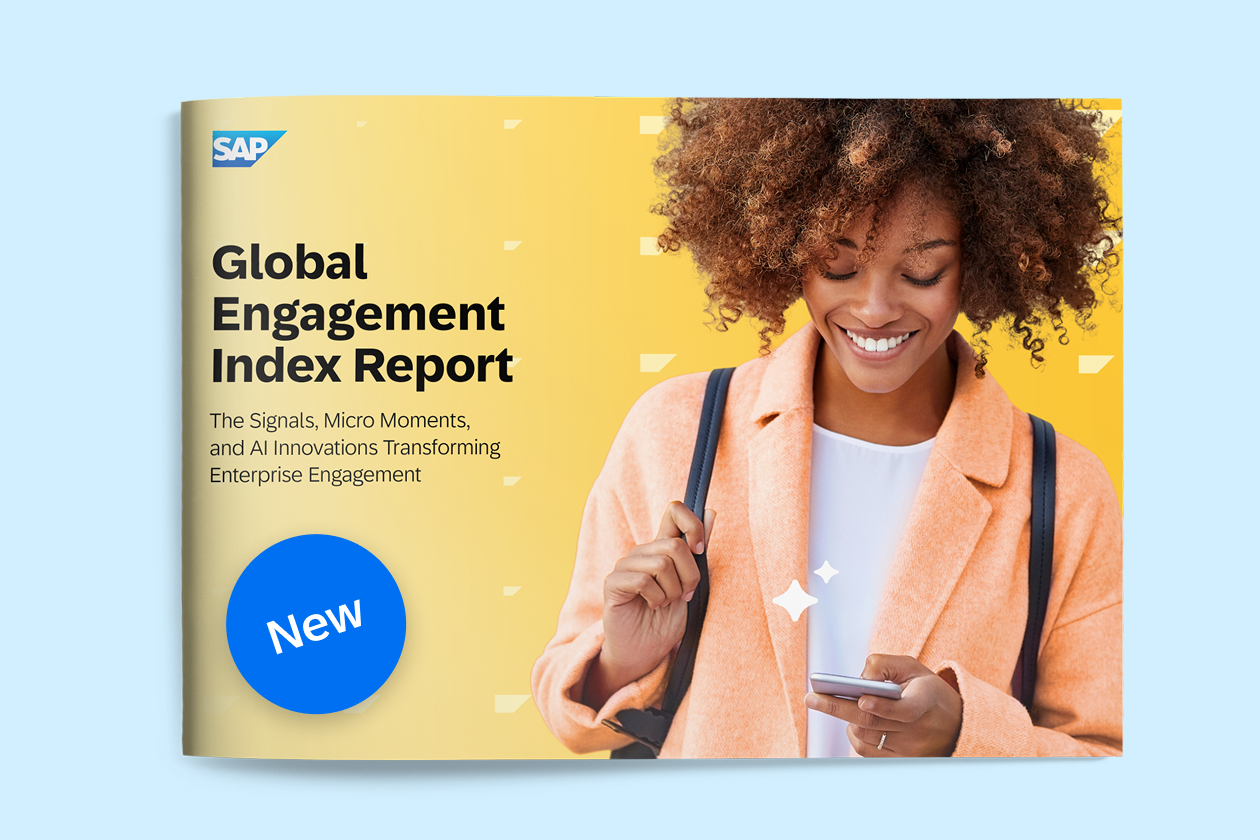
Global Engagement Index Report
New research reveals a significant perception gap between what brands think they deliver and what customers actually experience. See where you stand.