
|
Key Takeaways
|
|
Marketing sees behavior. ERP sees business reality. When the two connect, brands can act on the full picture rather than just half. Most marketers are flying blind on operational data. Inventory, fulfillment, purchase truth, and lifecycle behavior are the signals that most influence loyalty, and most marketing teams don’t have access to them. Five signals emerge when ERP and customer data connect: purchase truth, inventory reality, fulfillment experience, business optimization, and lifecycle growth. The autonomous enterprise gives marketers earlier alerts and faster context. That means shifting spend before opportunities disappear, not two weeks after. Getting post-purchase wrong now stands out more than ever. When a handful of competitors are nailing timing and relevance, the brands that miss the mark look amateur by comparison. Ethics and explainability aren’t optional. As marketing leads AI adoption across the enterprise, a clear paper trail and transparent data use are non-negotiable. |
Prior to joining SAP, I was a brand manager for global consumer product brands, including Diet Coke and Ferrero. And in each of those roles, I ran into the same paradox that every consumer brand marketer faces today.
We had more data than we knew what to do with. And somehow, we still kept missing the moments that actually mattered to our customers. Scenarios like this start to happen without connected data across the enterprise:
- An email to loyal customers is sent, pushing them to buy something they purchased three days earlier.
- A push notification was sent to their mobile app featuring a flavor that wasn’t on the shelf within ten miles of them.
- A “we miss you” campaign was activated the same week they made a repeat order.
This is probably why only 38% of customers believe brands know who they are and what they need, according to the SAP Global Engagement Index. Every one of those misses had the same root cause, and I didn’t realize it until years later. The signals were there. They were just sitting in a system that marketing had never been invited to use. If this could happen at the world’s largest beverage brand, my assumption is that this is happening to marketing teams across the globe.
The data that marketing has overlooked for years
Marketers, historically, have not cared about Enterprise Resource Planning (ERP) systems. And why would we? It sounded like a back-office system built for finance, operations, and supply chains (not marketers).
But your ERP is where the business truth lives. This is where you know exactly what customers actually bought. You can answer questions such as:
- What has shipped on time?
- What’s overstocked in the warehouse right now?
- What do margins look like on the SKU you’re about to feature in a campaign?
- What will someone run out of next Thursday?
I’ve started thinking about ERP as the unsung hero of marketing. It’s the nerdy kid in the back of the after-school movie who turns out to be the one who saves the day. It’s been there the whole time. We just weren’t looking, and well, integration can be challenging too. In fact, SAP & Foundry CIO Research revealed that 65% of brands say integration challenges prevent them from scaling AI across customer-facing processes.
When you connect that operational reality to what marketing already sees (behavior, engagement, intent), you stop guessing. Stop reacting. Stop optimizing in a silo while the rest of the business runs on a different set of facts. The result is more than better campaigns. You start to improve retention, reduce wasted spend, protect margins, and deliver more relevant customer experiences at scale. Your customers will recognize this effort and reward you with their loyalty.
"One thing that we noticed was in our email channel. Our e-commerce business does exclusive guitars, which are usually exclusive colors or different pickup configurations. And so we started noticing that our email audience was buying more exclusive guitars than anything else. That's really the thing that they cared about. So what we did for the first time was offer early access to one of these exclusive guitars to one, help generate email signups, but also run a loyalty-building activity and show our email subscribers some love. We generated a ton of sales before the guitar technically went on sale to the public. And now early access is something that we can do going forward and have data to support it."
The autonomous future changes the game
I know “Autonomous Enterprise” can sound like a phrase built to make people nervous. It shouldn’t.
The way I’ve come to see it, autonomous execution is like turning on the lights for the first time between departments that used to work in the dark. Supply chain, trade promotion, retail execution, marketing—all of it finally in the same conversation, in real time.
I imagine the Autonomous Enterprise working like this: you get an alert that a trade promotion is blowing up in a specific store cluster. The product is flying off the shelves.
- In the old model, Marketing keeps pumping paid media into that region for another two weeks because nobody told them to stop.
- In the Autonomous Enterprise model, you get an alert. You shift spending to a region or campaign that needs the push with content that seals the deal. You extend the moment where it’s working and protect the margin where it isn’t.
When you look at it this way, you can see more clearly that this model is not about AI taking over. Instead, AI is handing you a flashlight. And the marketers who lead the way will be the ones who define how AI works alongside people–reimagining how campaigns and content are managed.
Here at SAP, we believe that humans matter more than ever in the age of AI. Marketers set the intent. We bring creativity. We provide judgment and accountability. And AI handles the speed and the scale that no human team could ever match on its own.
What "getting it right" looks like for your customers
I am sure you already know the brands are doing this well. They send you the right message. They stop selling to you the second you’ve bought. They anticipate the replenishment before you’ve thought about it. They treat post-purchase like the beginning of the relationship, not the end.
And the brands that don’t stand out for the wrong reasons. Because in a world where a handful of your competitors are getting it right, missing the mark stands out more than it ever has before.
The eBook my team just published, The ERP Advantage: 5 Hidden Signals Driving Customer Loyalty, walks through five specific signals where this plays out: purchase truth, inventory reality, fulfillment experience, business optimization, and lifecycle growth.
Each one is a place where marketing sees half the picture, and ERP sees the other half. And each one is a place where AI can quietly stitch the two together and act with more precision.
Do this work with your eyes wide open
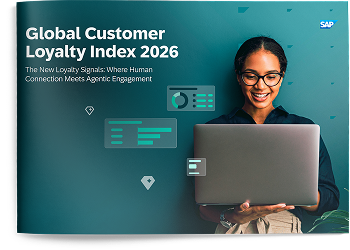
Marketing is among the earliest adopters of AI within most organizations. That’s a gift and a responsibility. As AI becomes more embedded in customer engagement, transparency becomes a competitive advantage. Marketers should be able to explain where customer data comes from, how it is being used, and how decisions are made. Trust is more than a compliance check box—it’s a critical part of the customer experience. In fact, our Global Customer Loyalty Index found that 34% of customers say irresponsible data use weakens loyalty.
So, get comfortable explaining, in five or six plain-language steps, how your data got where it is and why it’s fair to use. Pull yourself out of the digital fog every so often and imagine describing your customer strategy to a person who’s never worked in marketing. If you can’t explain it simply, you probably can’t defend it either. The paper trail matters. Trust matters. And the marketers who build both into the way they work now will be the ones setting the pace when the rest of the enterprise catches up.
Say hello to your new favorite data source
Your ERP has been sitting there this whole time, quietly holding the answers marketing has been chasing for years. It’s time to introduce yourself. Download The ERP Advantage: 5 Hidden Signals Driving Customer Loyalty and see exactly where the biggest missed moments are hiding in your business, and how to turn them into your next chapter of growth.

ERP Data for Marketers: FAQs
ERP (Enterprise Resource Planning) data covers the operational side of your business: what customers actually purchased, what shipped on time, what's sitting in your warehouse, and what margins look like on every SKU. Most marketers have never had access to it because ERP systems were built for finance and operations teams. But this data fills the gaps that behavioral and engagement data can't, giving you the full picture of what's happening after a customer clicks "buy."
It starts with integration between your ERP system and your customer engagement solution. When the two share data in real time, marketers can use operational signals (inventory levels, fulfillment status, purchase history) to trigger more relevant campaigns. Instead of promoting a product that's out of stock or re-engaging a customer who just placed an order, you're acting on what's actually true across the business.
ERP data surfaces five key signals that most loyalty strategies miss: purchase truth (what customers actually bought vs. what they browsed), inventory reality (what's available to promote), fulfillment experience (whether delivery met expectations), business optimization (where margins support promotional investment), and lifecycle growth (when a customer is ready for a replenishment or cross-sell).
The autonomous enterprise is SAP's vision for connecting every part of the business, from supply chain to marketing, so teams can act on shared data in real time. For marketers, that means getting automated alerts when conditions change (a promotion is outperforming in one region, stock is running low in another) and shifting spend or messaging before the opportunity disappears. The marketer still sets the strategy and the creative direction. AI handles the speed and scale.
About the author
Sunny Neely is a Customer Advisor in the Consumer Products Industry Business Unit for SAP, focused on customer experience and marketing. For the last 15 years, Sunny has worked with leading brands like Coca-Cola and Ferrero, honing expertise in brand growth strategy, content marketing, traditional and digital advertising, shopper marketing, sales effectiveness, product development, and consumer analytics.