
Customer engagement has never been more competitive.
Consumers move between brands faster, expect more from every interaction, and walk away from the ones that get it wrong. In this environment, the brands winning new customers and keeping them are the ones treating engagement as an operational discipline, not a campaign output.
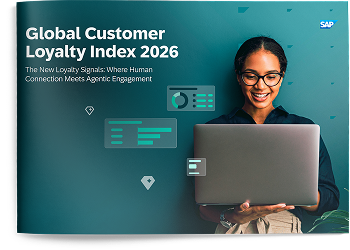
The 2026 SAP Global Engagement Index calls the gap between those two groups the Engagement Divide. The brands on the right side of it convert better, retain longer, and waste less marketing spend. The brands on the wrong side of it are watching loyal consumers start buying from their competitors.
In a recent SAP webinar panel discussion, practitioners from Essity, Sinch, and SAP unpacked what that looks like in practice. Across the conversation, five clear habits emerged that show how the fastest-moving brands are winning new customers and keeping them. Let’s take a closer look.
See What Separates the Brands Closing the Engagement Divide

1. Start Narrow, Prove Value, Then Scale
"Choose AI investments wisely. There could be a lot of prep work done upstream which will reap the benefits downstream. Apply it in bite sizes. No need to boil the ocean. Start with those high-frequency engagement moments which are ideal to optimize the customer engagement experience."
Most AI engagement programs stall because they’re scoped too broadly. Whole-customer-journey transformations are hard to measure, harder to debug, and tough to rally a team around. The brands who are moving fastest pick a single high-frequency engagement area, instrument it well, and ship it. From here, they measure results, and once the value has been proven, they expand upon it.
In the webinar, Venky shared a useful example of a premium coffee machine manufacturer. The brand pasted QR codes onto each unit in the field:
- Scan it, and the customer is instantly in a WhatsApp conversation with a trained agent.
- Send a video of the fault, get a fix.
- An AI agent handles the routine questions, and a human picks up the rest.
Narrow scope, provable value, measurable result.
What this looks like in practice: List key engagement touchpoints in your customer journey that happens daily or weekly. Pick one. Define the metric you're trying to move and capture a baseline. Then integrate AI. If it works, expand. If it doesn't, you've saved yourself months of work that likely wouldn’t have yielded results.
2. Run AI Behind the Scenes Before You Put It in Front of Customers
"When the consumer sees that, it feels a little bit synthetic. It can feel a little bit like, this is an AI agent, why? But when you use it to create product content or really create segmentation behind the scenes, that's where the power really lies."
Essity’s brands touch one in eight people every day, often in sensitive categories like incontinence and femcare. Trust took decades to build, and Daniele’s team is cautious about putting Gen AI directly in front of consumers in those moments. But behind the scenes, AI is everywhere:
- Product teams use it to automate configurations and content generation.
- Segmentation runs on it.
- Customer service agents use it to answer complicated medical questions without escalating to a product manager.
The customer never sees the seam, and the team spends less time on tasks and more time optimizing the experience.
What this looks like in practice: Audit where AI accelerates your team before you ask where it replaces them. The internal wins compound faster and carry less brand risk.
3. Treat Engagement as a Conversation, Not a Campaign
"The brands that get ahead in this Engagement Era are those who stop thinking of channels as just broadcast pipes, but treat them as relationship interfaces and ensuring that conversations stay seamless, whether it is in SMS or WhatsApp, and engaging them in an automated fashion, personalized, and also being able to hand off to a human agent at the right time."
In the Engagement Era, customers don’t want to feel like names on a send list. They expect brands to recognize what they’re trying to do, respond in the moment, and make the next step feel easy.
That means moving beyond one-way campaigns to conversations that give your customers a way to respond, ask questions, get support, and keep moving without starting again in another channel.
Venky shared the example of a customer who browses a favorite product, such as a dress or pair of running shoes, while it’s out of stock. Instead of sending a generic promotion later, the brand can trigger a personalized back-in-stock message on the customer’s preferred conversational messaging channel.
From there, the customer can then ask a question about the product, get a quick AI-powered answer, or move seamlessly to a human agent if the question needs more support. What could have been a simple notification becomes a guided path from interest to purchase.
What this looks like in practice: audit your highest-volume outbound campaigns. For each one, ask whether the channel can hold a reply, route to a human, and remember context across sessions. If the answer is no, that's the campaign to redesign first.
4. Use a Single, Unified Customer Profile as the Ground Truth
"On the unified customer profile, the challenge most brands face is not lack of data. The problem is the data is in silos. Identify a finite desired outcome that calls for a finite set of customer attributes to work together. No need to solve all the problems."
A unified customer profile means integrating your cross-channel data so every team in the business sees the same customer. Loyalty, e-commerce, support, brand, and trade marketing all reference the same record, with the same attributes, updated in the same place.
Ferrara is a great example of why this is so important.
Once the snack brand built a unified profile across its consumer touchpoints, the data surfaced something nobody had spotted: a substantial share of customers were eating Trolli and other Ferrara snacks while gaming. That insight became a new usage occasion, with sweepstakes and messaging built around it.
The result was a 60% increase in contactable customers in the database and a 20% increase in open rates against industry benchmarks. Without the unified profile, no one inside Ferrara would have spotted a behavior that was already happening across millions of pack purchases.
What this looks like in practice: don't try to unify everything at once. Pick one outcome that requires a finite set of attributes (purchase recency, channel preference, loyalty tier) and start there. Build the connections between systems for that outcome, prove the lift, then expand to the next.
5. Connect the Front Office to the Back Office
"What if that increased lift you're driving with that CX engine overshoots your available inventory and you don't have a real-time connection? You can go straight into a stockout and waste all of your marketing and sales expenses. The standardized data layer can drive the real-time connections between back office functionality and your front office customer engagement."
An engagement layer is only as valuable as the operational layer beneath it. Without it, a campaign that drives a 20% lift in demand can torch its own ROI if it pushes inventory past available stock, and a loyalty program built on out-of-date margin data can recommend products that lose money on every conversion. The brands operating at scale connect their CX activity to inventory, profitability, and cost of goods sold in real time, so marketing decisions reflect what the rest of the business already knows.
Molton Brown is the proof point. The premium beauty brand integrated SAP Commerce Cloud and Engagement Cloud with its ERP, which meant marketing activity sat on the same data layer as commerce, finance, and supply chain. The result was a 20% uplift in repeat purchases and a 5x increase in revenue from email.
What this looks like in practice: Tie one CX metric to one operational metric this quarter. Repeat purchase rate against margin per customer. Email-attributed sales against sell-through. One real-time connection changes how marketing decisions get made and where the budget goes next.
About the author
Mikkel Tophoj has worked in digital marketing for 11 years with a focus on strategy. As a Services Consultant at SAP Engagement Cloud and previous roles at agencies, he has helped Fortune 1000 brands across all industry verticals connect their data to create dream customer experiences and drive measurable results. Keeping up with innovation, he is focusing on how AI can amplify marketing efforts. He holds a BS in business administration with an emphasis in marketing and a minor in economics from CU Denver.