



Every satisfying customer experience follows a familiar pattern: A shopper browses a product on their phone during lunch, picks up where they left off on their laptop that evening, and receives a helpful recommendation the next morning that feels like the brand read their mind.
The journey is seamless. Every touchpoint remembers the last. The customer feels recognized. Not surveilled, not forgotten, just understood.
Now consider how most brand experiences actually feel. A customer spends twenty minutes on hold with support, finally gets their issue resolved, and wakes up the next morning to a cheerful “We miss you” email from the same brand.
A loyal shopper walks into a store, and the associate has no idea they’ve been a customer for three years. A first-time buyer completes a purchase and immediately gets retargeted with ads for the exact product they just bought.
Same brand, but completely different realities. One is the experience organizations believe they deliver. The other is the one customers actually receive.
This separation between what brands think they’re delivering and what customers are actually experiencing is what we call the Engagement Divide. In this article, we’ll explore the systemic challenges driving this divide and, critically, what organizations can do to close it.
Discover where your organization stands, and what it takes to close the Engagement Divide.

What Is the Engagement Divide?
For our 2026 Engagement Index, we surveyed 10,000 consumers and 4,800 senior decision-makers across six countries to measure the real state of customer engagement.
The headline finding is stark: 78% of businesses believe they deliver seamless experiences, but only 41% of consumers say brands recognize them as a person.
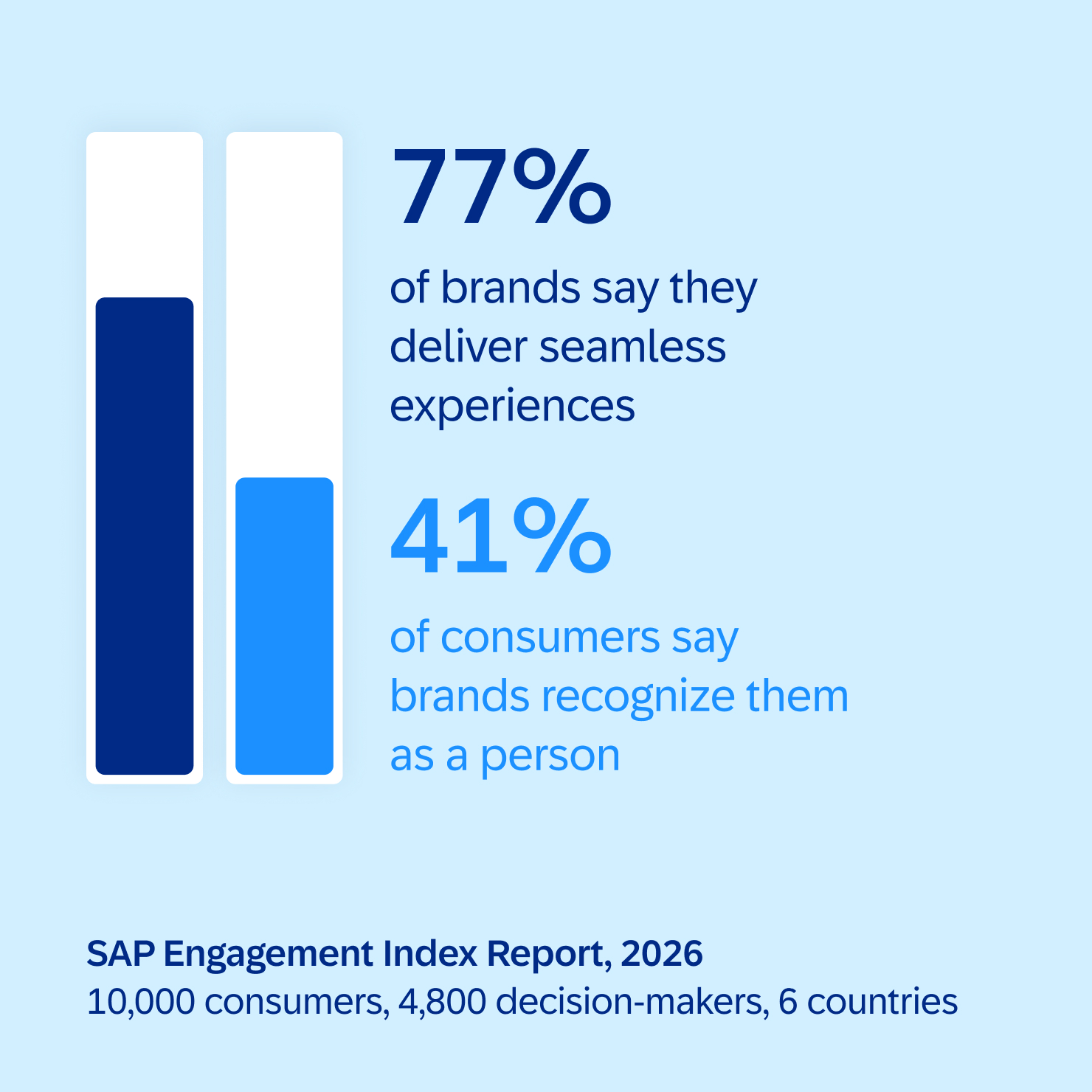
That 37-point gap is what we call the Engagement Divide, the distance between what customers need in the moments that matter and what brands are delivering. The Engagement Divide is rooted in disconnected teams, siloed systems, and data that can’t be activated in real time.
AI is compounding this Divide faster than most organizations realize. Consumers are already using AI to compare, evaluate, and switch brands in seconds. Meanwhile, most enterprises can’t activate enough of their data to make AI effective, and the longer the gap persists, the harder it becomes to close.
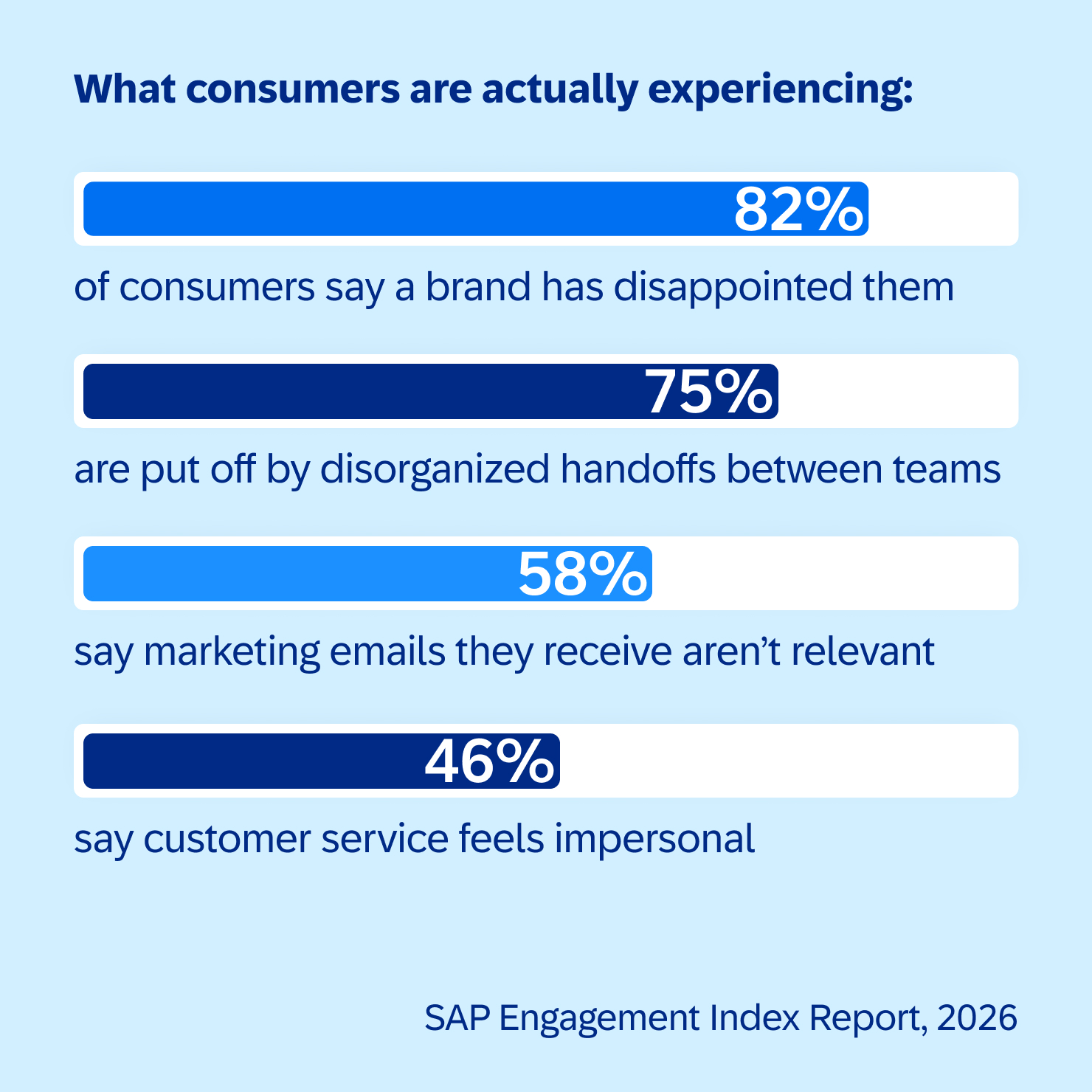
In our research, we found that:
- 82% of consumers have been disappointed by a brand.
- 58% say the marketing emails they receive aren’t relevant.
- 75% are put off when a brand passes them between multiple teams to resolve a single issue.
- 46% of consumers say customer service feels impersonal.
- 66% of brands can’t use AI to optimize campaign performance.
Consumers aren’t asking for perfection. They’re asking to be recognized, to receive relevant communication, and to experience consistency across every interaction.
When that doesn’t happen, they disengage – often quietly, without a complaint, and without a cancellation. They simply move on.
The Challenges Costing Brands Loyal Customers
In the Engagement Index, we identified four systematic challenges that are fuelling this:
1. Brands are investing in AI they can’t fully use
There’s no shortage of ambition when it comes to AI. 78% of businesses see AI as essential for acquiring and retaining customers, and 77% say they already have AI guardrails in place. The intent is there.
But the infrastructure to act on it often isn’t. 66% of brands can’t yet use AI to optimize campaign performance, and 78% can’t practice real-time AI optimization in their day-to-day campaigns. Without connected, structured, real-time data feeding into AI systems, even the most sophisticated solutions can’t deliver the personalized experiences consumers are starting to expect.
And that expectation is forming fast. 12% of consumers already expect brands to use AI or automation to speed up and simplify their experience. It’s a small number today, but it’s a leading indicator. The brands that connect AI to their customer data now will be ready when that expectation becomes the norm. The ones that don’t will find themselves widening the divide further.
2. The experience consumers expect isn’t the one they receive
48% of consumers care more about the overall experience than the brand itself. Yet 78% of businesses believe they’re already delivering seamless experiences across channels.
This confidence gap is at the core of the divide.
Consumers want relevance, transparency, and simplicity. What many organizations deliver is inconsistency, over-contact, and generic content.
Consider a common scenario: a customer purchases a product and immediately receives ads for that same product. Or they start a journey on mobile that the website has no memory of. These are clear signals that the experience isn’t designed around the customer.
3. Brands collect data they can’t activate
Organizations have never had access to more customer data, but despite this, our research uncovered that:
- 54% of enterprises in our study can’t access and use it in real time.
- 60% suffer from dark data, information that’s collected but never analyzed or connected.
- 55% acknowledge that their data is too unstructured to use effectively.
Meanwhile, consumers are moving faster and faster, with 30% reporting having already used AI agents that make decisions and act on their behalf when purchasing from brands.
When organizations can’t match that speed with relevant, personalized responses, the gap widens. And as dark data grows, customers become increasingly wary of what data they’re sharing, and what they’re actually getting in return.
4. Engagement happens everywhere, but no one owns it
Engagement is shaped across the entire business, from marketing to sales, and operations to customer service. But our data reveals deep operational silos. Only 2 in 5 decision-makers believe their departments are truly coordinated, and 46% of consumers say customer service feels impersonal as a result.
When teams can’t see the same customer data, the consequences are immediately felt.
A promotional email arrives the same morning a customer had a frustrating service interaction. The loyalty program doesn’t reflect what happened in-store. Each business function optimizes its own touchpoint, but the customer, who experiences the brand as one entity, feels the disconnect.
How to Close the Engagement Divide
The Engagement Divide isn’t inevitable. Our research found a clear tier of organizations that have closed it by treating engagement as an enterprise-wide discipline, not a marketing-only responsibility:
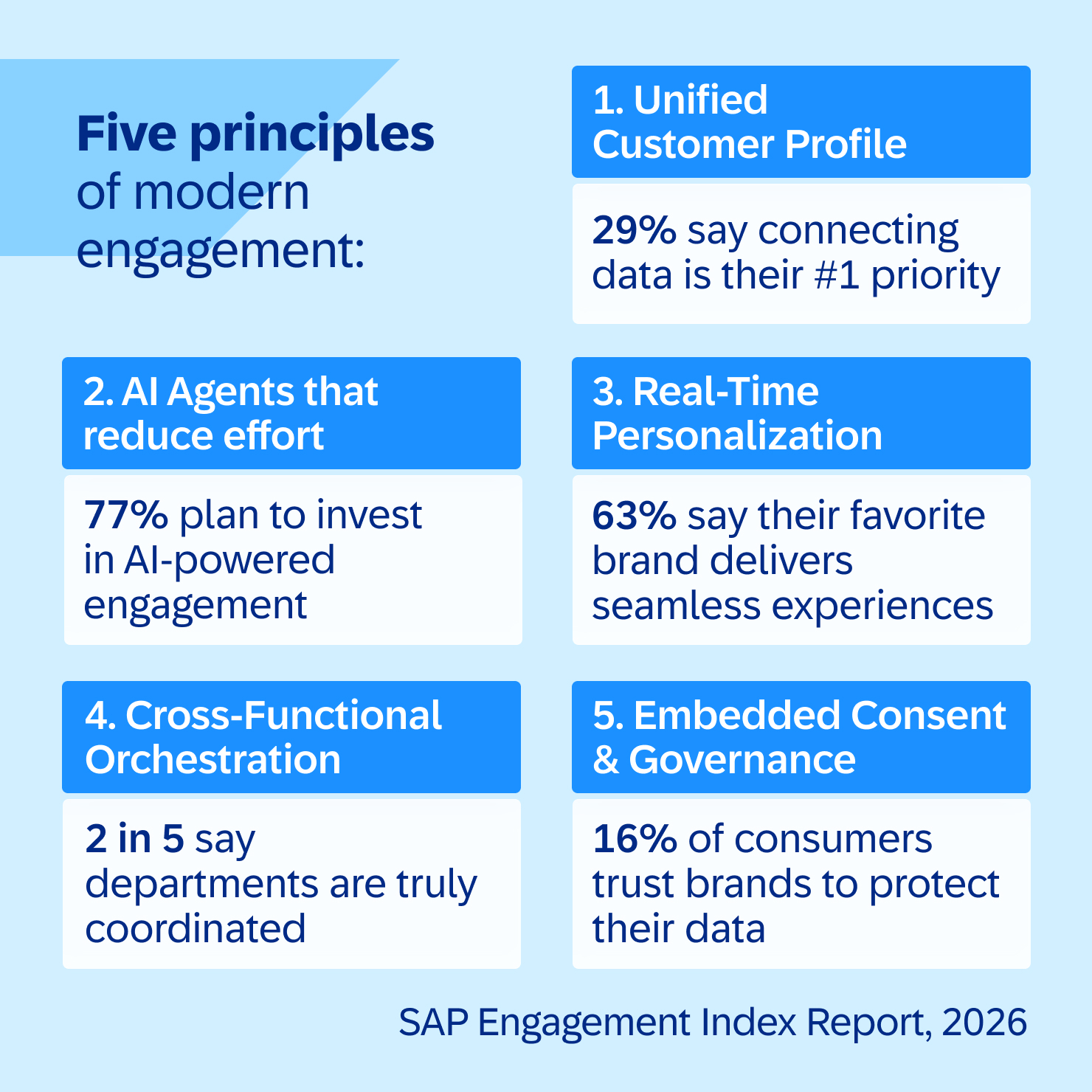
1. Build a unified customer profile
The disconnects that widen the Engagement Divide, like conflicting messages and impersonal service, almost always trace back to the same root cause:
Teams are working from different versions of the customer.
The fix starts with building a single, real-time customer profile that every department can access. When your service agent can see what marketing just sent, and marketing can see that a delivery was delayed, the customer experience changes from a series of disjointed interactions into one connected, ongoing customer conversation.
2. Deploy AI across the customer journey
Many organizations treat AI as a separate capability: A standalone tool for generating content, predicting churn, or optimizing a campaign. The problem with this is that customer engagement doesn’t happen in isolation. Engagement unfolds across marketing, commerce, service, and operations. When AI sits outside of those workflows, it can improve individual tasks, but rarely the overall experience.
The organizations closing The Engagement Divide are taking a different approach. Instead of bolting AI onto existing systems, they’re using purpose-built AI marketing solutions like SAP Engagement Cloud to embed it across the entire customer lifecycle, enabling it to act on real customer data in real time across every touchpoint.
With this approach, AI becomes part of your business’s operational fabric, helping your teams move faster and make smarter, data-backed decisions throughout the customer journey. For example, embedded AI can help organizations:
- Automatically trigger campaigns based on real-time behavior
- Generate and personalize content across channels
- Recommend next-best actions for customers
- Identify high-value segments and emerging trends instantly
- Surface insights that would usually require weeks of analysis
Instead of manually coordinating dozens of systems and processes, your team can focus on strategy while AI manages the complexity of execution.
3. Personalize content in real time
First-name personalization was groundbreaking in 2010. Today, it’s table stakes, and consumers know the difference: only 29% of shoppers believe brands personalize content to their actual needs.
Closing the Engagement Divide requires personalization that responds to what customers are doing right now, not what a cohort did last quarter. This starts with connected customer data that updates continuously and AI that can interpret those signals as they happen.
With that foundation in place, you can adjust engagements in the moment, suppress irrelevant messages, recommend relevant products, and tailor content across channels based on real-time customer behavior.
4. Orchestrate across functions, not just channels
When engagement is owned solely by marketing, it’s measured by marketing metrics like opens, clicks, and conversions, but this doesn’t reflect how customers experience your brand. They experience it across a journey that touches sales, service, logistics, and product.
The organizations at the top of our maturity index have redrawn the lines.
They measure engagement by retention, loyalty, and lifetime value. They’ve replaced channel-specific silos with event-driven workflows that coordinate actions across the business. When a customer completes a purchase, the journey doesn’t end at the confirmation email. Instead, it continues through fulfillment, delivery communication, and post-purchase support, all orchestrated as one experience. This is the shift from running campaigns to managing customer relationships.
5. Embed consent and governance from the start
None of the above matters if customers don’t trust you with their data. And right now, most don’t:
The organizations that get this right don’t treat consent and governance as a compliance checkbox separate from their engagement systems. They build it in from the start, with embedded guardrails that ensure every personalized interaction is ethical, transparent, and customer-first.
When your customers can see that their data is being used to genuinely improve their experience, not just to sell to them, they share more, engage more, and stay longer.
The Road Ahead
The Engagement Divide is real and measurable, but it’s also closing for the brands that choose to act. The organizations seeing progress are the ones making AI work in their favor by connecting data across the business, aligning teams around shared customer outcomes, and treating every interaction as part of one coherent relationship.
This isn’t a small change, but it’s an achievable one. And our Global Engagement Index provides the data, the maturity framework, and the benchmarks to help you understand exactly where your organization stands and where to focus next. I encourage every marketing and CX leader to explore the full findings and assess where your organization sits today.
Discover where your organization stands, and what it takes to close the Engagement Divide.
About the author
Sara has more than 15 years of experience in senior global marketing roles at high-growth martech organizations including Clicktale, IBM Tealeaf, Acquia, & Unica. Her passion is for building marketing teams that act as a trusted partner to the sales organization. Sara excels in strategy and communications which deliver measurable pipeline and revenue. Sara holds a BA from the University of California in Los Angeles.