
In an era where consumers compare, decide, and switch brands in an instant, customer engagement has become the defining factor between brands that grow and brands that get left behind.
With AI reshaping expectations and loyalty becoming more fragile than ever, the gap between what customers expect and what most organizations can deliver—what SAP calls the Engagement Divide—is widening. The brands closing that divide are the ones investing in connected data, real-time personalization, and engagement strategies that span the entire business, not just the marketing department.
To help you build the case for customer engagement (or sharpen the strategy you already have), we’ve compiled 24 of the most important customer engagement statistics for 2026. Drawing from SAP’s original research, including the 2026 Engagement Index Report and the 2025 Customer Loyalty Index, these stats paint a clear picture: brands that engage customers effectively win. Those that don’t, lose them.
Let’s dive in.

General Customer Engagement Statistics
Before we dig into specific areas like loyalty and retention, let’s set the scene. These statistics capture the current state of customer engagement, including how consumers feel about the brands they interact with, and how far many organizations still have to go.
1. 75% of consumers are put off by disorganized brands that pass them between multiple teams to solve a single problem [SAP Engagement Index 2026]
This statistic underscores why customer engagement can’t be siloed within a single team. It has to be an enterprise-wide discipline. Three out of four consumers are actively turned off when their challenges can’t be solved with a single point of contact. Being bounced between departments, repeating your issue to multiple people, or hitting dead ends in customer service can seriously harm engagement.
2. Yet 78% of businesses believe they deliver a seamless experience across channels [SAP Engagement Index 2026]
Here’s the disconnect: while three-quarters of consumers feel frustrated by fragmented experiences, nearly 4 in 5 businesses think they’re delivering seamless ones. This perception gap, the Engagement Divide, is one of the biggest threats to customer relationships today.
3. 82% of consumers admit that a brand has disappointed them [SAP Engagement Index 2026]
More than 4 in 5 consumers can recall a time a brand let them down. Whether it’s a missed delivery, irrelevant marketing, or a clunky service experience, these moments erode trust and make it harder to earn loyalty. The takeaway? Every interaction is a chance to either strengthen or damage the relationship.
4. 63% of brands are stuck at the “developing” stage of engagement maturity, with only 21% reaching high maturity [SAP Engagement Index 2026]
SAP’s Engagement Maturity Index reveals that most brands remain in the middle tier. They’ve adopted some engagement technologies but still struggle with disconnected systems, siloed teams, and data that can’t be activated in real time. Only about 1 in 5 brands have reached a level of maturity where data, intelligence, and action are connected across the business. The gap between “developing” and “established” is where competitive advantage lives.
5. 58% of consumers think that most marketing emails they receive aren’t relevant [SAP Engagement Index 2026]
Email remains one of the most powerful engagement channels, but the majority of consumers feel like brands are missing the mark. When nearly 6 in 10 consumers say the emails they receive don’t resonate, it’s a clear signal that batch-and-blast approaches are failing. Relevance, powered by real-time data and AI-driven personalization, is what separates the emails customers open from the ones they ignore.
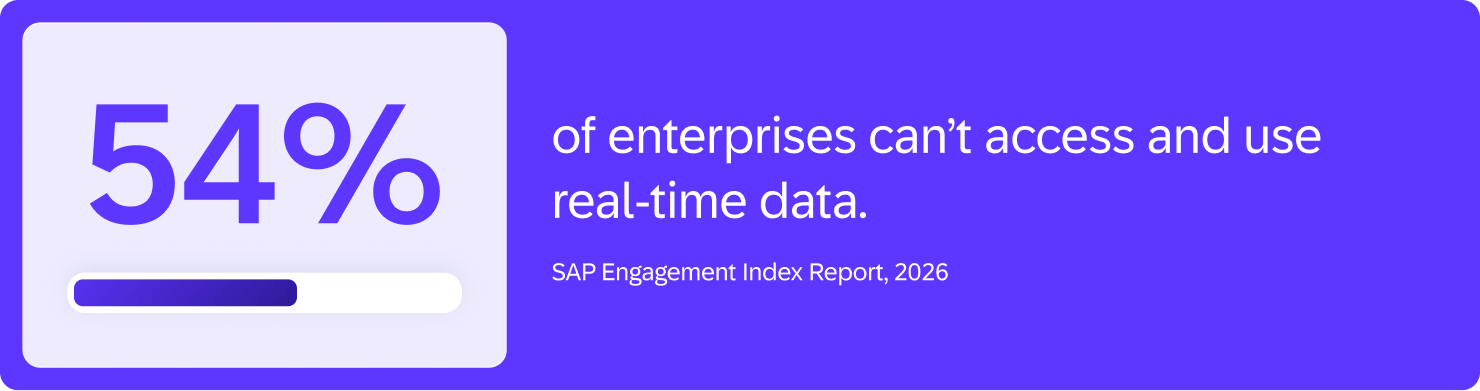
6. 54% of enterprises can’t access and use real-time data [SAP Engagement Index 2026]
Over half of enterprise organizations are sitting on data they can’t activate when it matters most. Without real-time access, brands are making decisions based on outdated insights, delivering experiences that feel generic, and missing the micro moments where engagement happens.
7. 84% of brands don’t excel in differentiating themselves with personalization [SAP Customer Loyalty Index, 2025]
The vast majority of brands know personalization matters, but very few are doing it well. When 84% of businesses can’t differentiate through personalized experiences, it signals a massive opportunity. The brands that crack personalization by delivering contextually relevant content, offers, and interactions will stand out in a crowded market.
8. 48% of consumers care less about the brand and more about the overall experience [SAP Engagement Index 2026]
Nearly half of consumers are telling brands something crucial: your name and reputation alone won’t keep them. What matters is how seamless, personalized, and effortless the experience feels. In a space where consumers have endless alternatives, the experience you deliver is the brand. This stat is a wake-up call for any organization still relying on brand equity alone to drive engagement.
9. Only 38% of consumers believe brands know who they are and what they need when contacted [SAP Engagement Index 2026]
Less than 4 in 10 consumers feel recognized and understood by the brands they interact with. That means the majority of customers experience a disconnect between the data they’ve shared and the service or marketing they receive. Closing this gap requires a unified customer profile—one that connects data across marketing, sales, service, and commerce—so every interaction feels informed and relevant.
Customer Engagement and Retention Statistics
Acquisition gets the headlines, but retention is where sustainable growth lives. Customer engagement and retention are deeply intertwined because when brands engage customers meaningfully, they stay longer, spend more, and cost less to serve. These statistics highlight why doubling down on retention through engagement is one of the smartest moves a brand can make.
10. 60% of consumers don’t pay attention to brands if the product meets their needs [SAP Engagement Index 2026]
This is a stark reminder of how easily brands can fade into the background. To stay top of mind, brands need ongoing engagement that adds value beyond the product itself — think personalized recommendations, loyalty rewards, and proactive service.
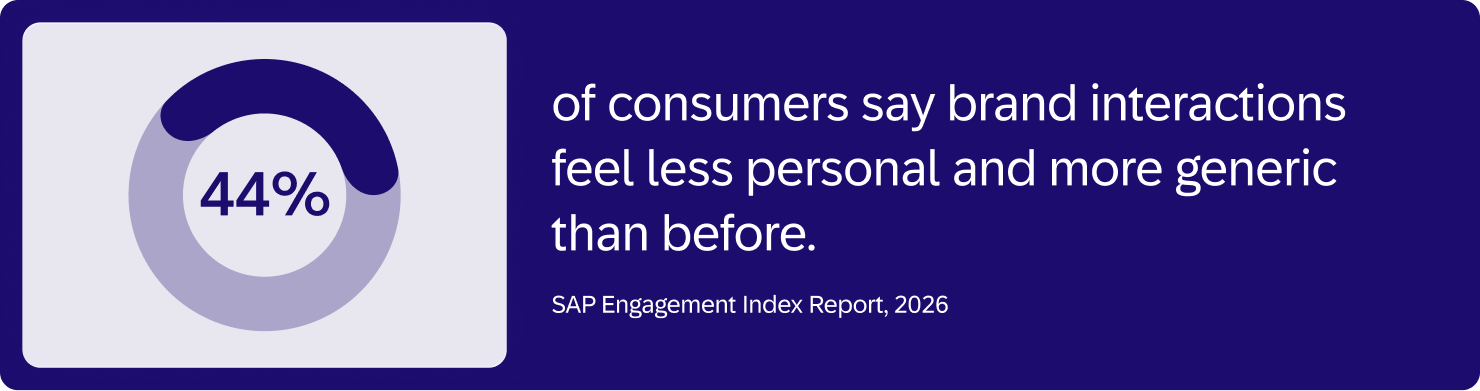
11. 44% of consumers say brand interactions feel less personal and more generic than before [SAP Engagement Index 2026]
Despite the explosion of marketing technology and AI tools, nearly half of consumers feel like their brand experiences are getting worse, not better. This suggests that many organizations are scaling output without scaling relevance. More campaigns don’t equal better engagement. What matters is whether each interaction feels like it was designed for the individual.
12. 54% of consumers say lower product quality is the top reason they leave a brand [SAP Customer Loyalty Index 2025]
Quality remains the foundation of retention. More than half of consumers cite a drop in product quality as the number one reason they’d abandon a brand, followed by price increases (49%) and poor customer service (47%). While engagement strategies can drive loyalty and advocacy, they can’t compensate for a product that doesn’t deliver. Engagement and product excellence must work hand in hand.
13. 28% of consumers have switched brands due to “boredom” [SAP Customer Loyalty Index 2025]
More than 1 in 4 consumers have left a brand simply because the relationship went stale. This is a powerful reminder that retention is about continuously delivering fresh, relevant experiences. Triggered journeys, personalized content, and timely engagement based on customer behavior can keep the relationship dynamic and prevent the quiet churn that “boredom” represents.
14. Increasing customer retention rates by 5% increases profits by 25% to 95% [Bain & Company]
This classic Bain & Company insight remains one of the most cited statistics in customer strategy, and for good reason. Even modest improvements in retention have an outsized impact on profitability. Retained customers cost less to serve, spend more over time, and are more likely to refer others. When you pair this economic truth with the engagement statistics above, the case for investing in customer engagement becomes impossible to ignore.
Customer Engagement and Loyalty Statistics
Loyalty is the ultimate outcome of sustained, meaningful customer engagement. But in 2026, loyalty looks very different than what it did even a year ago. True Loyalty is declining, trend-driven loyalty is rising, and consumers are more discerning than ever about which brands earn their attention. These statistics reveal what’s driving (and undermining) customer loyalty today.
15. 68% of consumers say they’re loyal to a brand, returning to pre-2022 levels [SAP Customer Loyalty Index 2025]
After peaking at 77% in 2022, the percentage of consumers who consider themselves loyal to a brand has fallen back to 68%, the same level seen in 2021. Economic uncertainty, rising prices, and a flood of alternatives have made loyalty harder to hold onto. The message is clear: loyalty can’t be taken for granted. It must be earned and re-earned at every touchpoint through consistent, personalized engagement.
16. True Loyalty dropped 5% from 2024 to 2025—the most significant decline in 5 years [SAP Customer Loyalty Index 2025]
SAP’s Customer Loyalty Index tracks six types of loyalty, and “True Loyalty”, the deepest, most unwavering form built on trust and devotion, has taken its biggest hit since tracking began. This decline signals that even brands with strong emotional bonds are vulnerable. In its place, Trend Loyalty, short-lived and driven by social media buzz, is gaining ground. Brands need to focus on the fundamentals of engagement to convert fleeting attention into lasting relationships.
17. 23% of consumers say batch-and-blast marketing actively damages their loyalty [SAP Customer Loyalty Index 2025]
Nearly a quarter of consumers say generic marketing actively makes them less loyal. Every irrelevant email, push notification, or ad risks pushing a customer away rather than drawing them closer. This is one of the strongest arguments for AI-powered segmentation and real-time personalization.
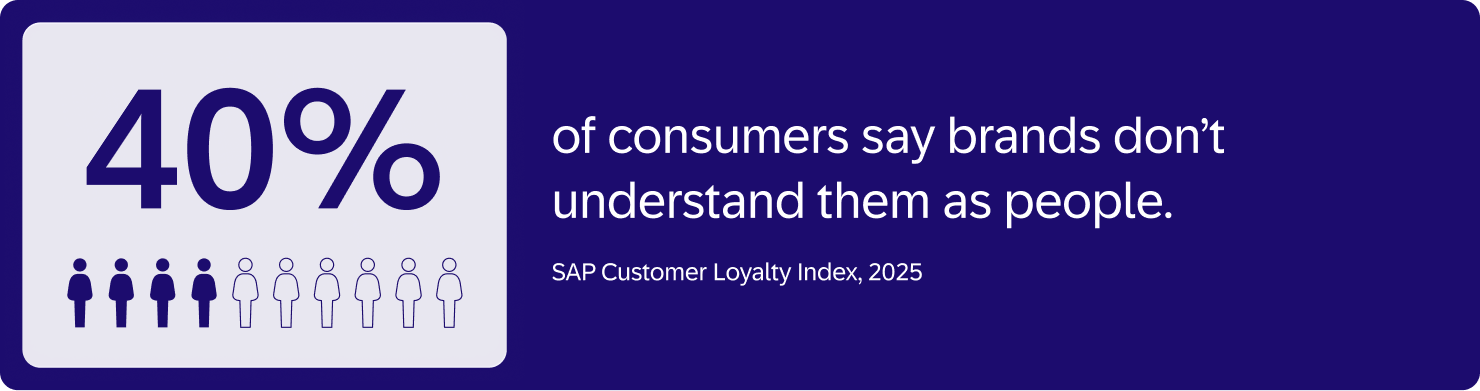
18. 40% of consumers say brands don’t understand them as people [SAP Customer Loyalty Index 2025]
Two in five consumers feel like brands see them as data points rather than individuals. This disconnect between data collection and genuine understanding is one of the root causes of the Engagement Divide. Brands collect more customer data than ever, but if that data doesn’t translate into interactions that feel personal and human, it’s doing more harm than good. The fix? Unified customer profiles that connect the dots across every channel and touchpoint.
19. 64% of consumers are more likely to spend with a brand if they have a loyalty card or subscription [SAP Customer Loyalty Index 2025]
Loyalty programs still work when they’re done right. Nearly two-thirds of consumers say having a loyalty card or subscription makes them more likely to spend with that brand. But the bar is rising. Consumers now expect personalized rewards, exclusive access, and seamless experiences across channels, not just points and discounts. Brands that treat their loyalty programs as engagement platforms, not just reward schemes, will see the biggest returns.
20. 59% of consumers cite high-quality products as the top driver of loyalty [SAP Customer Loyalty Index 2025]
Product quality remains the number one reason consumers stay loyal. But it’s no longer enough on its own. Behind quality, consumers also value a wide product range (41%), discounts and loyalty incentives (39%), and excellent customer service (37%). The brands winning at loyalty are those that deliver on the product promise and surround it with engagement experiences that deepen the relationship.
Omnichannel Customer Engagement Statistics
Omnichannel engagement, the ability to deliver consistent, connected experiences across every channel and touchpoint, is the new table stakes for brands serious about customer engagement. But there’s a significant gap between where consumers spend their time and where brands are showing up. These statistics reveal the state of omnichannel customer engagement in 2026.
21. 63% of consumers say their favorite brand delivers seamless, connected experiences across mobile, web, and in-store [SAP Engagement Index 2026]
The brands that earn ‘favorite’ status are the ones that show up consistently everywhere. Nearly two-thirds of consumers identify seamless cross-channel experiences as a hallmark of the brands they love most. And consumers aren’t asking brands to be on every platform — they’re asking for the experience to feel connected and coherent, whether they’re browsing on their phone, shopping online, or walking into a store.
22. 41% of consumers prefer mobile apps to shop, but only 28% of brands engage via mobile apps [SAP Engagement Index 2026]
There’s a 13-percentage-point gap between where consumers want to shop and where brands are meeting them. Similarly, 43% of consumers prefer online shopping while only 26% of brands engage via web and e-commerce, and 26% of consumers (43% for Gen Z) shop on social media while only 30% of brands engage via social content. These channel misalignments represent missed opportunities to engage customers where they already are.
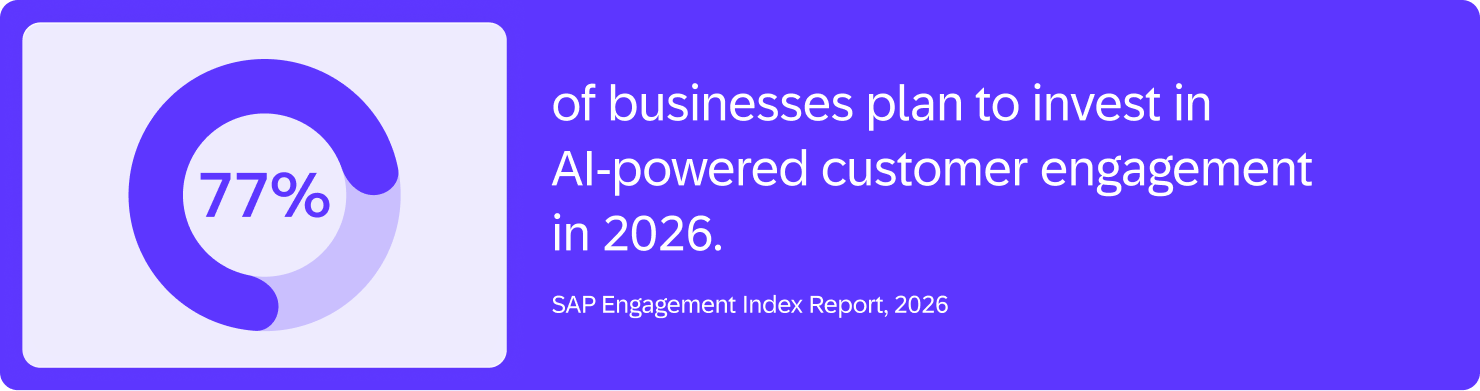
23. 77% of businesses plan to invest in AI-powered customer engagement in 2026 [SAP Engagement Index 2026]
The intent is there. More than three-quarters of businesses recognize that AI is essential to the future of customer engagement and are planning investments accordingly. But intent alone won’t close the Engagement Divide. With 54% of enterprises still unable to access real-time data and fewer than 40% sharing engagement data with their CX or CRM platforms, the gap between AI ambition and AI readiness remains significant.
24. 69% of consumers say email is the most useful communication channel, followed by SMS (43%) and direct mail (43%) [SAP Customer Loyalty Index 2025]
Despite the rise of new channels, email continues to dominate consumer preferences. But the keyword here is “useful”. Consumers value email when it delivers relevant, timely content, not when it floods their inbox with generic blasts. With SMS and direct mail tied for second, the takeaway is clear: a true omnichannel strategy doesn’t mean being everywhere. It means being useful and relevant on the channels your customers actually prefer.
Omnichannel Customer Engagement Is a Necessity in 2026
Consumers are more discerning, less patient, and quicker to switch than ever before. Loyalty is declining. The gap between what customers expect and what brands deliver is widening. And yet, the opportunity has never been greater for brands willing to treat customer engagement as a true enterprise-wide discipline.
The brands that will thrive in 2026 and beyond are those that connect their data, align their teams, and use AI to deliver personal, relevant experiences at every touchpoint. Customer engagement isn’t a marketing initiative. It’s a business strategy. And the time to invest in it is now.
About the author
Ellie Quacquarelli is a Strategic Consultant & Team Lead at SAP Engagement Cloud in London. With 10+ years of experience, she helps businesses develop customer-centric CRM strategies and measure ROI in an era of evolving email privacy. Passionate about enhancing customer experiences, Ellie specializes in driving meaningful audience connections across marketing channels, working closely with brands to optimize engagement and long-term retention.