


For the first time in our five years of conducting research for the Customer Loyalty Index, we’ve seen a decline in customer loyalty globally. This should set off alarm bells across industries, especially FMCG, which historically has struggled to understand and engage customers beyond the retail shelves.
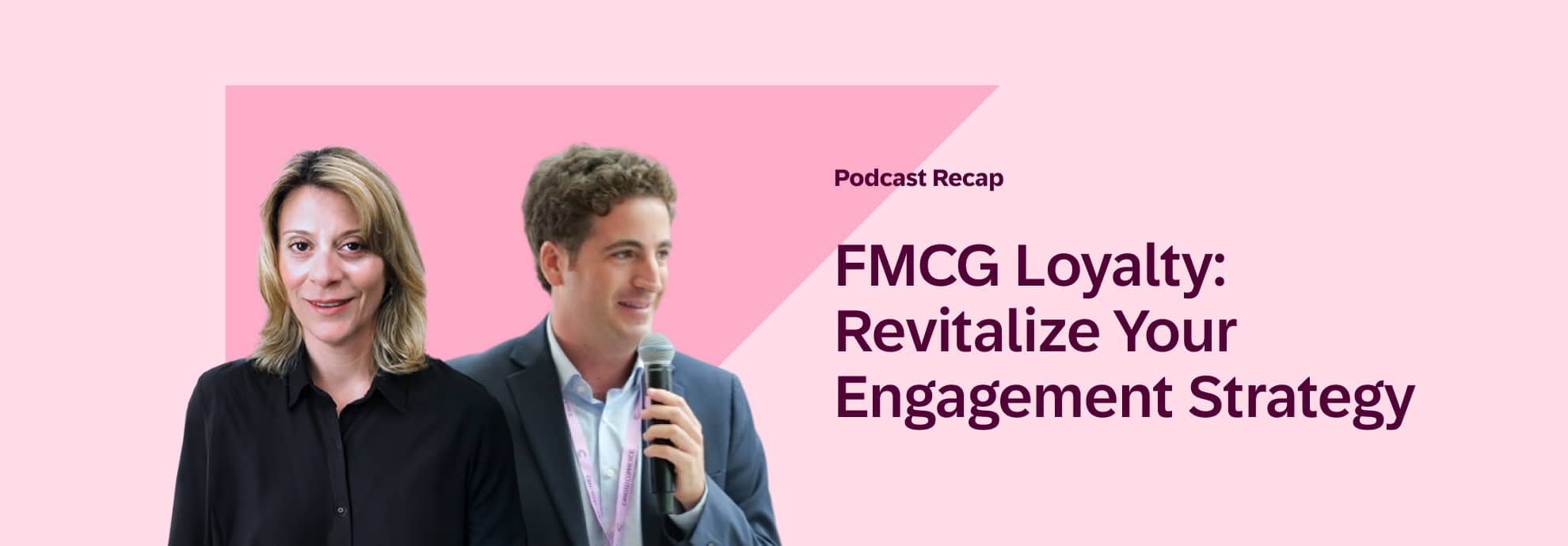
Daniel Torres Dwyer, host of The FMCG Guys podcast, interviewed Sara Richter, CMO of SAP Engagement Cloud, to discuss consumer loyalty and how brands can close the gap in consumer engagement to build true loyalty.
According to Sara, the decline is a wake-up call to brands that they need to rethink their CX strategy.
“Brands are not engaging with their customers in the right way. They’re not thinking about involving their engagement strategies. They’re not looking to provide that seamless experience. They’re not activating the data. They’re not personalizing. Those are basics now. Personalization is a competitive imperative.”
Following are our top takeaways from the podcast, FMCG Loyalty: Revitalize Your Engagement Strategy, that will help you rethink customer loyalty for 2026!
1. Put Customer Loyalty at the Center of Your Organization
Loyalty isn’t a static result, but rather a sentiment. The challenge is that sentiments are complex, ever-changing, and they’re influenced by a wide range of factors.
The ownership and responsibility for nurturing loyalty in consumers—to engage them, increase lifetime value, and even promote advocacy—belongs to the entire organization. Creating a loyalty program and expecting it to be the sole driver behind loyalty is short-sighted.
Sara makes a powerful statement that’s worth repeating: Everything the company does needs to be structured around understanding the customer and customer loyalty.
Takeaway Actions:
- Establish cross-functional objectives that are loyalty-oriented.
- Review KPIs across the organization. How are you measuring loyalty? Do the metrics you currently measure foster customer loyalty?
2. Get to Know the 6 Types of Customer Loyalty
Not all customer loyalty manifests in the same way. While one shopper may buy your product whenever a discount is available, another might quietly buy your product on a regular basis but never engage outside of those purchases.
The Customer Loyalty Index, Global Edition explores the different ways consumers engage based on responses from 10,000+ consumers. This in-depth research reveals six types of loyalty:
- Trend Loyalty (NEW): Newly revealed this year, Trend Loyalty is a fleeting type of loyalty based on popularity, viral movements, and cultural relevance or momentum.
- True Loyalty: This is the deepest form of loyalty, an unwavering devotion toward the brand that’s based on a long history of trust and positive experiences.
- Incentivized Loyalty: The customer’s loyalty is dependent on rewards and discounts. The inherent weakness of this type of loyalty is that as soon as a better deal comes along, the customer is quick to switch brands.
- Inherited Loyalty: This type is based on a brand’s traditions or heritage, or it could even be passed down within a family. It could also be shared via association with other brands.
- Silent Loyalty: Customers make repeat purchases but avoid endorsing or recommending the brand.
- Ethical Loyalty: Customers are loyal to the brand based on the brand’s alignment to their personal values.
The types of loyalty have a certain degree of overlap and fluidity to them. A consumer’s loyalty type may change depending on their interactions with the brand. For example, say a brand launches a new product, putting extra promotion behind it and partnering with influencers. This can help establish Trend Loyalty, and from there, the brand can gradually deepen and grow that into True Loyalty based on positive, personalized experiences.
Takeaway Action:
- Create a map of your customer loyalty lifecycle.
- Identify key moments when the customer’s loyalty type is likely to change and then create programs that foster True Loyalty.
3. Prioritize Customer Data and Personalization
The FMCG brands leading the way are the ones that are breaking the mold. They’re engaging with customers directly, whether through innovative campaigns, loyalty programs, or other initiatives. As they engage, they’re gathering data, granting them insights about their customers and the ability to activate that data to deliver more relevant, personalized messages across channels.
Brands like Wella Company, Ferrara, and Bioré are great examples of how this is done.
Bioré launched a new suncare product in the US, where the market is highly competitive. The brand leveraged AI for personalization, measured and activated customer data, partnered with influencers on TikTok, and launched an email campaign. By bringing together their data and channels, Bioré achieved a 30% sell-through rate.
Takeaway Action:
- Review your data infrastructure to ensure the foundation supports your objectives. Is customer data unified across the organization? Can you measure and activate it?
- Ensure the data you collect is being leveraged. Customers need to feel that there’s a valid reason to share personal data and that they’re receiving a value exchange.
4. Understand What Drives Loyalty from Gen Z to Boomers and Beyond
Loyalty not only comes in different types, but it also manifests differently across generations. Sara went into great depth about this throughout the podcast, but here’s a particularly insightful clip that touches on multiple generations:
In addition to these insights from the Customer Loyalty Index about Gen Z, Millennials, and Baby Boomers, Sara went on later to share a story about how an SAP Engagement Cloud customer made a surprising discovery. The brand has an older target audience, the Baby Boomer generation. When trialing a new referral program, it turned out that SMS was a highly effective channel for engagement, which no one had predicted.
As Sara explained, “They took the time to understand their audience and try a new channel, and they learned something about how their customers wanted them to communicate with them.” Testing is believing!
Takeaway Action:
- Examine your target audience not just in terms of age, but also how their generation may influence how they show their brand loyalty.
- Be careful about the assumptions you make about your target audience based on generation! Test new channels to see what actually resonates.
5. See Why FMCG Loyalty Is Booming in the UK (Spoiler: Loyalty Programs Saved 2025)
Although loyalty is trending downward around the globe, the UK has seen a powerful spike in loyalty toward FMCG brands, with an increase of 13 points year over year. But… why?
With 39% of UK FMCG brands using more loyalty schemes, it’s safe to say they were ahead of the curve on addressing the current loyalty recession.
“Loyalty” isn’t all about points and rewards, though, and this is critical to remember when so many consumers are price-sensitive. An omnichannel journey that delivers value in exchange for data becomes a powerful loyalty driver.
Loyalty programs and even loyalty strategies have to be about helping consumers stay engaged consistently.
Takeaway Action:
- Already have an existing loyalty program? Review it to ensure you’re demonstrating value, educating customers about your product, and activating the data you collect to enhance the customer journey across channels.
- Don’t have an existing loyalty program? Review your buyer funnel. Where and when are customers likely to churn? SAP Engagement Cloud has pre-built tactics for predicting and preventing customer churn.
Where to Go from Here?
In a world where personalization is a competitive imperative, FMCG brands must ensure each touchpoint throughout the journey is tailored to the consumer.
SAP Engagement Cloud helps FMCG brands excute such journeys, unifying data to create a single source of truth and then activating that data intelligently and in real time. By powering truly personalized journeys that reach customers with the right message at the right time, FMCG brands can create long-lasting relationships, increase customer lifetime value, and come out on top even in the midst of the current loyalty recession.
Watch the complete podcast on demand and learn more about the 2025 Customer Loyalty Index.