





Website Personalization’s New Role in Customer Experience
Every customer who visits your website brings different goals, preferences, and expectations. Despite this, most sites still deliver the same static experience to everyone: the same homepage, the same offers, the same navigation path. In a world where attention is limited and loyalty is fragile, that’s a missed opportunity.
The challenge is that personalization has changed. What used to mean adding a first name to a page or showing “recommended products” now involves understanding intent in real time and responding with relevance across every touchpoint. At the same time, the rules have evolved, with privacy regulations, cookie restrictions, and shifting consumer trust making it harder to rely on old tracking methods.
That’s where AI and owned data come together to redefine what’s possible. When personalization is powered by unified profiles and intelligent decisioning, your website becomes adaptive, learning from every click, anticipating next actions, and connecting seamlessly with email, mobile, and in-store experiences.
In this article, we’ll explore the website personalization strategies driving results in 2026, show how leading brands are using data and AI to create tailored experiences, and outline how SAP Engagement Cloud helps marketers bring it all together.
Get the go-to guide for high-impact personalization tactics

At a Glance: Why Website Personalization Matters
The gap between what customers expect and what brands deliver is widening. Insights from the SAP Engagement Cloud Customer Loyalty Index 2025 show just how much relevance, understanding, and consistency now shape loyalty decisions:
Strategy 1: Deliver Real-Time Personalization at Scale
Personalization shouldn’t stop at first names or “Welcome back.” More and more often, visitors expect your website to adapt based on what they’re doing right now, not what they did last month. Real-time personalization solves this challenge, using data from every interaction to tailor pages, content, and offers as the visitor browses.
When someone lands on your site, their experience should change dynamically: product grids that reorder based on browsing history, banners that reflect recent purchases, or homepage hero images that align with their preferred category. These subtle changes make each visitor feel recognized without breaking the flow of their journey.

Why it matters
When a site remembers a customer, the customer will remember that site.
Real-time personalization can boost engagement and conversion rates by keeping experiences relevant and friction-free. It also increases time on site and repeat visits, since people are more likely to return when the experience feels designed for them.
What to do
- Centralize first-party data from every channel to create a unified customer view.
- Use behavioral triggers (e.g., viewed category, added to cart, time on page) to personalize content blocks instantly.
- Automate recommendations for returning visitors using predictive models instead of static rules.
- Test changes continuously to learn what drives deeper engagement.
How SAP Engagement Cloud helps: SAP Engagement Cloud connects your web channel to the same AI engine that powers your omnichannel personalization. The solution learns from each visitor’s behavior and automatically adjusts content, recommendations, and offers in real time, helping you scale one-to-one website experiences without manual intervention.
Strategy 2: Use Contextual Triggers to Guide Each Journey
Good personalization focuses on what a visitor sees. Great personalization focuses on when and why they see it. With contextual triggers, you can respond to behavior in the moment, guiding visitors forward naturally instead of interrupting their experience.
Instead of relying on blanket pop-ups or generic exit overlays, modern personalization uses subtle cues to match intent. If a visitor lingers on a pricing page, the site can surface a comparison guide or a testimonial to build confidence. If they’ve abandoned a cart, it can highlight reassurance messaging around delivery or returns. These timely adjustments help reduce friction, build trust, and move people closer to conversion.

Why it matters
Relevance drives attention. Visitors ignore static promotions but respond to helpful interactions that appear at the right time and context. Contextual triggers create these micro-moments of support — improving conversion rates while keeping the experience smooth and unobtrusive.
What to do
- Identify on-site behaviors that signal curiosity, hesitation, or intent.
- Replace intrusive pop-ups with personalized modals, tooltips, or embedded messages that respond to real actions.
- Use predictive models to time these interactions, anticipating engagement or potential exits.
- Extend these triggers across channels by following up through email or mobile when visitors continue their journey elsewhere.
How SAP Engagement Cloud helps: SAP Engagement Cloud captures behavioral signals across web and mobile to anticipate what each visitor needs next. The solution delivers personalized content, recommendations, and offers in real time, turning every interaction into a guided step toward conversion.
Strategy 3: Personalize Incentives Based on Intent and Value
Not every visitor needs a discount to convert, and not every customer should get the same one. Modern personalization goes deeper, using data and predictive analytics to tailor incentives based on a person’s likelihood to buy, potential lifetime value, and engagement history.
Someone visiting for the first time might need a small welcome offer to build trust, while a loyal repeat customer might respond better to early access or personalized recommendations. The goal is to make every incentive feel earned and relevant, not automatic or random.

Why it matters
Over-discounting erodes margin and conditions customers to wait for promotions. By personalizing incentives, brands can reward high-value customers, motivate hesitant ones, and protect profitability, all while delivering experiences that feel personal rather than transactional.
What to do
- Segment visitors by purchase intent, engagement level, or predicted lifetime value.
- Offer non-monetary rewards where possible, such as exclusive content, early access, or loyalty points.
- Use AI models to identify when and where an incentive is most likely to convert.
- Track the impact of each offer on conversion rate, average order value, and repeat purchase behavior.
How SAP Engagement Cloud helps: SAP Engagement Cloud analyzes behavioral and transactional data to predict which visitors are most likely to convert and what type of incentive will resonate best. The solution automatically tailors offers in real time, ensuring each visitor sees the right message at the right moment without unnecessary discounting.
Strategy 4: Create Connected Omnichannel Journeys
A personalized website experience is powerful on its own, but it becomes truly effective when it connects seamlessly with every other channel your customer interacts with.
This is because your visitors don’t think in terms of touchpoints. They experience your brand as one continuous journey. That means what they see on your site should align with what they receive in their inbox, app, or even in-store.
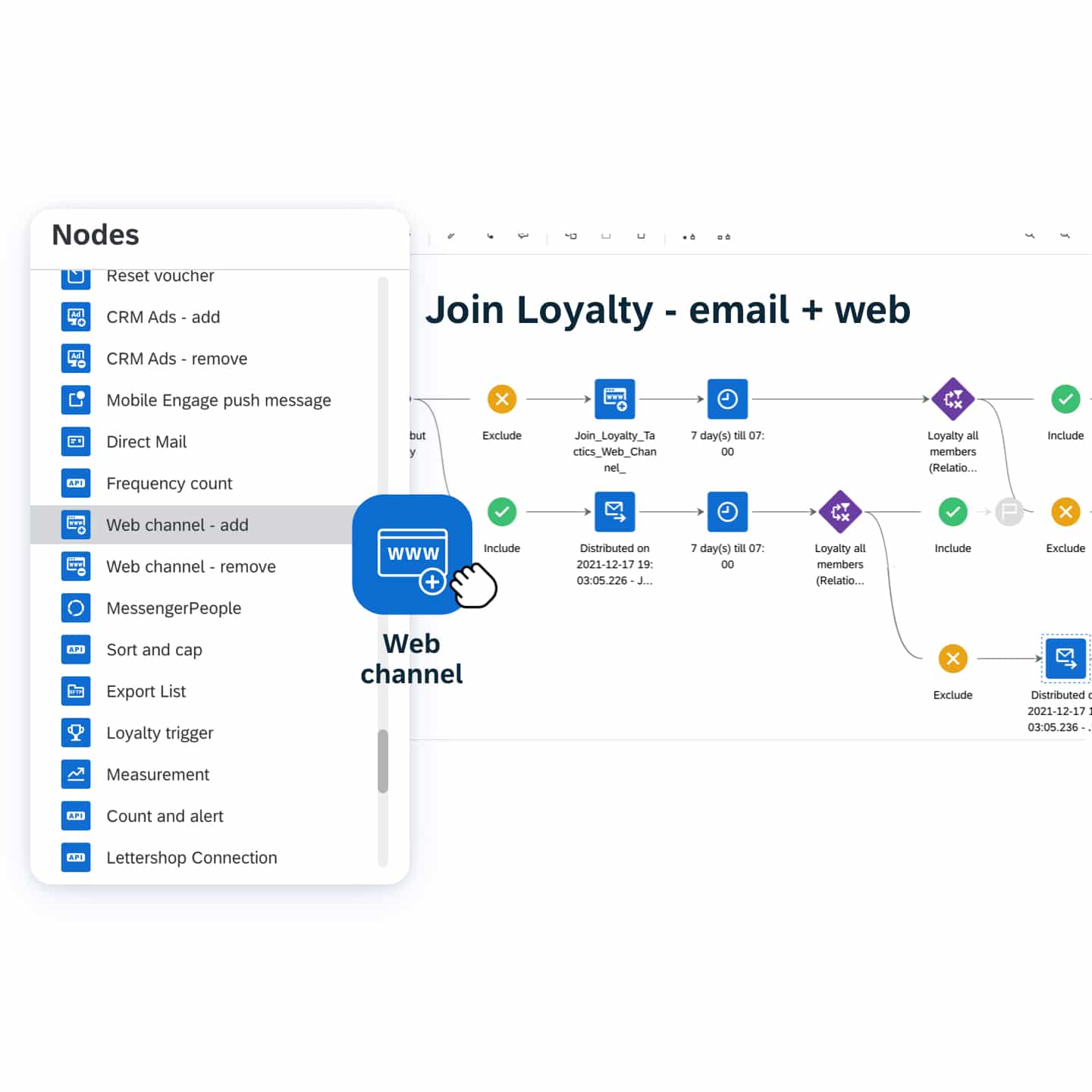
When your website recognizes a returning visitor, it should pick up right where the last interaction left off. If a customer browses a product but doesn’t buy, the next email can feature that item alongside complementary suggestions. If someone clicks a social ad for a specific collection, your homepage should reflect that interest the moment they arrive. Consistency like this builds trust, speeds up decision-making, and strengthens loyalty.
Why it matters
Your customers expect you to remember their preferences and maintain context across every channel. When the experience feels connected, engagement increases and drop-off rates fall. This level of continuity also helps marketers build richer customer profiles that feed more accurate personalization over time.
What to do
- Sync website personalization with email, mobile, social, and in-store data to maintain consistent messaging.
- Ensure product recommendations and offers reflect the customer’s most recent behavior, not just past purchases.
- Use unified profiles to recognize known visitors instantly and continue their journey wherever they left off.
- Measure success by looking beyond clicks to track retention, repeat purchase, and long-term engagement.
How SAP Engagement Cloud helps: SAP Engagement Cloud unifies customer data across channels, enabling truly connected experiences that adapt to each individual. The solution's AI ensures that content, offers, and timing are consistent across web, email, mobile, and beyond, so every interaction feels coordinated and personal, no matter where it happens.
How to Implement Website Personalization
Delivering personalized experiences doesn’t have to be overwhelming. With the right foundation, you can start small, scale quickly, and build sophistication over time. The key is to focus on data quality, clear goals, and measurable impact rather than chasing complexity from day one.
Step 1: Collect meaningful data
Gather first-party and zero-party data that reflects real customer behavior and preferences. Go beyond clicks and pageviews to include purchase history, engagement patterns, and declared interests. Every data point should have a clear purpose in improving the customer experience.
Step 2: Build unified profiles
Centralize your customer data in a single view so every channel draws from the same source of truth. This prevents fragmented messaging and keeps personalization consistent and relevant.
Step 3: Define your goals
Clarify what success looks like. Decide whether you want to increase conversions, reduce bounce rates, or drive repeat visits. Setting measurable objectives ensures your personalization strategy delivers tangible results.
Step 4: Plan and activate
Start with high-traffic pages such as your homepage, product listings, and cart. Test different content variations and calls to action, then expand to other parts of the site as you learn what performs best.
Step 5: Measure and refine
Track performance using metrics that reflect engagement and business outcomes, including conversion rate, average order value, time on site, and retention. Use these insights to improve your strategy continuously and feed better data back into your personalization engine.
How SAP Engagement Cloud helps: SAP Engagement Cloud gives marketers a complete framework for website personalization, from data unification to AI-powered activation. The solution simplifies setup, automates optimization, and measures performance in real time to help you move from manual effort to intelligent personalization that grows with your business.
Conclusion: Turning Visitors into Loyal Customers
A good website doesn’t just look great. It feels personal. Every visit should make the customer think, “This brand gets me.” By replacing guesswork with experiences that resonate with your audience, that’s exactly what website personalization does.
The best results don’t come from adding more pop-ups or promotions. They come from using what you already know about your customers to make every interaction more helpful, faster, and more relevant. Small changes compound quickly when they’re based on real data and intent.
When your website responds to each visitor in real time and stays in sync with the rest of your channels, you stop marketing at people and start building relationships with them. That’s when one-time shoppers turn into repeat buyers, and repeat buyers become loyal advocates.